Residential Mental Health Treatment for Youth in Idaho
Trauma-informed, family-centered residential program for youth ages 11–17 who need more support than outpatient care alone can provide.
If you are reading this page, your family may be facing something that outpatient therapy, school interventions, and your best efforts at home have not been able to resolve. You may be wondering whether residential care is the right next step — and whether considering it means you have somehow failed your child.
Choosing residential care is recognizing that your child needs a level of support that no home environment, no matter how loving, can provide on its own.
The Residential Center for Healing & Resilience at Idaho Youth Ranch is Idaho’s first and only accredited long-term psychiatric residential facility for youth. We serve young people ages 11–17 who need around-the-clock therapeutic support in a safe, structured, trauma-informed environment built for healing. Our goal is not permanent placement. It is stabilization, treatment, and preparation for your child to return home stronger.






Joint Commission Gold Seal of Approval

Idaho’s first accredited long-term psychiatric residential for youth

70+ years serving Idaho families

Experienced: Successfully treated over 100 youth ages 11–17

On-site accredited charter school (Promise Academy

Trauma-informed care, purpose-built campus

24/7 medical and clinical support
We work with Medicaid and most Private Insurance Providers.
Our admissions team helps you verify your benefits.
WHAT RESIDENTIAL TREATMENT IS
What Residential Treatment Actually Is — and What It Is Not
Select a topic to begin:
Structured Support Around The Clock
It is not a boot camp. It is not a place where children are sent because their parents have run out of options. It is a level of mental health care designed for young people whose needs require more therapeutic support than outpatient and other treatments can provide. It is a structured environment where healing happens around the clock, not just during a 50-minute appointment.
Home-Like Setting Builds Trust
Your child will live on campus in a home-like setting with private bedrooms, shared common spaces, and daily routines designed to support safety, connection, and recovery. They receive individual therapy, group therapy, family therapy, psychiatric assessment, and medication management as needed, all within a trauma-informed environment where every interaction is designed to build trust rather than enforce compliance.
Prepares Families For Successful Return
It is to help your child reach a level of mental health stability where residential care is no longer needed and to prepare both your child and your family for a successful return home. Treatment planning for discharge begins from the first week, because the entire program is oriented toward what comes next, not just what is happening now.
WHAT RESIDENTIAL TREATMENT IS
When Residential Care May Be Appropriate
Residential care is rarely the first step. It is usually the next step when earlier support has not been enough. You may be in the right place if:

Outpatient therapy has not produced the progress your child needs, despite consistent effort.

Your child has had recent psychiatric hospitalization and needs more structured support than home can provide during the transition back to stability.

Safety concerns — self-harm, suicidal thinking, severe emotional dysregulation — are becoming harder to manage at home.

Your child’s mental or behavioral health needs are affecting every part of their life — school, relationships, family functioning, and daily routines — in ways that outpatient care alone cannot address.

Your family needs a more intensive level of support to stabilize the situation and create a foundation for longer-term healing.
Safety concerns — self-harm, suicidal thinking, severe emotional dysregulation — are becoming harder to manage at home.
Your child’s mental or behavioral health needs are affecting every part of their life — school, relationships, family functioning, and daily routines — in ways that outpatient care alone cannot address.
Your family needs a more intensive level of support to stabilize the situation and create a foundation for longer-term healing.
Your family needs a more intensive level of support to stabilize the situation and create a foundation for longer-term healing.
* NO COMMITMENT: A conversation with our admissions team does not commit your family to treatment. It is simply a way to understand whether this level of care may be appropriate for your child and what your options are. For detailed fit criteria, clinical exclusions, and the full application process, visit our Admissions Information page.
Understanding Levels of Care
Choosing the Best Level of Care for Your Family
Parents often wonder where residential treatment fits relative to other options their child may have already tried. Here is how the main levels of mental health care for youth compare:
Outpatient Care
Psychiatric Hospitalization
Residential Treatment at RCH&R
Weekly therapy sessions, child lives at home
Best for: mild to moderate symptoms manageable in daily life
Duration: ongoing
Family involved through sessions
Education continues at home school
Short-term crisis stabilization, highest acuity
Best for: acute psychiatric crisis requiring immediate safety intervention
Duration: days to 1–2 weeks
Family involved in discharge planning
Education typically paused
Long-term therapeutic environment, around-the-clock care
Best for: complex needs that outpatient has not resolved and that require sustained intensive treatment
Duration: weeks to months, based on clinical progress
Family involved throughout — therapy, coaching, treatment planning, transition
Education continues on-site at Promise Academy (accredited charter school)
An Integrated System
Customized and Intetrated Treatment for each Child
Treatment at RCH&R is individualized, trauma-informed, and integrated across clinical care, family work, daily living, and education. Each young person receives a treatment plan shaped by thorough assessment, reviewed regularly, and adjusted as their needs change.
- Individual therapy multiple times per week
- On-site family therapy sessions weekly
- Discharge planning begins in Week 1
- 24/7 on-site medical and clinical support
- On-site charter school with integrated therapy support

Equine and Campus-Based Therapeutic Supports
The Hands of Promise campus includes equine-assisted psychotherapy opportunities and outdoor therapeutic spaces that extend healing beyond the traditional therapy room.

Psychiatric and Clinical Assessment
A comprehensive evaluation of your child’s mental health, trauma history, behavioral patterns, developmental needs, and current functioning. This assessment drives the entire treatment plan.

Individual Therapy
Regular one-on-one therapy with a licensed clinician using evidence-based approaches matched to your child’s needs, including CBT, DBT, TF-CBT, and EMDR.

Group Therapy
Structured group sessions that build social skills, emotional regulation, and peer connection in a safe, facilitated environment.

Family Therapy
Ongoing family therapy and parent support throughout your child’s stay. Family involvement is part of treatment, because lasting progress depends on more than what happens on campus.

Education Through Promise Academy
An on-site accredited charter school where education continues without interruption and teachers collaborate directly with the treatment team.

Discharge and Aftercare Planning
Transition planning begins early, not at the end of treatment. We coordinate with your family, your child’s providers, and their school to support a successful return home.
Promise Academy
Your Child’s Education Continues during Treatment
Promise Academy is designed so that needing residential care doesn't mean your child falls behind in school.
Education Continues Without Interruption
One of the most common fears parents have about residential care is that their child will fall behind in school. Promise Academy is designed to prevent that. It is an accredited charter school on the Hands of Promise campus with credentialed teachers, small classes, individualized learning plans, and a trauma-informed approach to education.
Teachers And Therapists Collaborate Closely
What makes Promise Academy different is the integration between education and treatment. Teachers and therapists communicate regularly, so academic progress and clinical progress support each other instead of operating in separate systems.
Special Education Support Included
Promise Academy provides special education services in compliance with state and federal law. The school environment is intentionally designed to feel calm, welcoming, and unlike the institutional spaces many students associate with failure.
Smooth Transition Back Home
As discharge approaches, Promise Academy works with families and home districts to support credit transfer, continuity, and a smoother return to school.
Idaho Youth Ranch Difference
Choose the
Residential Center for Healing & Resilience
Why Families Choose Us
01
Idaho’s first accredited long-term psychiatric residential facility for youth - Experience matters
Before RCH&R opened, many Idaho families had to send their children out of state to access this level of care. RCH&R was built so Idaho youth can receive long-term residential treatment closer to family, community, and the relationships that matter in recovery. Since opening RCH&R has successfully treated over 100 of Idaho's youth.
02
Trauma-informed from the ground up
RCH&R was designed around a trauma-informed philosophy from the beginning. The environment, daily routines, staff interactions, and clinical approach are built on the understanding that behavior is communication and that healing happens faster when young people feel safe.
03
Purpose-built campus
The Residential Center for Helaing & Resilience was built specifically for therapeutic residential care. Private bedrooms, shared living spaces, natural light, outdoor areas, an on-site school connected to the therapy and wellness center, and equine facilities — every detail serves a therapeutic purpose. This is not a repurposed building. It was designed for this work.
04
Family involvement is clinical, not optional
Families are not kept at the edge of treatment. Family therapy, parent coaching, regular communication, and discharge planning are built into the program so healing extends beyond the campus.
05
Education continuity through Promise Academy
Your child’s education continues on site through Promise Academy, an accredited charter school where teachers and therapists work together every day. School is not an add-on here. It is part of treatment.
06
Built for the cases where shorter programs have not been enough
RCH&R is built for young people whose needs are too complex for short-term solutions. Many have already tried outpatient therapy, hospitalization, or shorter programs. This program is designed for the cases where progress has not held and deeper treatment is needed over time.

What Your Child’s Days Will Look Like
What Happens During a Stay at RCH&R?

Parents often ask: what will my child actually do every day? Days at RCH&R follow a predictable rhythm because predictability reduces the hypervigilance that trauma and emotional instability produce. Your child will know what comes next, and that knowing is itself therapeutic.

A typical day includes structured morning routines, classes at Promise Academy, individual and group therapy sessions, meals together, time with peers in shared common spaces, equine or outdoor activities when appropriate, skill-building exercises, and structured evening routines. The pace is intentional: enough structure to feel safe, enough flexibility to feel respectful, and enough genuine connection to feel human.
Your child will live in a dorm-style setting with a private bedroom, shared kitchenette, laundry facilities, and a lounge where they spend time with peers. Trained residential staff are present around the clock — not as guards, but as caring adults who are part of the therapeutic environment. An on-site medical team is available 24/7.
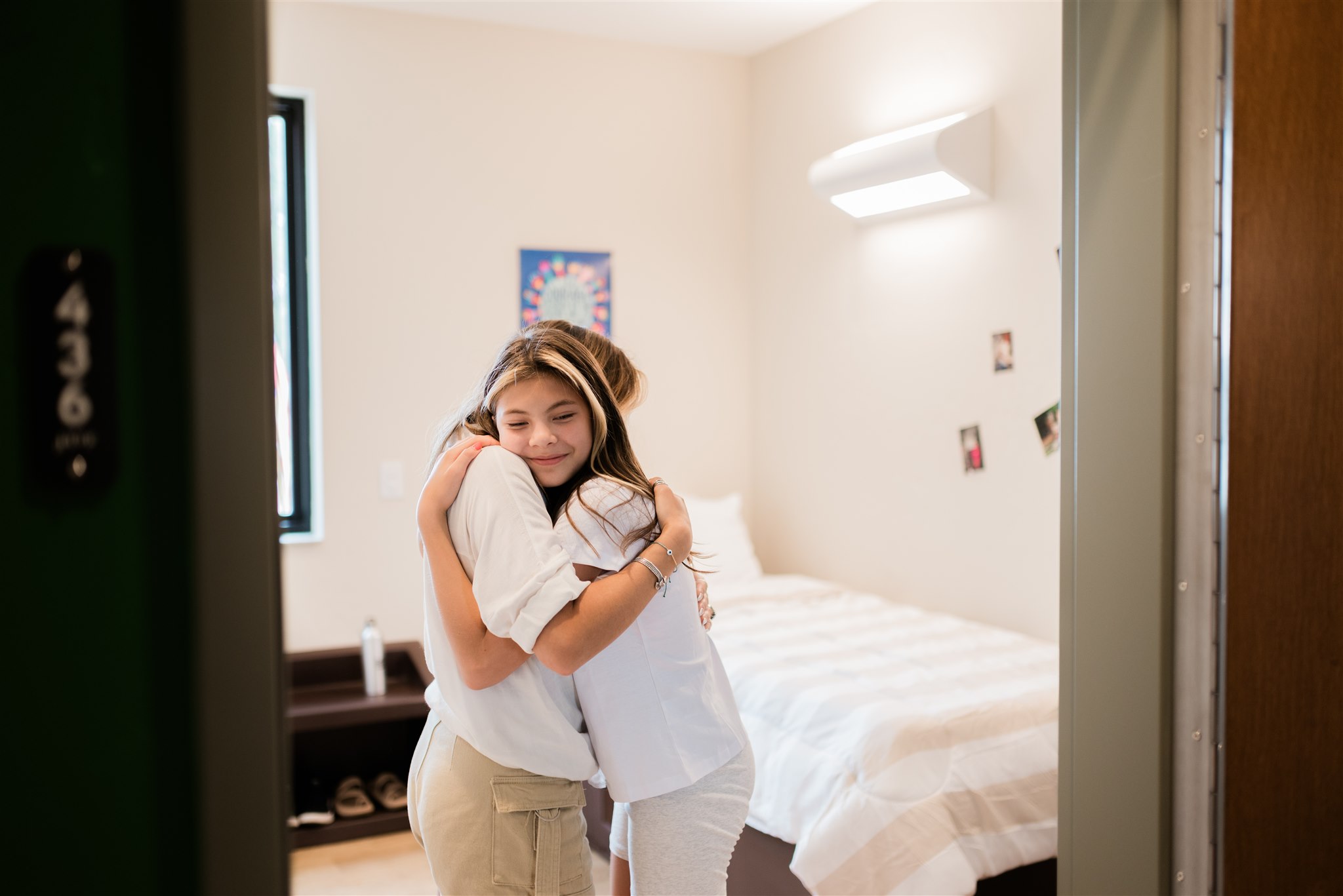
We are on your team
Families are Integral to the Healing Process
You're joining a team, not stepping back — your voice stays part of every decision.
Choosing residential care means gaining a team, not losing your role in your child's healing.
One of the hardest parts of considering residential care is the fear that you are sending your child away and losing your place in their care. That is not how RCH&R works. From the beginning, families are part of the treatment process. You will participate in family therapy, receive guidance from the clinical team, and be included in treatment planning and transition decisions.
We communicate with families consistently throughout the stay, not only when there is a problem. You will understand what your child is working on, what progress looks like, and how you can support that work at home and after discharge.
We understand that families arrive at different starting points. Some are ready to engage immediately. Others are exhausted or grieving. We meet you where you are and build the partnership from there. The family system is part of the clinical picture, and involving it is part of the clinical solution.
"
If you are carrying guilt about this decision, hear this clearly: families who choose residential care are not giving up. They are recognizing that their child needs more support than can be provided at home and choosing to act.
That is not failure. It is care.
"
Admissions
How the Process Works
From First Conversation to Admission
1

talk with admissions
Call or connect online to talk through your child’s situation, ask questions, and get an honest assessment of whether residential care may be the right next step. There is no obligation.
208-996-2896

2

complete an
application
Share clinical, educational, and family information that helps our team understand your child’s needs. You do not need to have every document ready — our team will guide you through what is needed.
Online or secure email
3

clinical review
Our clinical team reviews the application to determine fit, safety, and treatment needs. We evaluate each application individually.
Typically 3–5 business days
4

planning
If RCH&R is a fit, we guide your family through admission preparation. If another level of care is more appropriate, we will tell you directly and help point you toward the right option.
208-996-2896
Our Commitments to You

Receipt acknowledged
We confirm receipt within one business day by phone or email .

Review timeline
Clinical review is typically completed within 3–5 business days of receiving complete documentation. Urgent step-downs handled by direct call.

Clear disposition
Whether accepted, waitlisted, or not a fit, we communicate the outcome directly with clear clinical rationale.

Continuity of care
From admission through discharge, we coordinate with referring providers to maintain continuity, consistent with consent and privacy requirements.
"
I have struggled with my family my entire life. It was hard coming to Idaho Youth Ranch, but little did I know that my whole way I view the world would change. Family therapy was hard at first…but through that I was able to connect with them and work through things. Being able to connect and them being a support for me has change my life forever.
"
Mariah
Frequently asked questions
Common questions
parents may have
Answers to some of the questions families often ask when trying to understand these challenges.
What is residential treatment?

Residential treatment is a level of mental health care where your child lives on campus in a therapeutic environment and receives around-the-clock support, including individual therapy, group therapy, family therapy, psychiatric care, and education. It is designed for young people whose needs exceed what outpatient therapy can address. The goal is stabilization and healing, not long-term placement.
How do I know if my child needs residential care?
Residential care may be appropriate when outpatient therapy has not been sufficient, when safety concerns are present, when your child has had recent psychiatric hospitalization, or when mental health needs are significantly affecting daily functioning across home, school, and relationships. The best way to find out is to speak with our admissions team — that conversation carries no obligation.
What ages do you serve?
RCH&R serves youth ages 11–17.
How long do youth usually stay?
Length of stay at RCH&R is determined by individual clinical progress, not by a fixed calendar. Most young people complete the program in 4 - 6 months, though some stay longer based on their treatment needs. RCH&R is a long-term program designed for the level of complexity that requires more than a few weeks to address. Our goal is not to keep your child longer than necessary. It is to ensure the gains made in treatment are stable enough to sustain after discharge.
Can families stay involved during the stay?
Yes. Family involvement is a clinical requirement, not an optional add-on. Families participate in regular family therapy sessions, receive coaching, and are included in treatment planning and discharge decisions throughout the stay. We communicate with families consistently, not just during crises.
Will my child continue their education?
Yes. Promise Academy is an accredited charter school on the RCH&R campus. Your child receives individualized education with credentialed teachers in a trauma-informed environment. Teachers and therapists collaborate daily, and transition planning back to the home school is built into the discharge process.
Do you accept insurance?
RCH&R accepts Medicaid and works with most major private insurance plans in Idaho. Our admissions team handles benefits verification directly — you do not need to navigate insurance paperwork on your own. We verify your specific coverage and give you a clear picture of likely costs before you make any decisions.
What happens after discharge?
Discharge planning begins early in the stay, not at the end. We work with your family, your child’s outpatient providers, and their school to create a transition plan that sustains the gains made during residential care. Aftercare support and resources are provided to help your family navigate the transition home.
What if I am not sure this is the right fit?
That is exactly what the admissions conversation is for. You can call, ask questions, describe your child’s situation, and get an honest assessment — with no obligation to apply or move forward. If RCH&R is not the right fit, we will tell you and help you identify what might be.
How is RCH&R different from other residential programs?
RCH&R is Idaho’s first and only accredited long-term psychiatric residential facility for youth. It is Joint Commission accredited, purpose-built on the Hands of Promise campus, and includes an on-site accredited charter school (Promise Academy) where education and treatment are integrated daily. The program is designed for complex cases where shorter programs have not been enough, and family involvement is built into the clinical model from day one.
Choose the Path that Fits You
208-996-2896
Reaching Out Takes Courage. We Are Here When You Are Ready
Whether today is your first step or one you have been building toward for months, our admissions team is here to support your family with honesty, care, and no pressure.