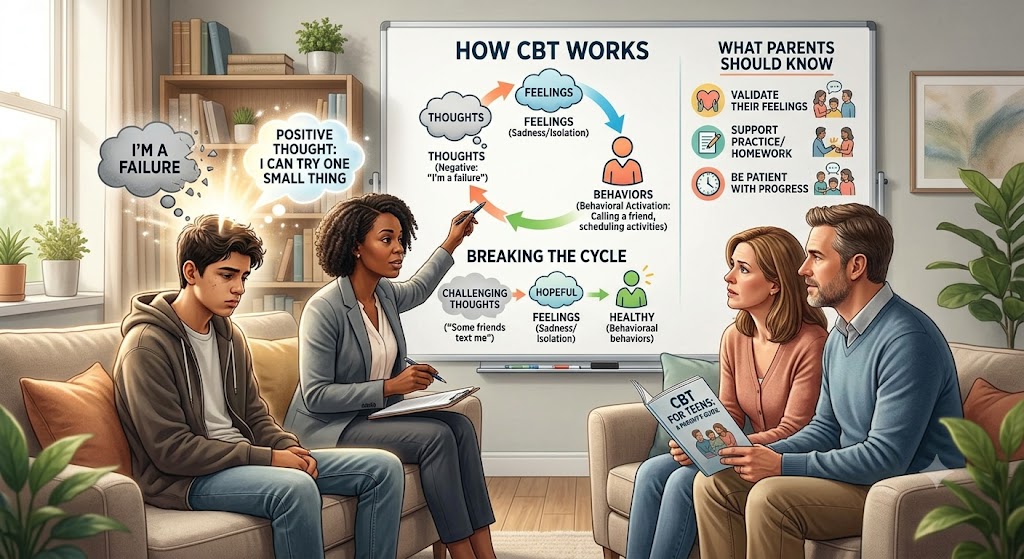
How CBT Works
What CBT Actually Is
The most studied therapy for teen depression, explained for parents
Cognitive behavioral therapy is based on a simple but powerful principle: the way you think affects how you feel, and how you feel affects how you behave. Depression distorts thinking — it creates mental filters that amplify the negative and block out the positive. A depressed teen might think "Nothing will ever get better," feel hopeless, and then withdraw from friends and activities, which makes the depression worse. CBT breaks this cycle by teaching teens to recognize distorted thoughts, evaluate them against evidence, and replace them with more balanced perspectives.
CBT is structured, time-limited, and goal-oriented. It typically runs 12–16 sessions, with each session building specific skills. This isn't open-ended talk therapy where teens discuss feelings indefinitely — it's a focused program with measurable milestones and homework between sessions.
What Happens in CBT Sessions
- Assessment: The therapist evaluates symptoms, thought patterns, behaviors, and family context to customize the approach.
- Psychoeducation: Your teen learns how thoughts create emotions and how depression distorts thinking — normalizing their experience.
- Goal setting: Therapist and teen identify concrete targets like improving sleep, re-engaging with one activity, or reducing negative self-talk.
- Cognitive restructuring: The core technique — identifying automatic negative thoughts, testing them against reality, and building more accurate alternatives.
- Behavioral activation: Scheduling enjoyable or meaningful activities to break the depression-withdrawal cycle, even when motivation is low.
- Skill building: Developing a personal toolkit for problem-solving, stress management, and emotional regulation.
- Progress evaluation: Tracking measurable indicators and adjusting the approach as needed.
- Maintenance planning: Building long-term habits so gains persist after therapy ends.
Why CBT Works Especially Well for Teens
CBT aligns naturally with how adolescent brains develop. Teens are primed for logical analysis — the kind of thinking CBT requires. The structured format gives them a sense of control over their recovery, which matches their developmental drive for autonomy. They're applying skills to real situations they face right now, not abstract concepts. And unlike medication, CBT produces lasting changes in how teens process information — skills that endure long after the sessions end.
Research supports this: a review found that CBT interventions substantially reduced the risk of depression at follow-up, and studies consistently show that most teens with depression respond well to CBT. For moderate to severe cases, combining CBT with medication produces the best outcomes.
CBT vs. Medication: What Parents Should Know
Parents often wonder whether their teen needs therapy, medication, or both. For mild to moderate depression, CBT alone is typically the first-line approach. For moderate to severe depression, CBT combined with an SSRI produces significantly better outcomes than either alone.
Medication tends to take effect faster (4–6 weeks) than CBT (which typically requires the full 12–16 session course), so for teens in acute distress, medication can stabilize symptoms while CBT builds the skills for lasting change. The key advantage of CBT over medication alone: when medication is discontinued, symptoms often return. When CBT skills are learned, they stay with the teen indefinitely.
Your Role as a Parent
You won't attend most sessions — your teen needs the space to build trust with their therapist. But your involvement matters. The therapist may include you in periodic family sessions, provide guidance on how to support skill practice at home, and ask you to reinforce behavioral activation goals. The single most important thing you can do: stay consistent. Help your teen attend every session, encourage them when homework feels hard, and avoid the temptation to pull them out when progress seems slow. CBT front-loads the work — the biggest gains often come in the second half of treatment.
Sources: Evidence-Base Update of Psychosocial Treatments for Child and Adolescent Depression, Journal of Clinical Child & Adolescent Psychology (2024); European Psychiatry (2019) review; NIMH Treatment of Adolescents with Depression Study (TADS).