OUR APPROACH TO CARE
Why Idaho Youth Ranch
More than 70 years of helping Idaho’s young people and families heal. Here is what makes us different — and why it matters for your family.
Choosing who will help your child is one of the most consequential decisions you will make as a parent. You want to know that the people caring for your child understand young people specifically, that the treatment is proven, that your family will be involved, and that the organization has the experience and stability to see the process through. This page answers those questions directly.
Idaho Youth Ranch has served Idaho families since 1953. We have grown from a single ranch into a statewide system of care that includes outpatient therapy, family counseling, equine-assisted psychotherapy, and residential treatment. What has not changed is the founding commitment: every young person deserves a chance to heal, and every family deserves support in making that possible.
Your Child Deserves a Therapist Who Understands Young People
Not all therapists are equipped to work with children and adolescents. A therapist who primarily treats adults and occasionally sees a teenager is working from an adult treatment model adapted downward. A youth specialist operates from fundamentally different training, experience, and understanding. Here is why that distinction matters for your child:

Youth brains are not adult brains
A therapist who specializes in young people understands adolescent and preadolescent neurodevelopment — the prefrontal cortex timeline, the limbic system’s heightened reactivity during these years, the role of identity formation in every presenting concern, and the developmental reasons why a 12-year-old processes therapy differently from a 30-year-old. The treatment approach is fundamentally different, not the same therapy delivered to a younger person.

Youth presentation is different
Depression in a 12-year-old looks like irritability, not sadness. Anxiety in a 9-year-old looks like defiance, not worry. Trauma in a teenager looks like anger, not flashbacks. A generalist may not recognize these presentations because they do not see them often enough. A youth specialist sees them every day and knows how to assess accurately — catching conditions that might otherwise be missed or misdiagnosed.

The therapeutic relationship works differently with young people
An adult typically enters therapy voluntarily, motivated to engage. A child or teenager is usually brought by a parent and maybe resistant, silent, or hostile in the first sessions. Building rapport with someone who does not want to be there is a specialized skill. Youth specialists know how to create engagement through equine work, activity-based sessions, strategic patience, and the understanding that trust must be earned before therapeutic work can begin. A generalist trained primarily in adult engagement may not have these tools.

Family involvement is clinical, not optional
In adult therapy, the client is the individual. In youth therapy, the client is the system. A youth specialist integrates parents and caregivers into treatment because the research is unambiguous: family involvement is one of the strongest predictors of positive outcomes for children and adolescents. At Idaho Youth Ranch, parent coaching, family sessions, and multi-family skills groups are not add-ons. They are core components of treatment because the evidence demands it.
Mission and history
Rooted in Idaho Since 1953
Idaho Youth Ranch was founded in 1953 with a simple conviction: young people who have been through difficult experiences are not beyond help. They need a safe place, caring adults, and the opportunity to heal. That conviction has guided every expansion, every program addition, and every clinical decision in the decades since.
Today, Idaho Youth Ranch serves young people ages 9–24 and their families across the state through outpatient therapy clinics, family counseling, equine-assisted psychotherapy, and the Residential Center for Healing & Resilience. Our services have evolved as the science of youth mental health has advanced, but the mission remains: to unite a safe family environment with a nurturing community to help young people become healthy, productive members of society.
Every clinician at Idaho Youth Ranch is a youth specialist. Our team holds master’s or doctoral degrees, maintains specialized training in evidence-based modalities for children and adolescents, and receives weekly reflective supervision focused specifically on youth-focused clinical practice. Your child is not a side population in a general practice.They are the entire focus of what we do.
One Organization, Every Level of Support
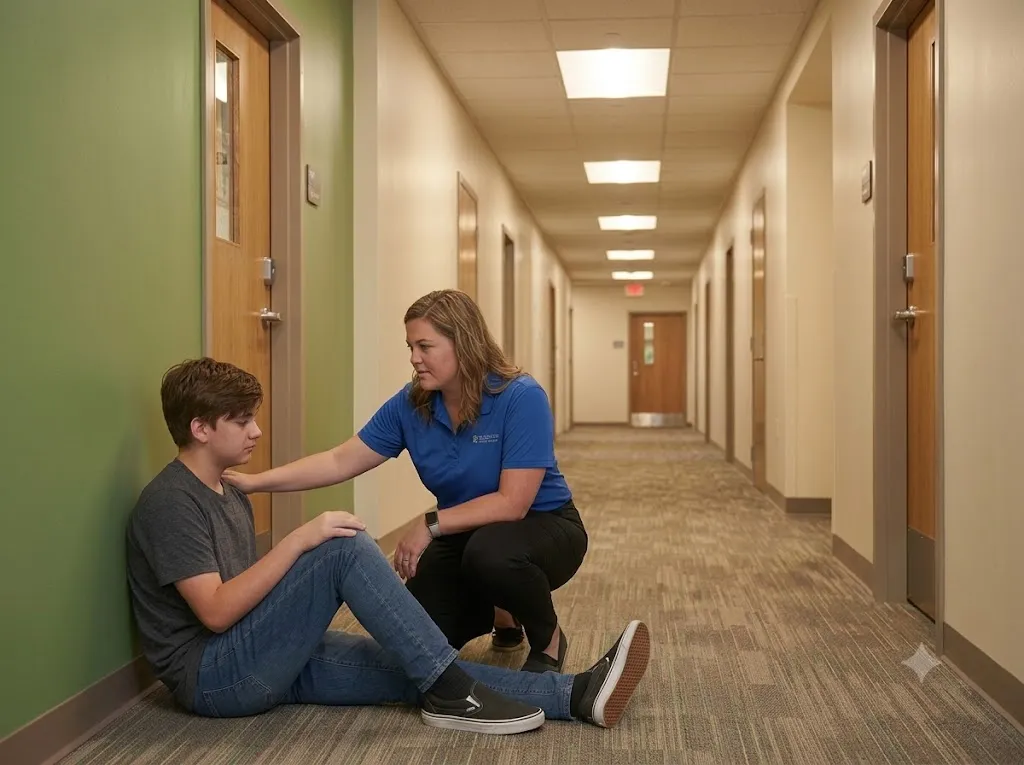
Most families navigating youth mental health are piecing together care from multiple providers who do not communicate with each other: one therapist for the child, a different practice for family work, a separate program if residential care is needed. Each transition means starting over — new intake, new relationship-building, new explanation of everything that has already happened.
At Idaho Youth Ranch, trauma-informed care is not a program add-on or a training checkbox. It is the foundation on which every service, every interaction, and every decision is built. It is why we exist in the form we do.
Outpatient Therapy
Individual and group therapy for children and adolescents ages 9–24. Evidence-based modalities matched to the child’s specific needs. Clinics across Idaho with telehealth options for underserved areas.
Equine-Assisted Psychotherapy
EAGALA-certified, fully integrated into the trauma-informed model. Particularly effective for young people who resist traditional talk therapy or who carry trauma in their body.
Family Counseling
Integrated into every treatment plan, not offered as a separate service. Parent coaching, family therapy sessions, and multi-family skills groups. Designed to change the family system, not just the individual child.
Residential Center for Healing & Resilience
For young people who need a higher level of support than outpatient care can provide. Trauma-informed residential environment with all five evidence-based modalities available on-site. Structured to support healing while maintaining family connection throughout the stay.
Outpatient Therapy
Individual and group therapy for children and adolescents ages 9–24. Evidence-based modalities matched to the child’s specific needs. Clinics across Idaho with telehealth options for underserved areas.
Equine-Assisted Psychotherapy
EAGALA-certified, fully integrated into the trauma-informed model. Particularly effective for young people who resist traditional talk therapy or who carry trauma in their body.
Family Counseling
Integrated into every treatment plan, not offered as a separate service. Parent coaching, family therapy sessions, and multi-family skills groups. Designed to change the family system, not just the individual child.
Residential Center for Healing & Resilience
For young people who need a higher level of support than outpatient care can provide. Trauma-informed residential environment with all five evidence-based modalities available on-site. Structured to support healing while maintaining family connection throughout the stay.
Your Family Is Part of the Treatment Team

At Idaho Youth Ranch, family involvement is not a courtesy or an afterthought. It is a clinical requirement built into every treatment plan. The research is consistent: young people whose families are actively engaged in treatment have significantly better outcomes than those treated in isolation. This is true across every condition we treat — anxiety, depression, trauma, defiance, self-harm, and suicidal thinking.
What family involvement looks like in practice: parents receive psychoeducation about their child’s condition and treatment. They participate in family therapy sessions where communication patterns, relational dynamics, and household strategies are addressed directly. In DBTprograms, parents attend multi-family skills groups alongside their child, learning the same language and techniques so the therapeutic work is reinforced at home. In residential care, families participate in regular sessions throughout the stay and receive transition planning support before the child returns home.
We understand that families come to us at different starting points. Some are ready to dive in immediately. Others are exhausted, skeptical, or working through their own feelings about their child’s struggles. We meet families where they are and build engagement over time. What we do not do is treat the child as if they exist in a vacuum. The family system is part of the clinical picture, and involving it is part of the clinical solution.
Built for Idaho Families
Idaho Youth Ranch is not a national franchise or a program imported from somewhere else. We were founded in Idaho, we serve Idaho families, and we understand the specific realities of this state: the rural distances that separate families from care, the cultural values that shape how families think about mental health, the economic pressures that affect access, and the community connections that make healing possible. Our clinicians live in the communities they serve.
We operate outpatient clinics across the state, provide telehealth for families in underserved areas, and serve rural, suburban, and urban Idaho communities. Whether your family is in Boise, Nampa, Twin Falls, or a small town hours from the nearest city, we have a pathway to care that can reach you.

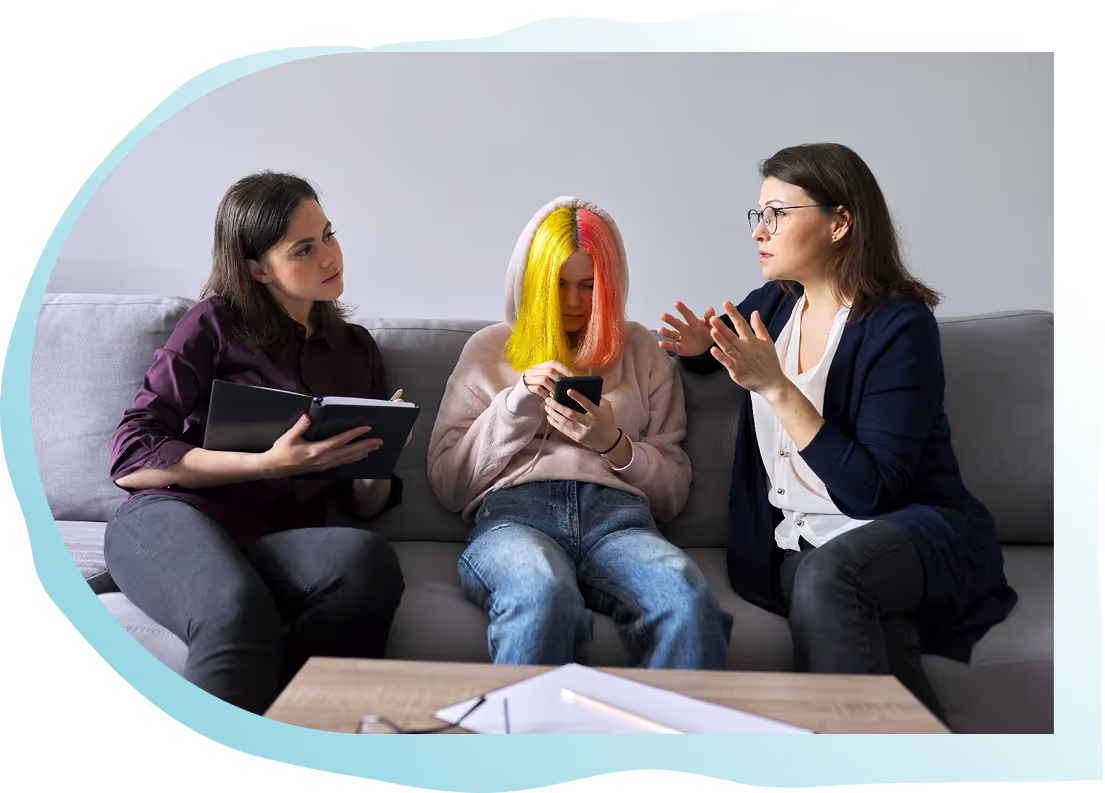
A Place Where Clinicians Do Their Best Work
The quality of care a young person receives is directly connected to how the clinician providing it is supported. At Idaho Youth Ranch, clinical culture is not a recruiting slogan. It is the infrastructure that makes excellent care sustainable.

Frequently asked questions
Common questions
parents may have
Answers to some of the questions families often ask when trying to understand these challenges.
Why choose Idaho Youth Ranch over other programs?

More than 70 years of serving Idaho families. Evidence-based treatment delivered by youth-specialized clinicians. A full continuum of care under one clinical umbrella. Family involvement built into every treatment plan. Trauma-informed practice that is organization-wide, not just a label. And deep roots in the Idaho communities we serve. Joint Commission Gold Seal of Approval.
What ages do you serve?
Idaho Youth Ranch serves young people ages 9–24 and their families. Our clinical approaches are developmentally tailored — the treatment a 10-year-old receives is different from what a 17-year-old receives, because the presentation, the developmental needs, and the family dynamics are different.
Do you accept insurance?
Yes. We accept most Idaho Medicaid plans and many private insurance providers. Sliding scale options are available for families who need them. Our team will verify your benefits during the initial conversation so you know what to expect before treatment begins.
Do I need a referral?
No. You do not need a referral from a physician, school, or other provider. You can contact us directly. If you are a professional making a referral, we welcome that and will coordinate with you throughout treatment.
Is Idaho Youth Ranch a good fit for clinicians?
If you are a clinician who is drawn to youth-focused, trauma-informed, evidence-based practice and who values structured supervision, continuing education, and mission alignment, Idaho Youth Ranch may be the right fit. We invest in our clinical team because the quality of care depends on it. Visit our careers page to learn more about current opportunities.
How do I get started?
Call us or use the online form on our Find Help For Your Child link below. Our admissions team will listen to what you are experiencing, answer your questions, and help you determine the right next step. We respond within one business day.