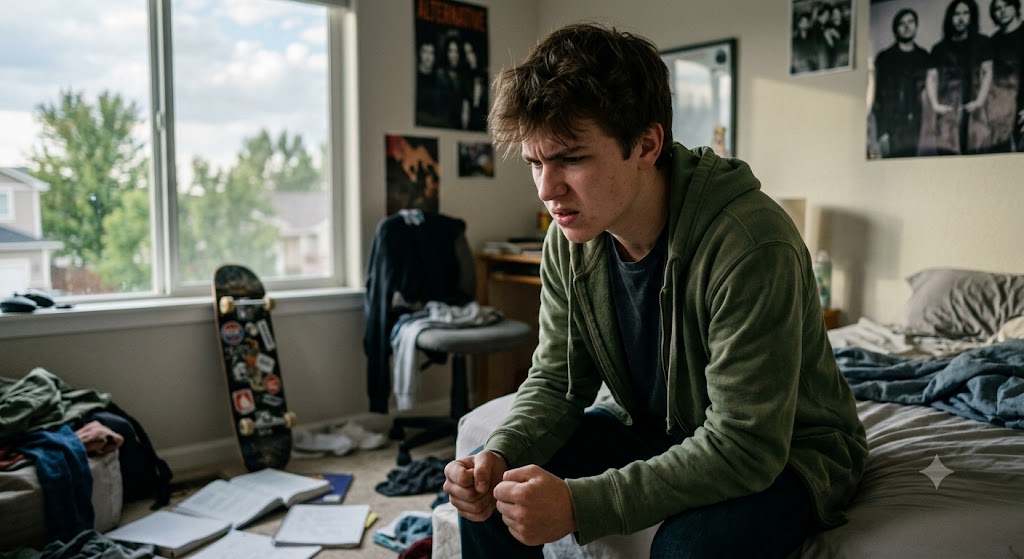
Anger as a Mask
Why Depression Shows Up as Anger in Teens
Why depression in teens can look like anger instead of sadness
Adults tend to associate depression with sadness, withdrawal, and tearfulness. But in adolescents, the developing brain processes emotional pain differently. The prefrontal cortex — responsible for impulse control and emotional regulation — is still maturing, while the amygdala, which drives emotional reactivity, is already running at full intensity. The result: when a teen feels overwhelmed by sadness, hopelessness, or worthlessness, their brain often converts that pain into the one emotion that feels powerful rather than vulnerable — anger.
As one child psychologist explains, when a teen feels angry or irritable, they're often actually experiencing disappointment, embarrassment, guilt, or sadness underneath. Anger becomes the surface expression because they don't yet have the words or impulse control to express what's really happening. For parents, this means the teen who seems most hostile may actually be the one who's hurting most.
Signs That Anger May Actually Be Depression
Not all teen anger is depression. But when anger appears alongside these patterns, it's worth looking deeper:
- Anger that's persistent — lasting weeks, not just bad days.
- Reactions that are disproportionate to the situation — explosive responses to minor frustrations.
- Irritability that shows up across settings — home, school, with friends — not just with parents.
- Loss of interest in activities they used to enjoy, alongside the anger.
- Changes in sleep — sleeping too much or too little.
- Declining school performance or motivation.
- Physical complaints like headaches or stomachaches.
- Social withdrawal or isolation between angry episodes.
- Expressions of hopelessness, self-blame, or worthlessness mixed in with the hostility.
Depression-Driven Anger vs. Typical Defiance
Parents often ask: how do I know if this is depression or just my teen being difficult? The distinction matters because the response is fundamentally different.
Typical teen defiance is usually situational and targeted. It shows up around specific issues — curfew, homework, screen time rules — and the teen can still enjoy themselves in other contexts. They push boundaries but bounce back to baseline relatively quickly.
Depression-driven anger is pervasive and persistent. It leaks into everything. The teen isn't just angry about the rules — they're angry at the world, at themselves, at things that didn't used to bother them. The anger doesn't resolve between episodes. And critically, it's accompanied by other depression symptoms: sleep changes, withdrawal, loss of interest, declining energy, and a flatness or emptiness underneath the hostility.
If what you're seeing is anger plus withdrawal plus loss of interest plus sleep disruption persisting for two weeks or more, you're likely looking at depression.
Why Boys Are Especially at Risk for Being Missed
Cultural expectations around masculinity make it especially hard for depressed boys to be recognized. Societal messages telling boys to suppress vulnerability mean anger becomes the only acceptable emotional outlet. A girl who cries gets concern; a boy who rages gets discipline. The result is that many depressed boys are treated as behavior problems — suspended, grounded, or labeled as difficult — when what they actually need is a depression evaluation.
Teen boys are significantly less likely to be diagnosed with depression than girls, even though the underlying rates may be closer than diagnostic numbers suggest. If your son's anger feels out of character, persistent, and accompanied by other changes, depression should be on the table — not just consequences.
Why Punishing the Anger Often Makes It Worse
When parents treat depression-driven anger purely as a behavior problem — with grounding, loss of privileges, or confrontation — it typically escalates the cycle. The teen already feels worthless, misunderstood, and out of control. Punishment confirms those beliefs: "I'm bad. Nobody understands. Nothing will help." This doesn't mean boundaries don't matter. Safety and respect are still non-negotiable. But consequences without understanding — discipline without curiosity about what's driving the behavior — often deepens the depression and intensifies the anger.
When Parents Should Seek Help
Consider reaching out to a mental health professional if:
- The anger has persisted for two weeks or more and represents a change from your teen's baseline.
- Your teen's anger is accompanied by withdrawal, sleep changes, or declining motivation.
- The intensity or frequency of outbursts is escalating.
- You've tried consequences and behavioral approaches and they're not working.
- Your teen has expressed hopelessness, self-blame, or worthlessness alongside the anger.
- You're walking on eggshells and the household rhythm is breaking down.
A professional evaluation can determine whether the anger is a standalone behavior issue, a symptom of depression, or both. You don't need to have the answer before seeking help.
Sources: MedlinePlus / NIMH child and adolescent mental health (2024); HelpGuide, "Parent's Guide to Teen Depression"; University of Utah Health / Huntsman Mental Health Institute (2025); Ascend Healthcare, "Teen Anger and Depression" (2025).