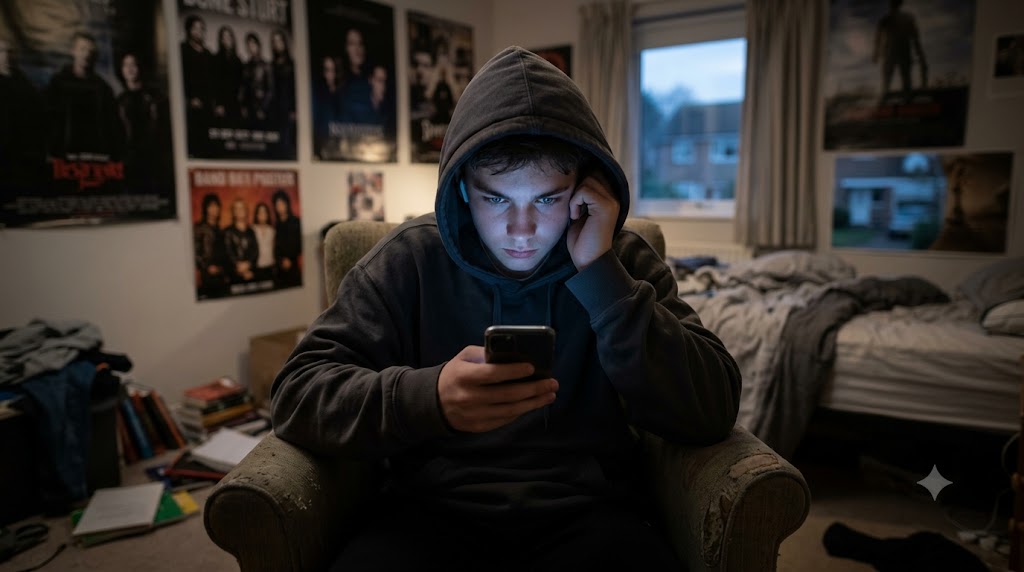
Why Kids Use Screens to Cope

When a child reaches for a phone during a hard moment, it isn't defiance — it's regulation. Understanding what screens actually do for your child emotionally is the first step.

When a child reaches for a phone during a hard moment, it isn't defiance — it's regulation. Understanding what screens actually do for your child emotionally is the first step.
Screens are extraordinarily effective at giving the nervous system a break from overwhelm — providing relief without resolving the underlying distress. Youth with anxiety, depression, ADHD, social difficulties, or high sensitivity are more likely to turn to screens to cope; the underlying distress usually precedes and drives the screen use. Coping becomes a trap when screens are the only way a child manages difficult emotion, crowding out skills that would serve them better. The most effective parental response isn't restriction — it's curiosity, building alternative coping skills, and negotiating limits rather than mandating them. Persistent withdrawal, a drop in functioning, loss of offline friendships, or worsening mood is a signal to bring in a clinician who specializes in adolescent mental health.

Regulation, Not Defiance

Why Screens Work When Everything Else Feels Hard

What screens are actually doing for a child in a hard moment

Screens are extraordinarily effective at one thing: giving the nervous system a break from overwhelm. When a child is anxious, sad, ashamed, or socially rejected, a phone provides immediate relief — predictable stimulation, a controlled environment, and social connection on their terms. This isn't weakness or avoidance in the clinical sense. It's the body doing exactly what bodies do: seeking relief from pain. The problem isn't that screens provide relief. The problem is that they provide relief without resolving the underlying distress — and over time, they can become the primary way a child manages emotion, crowding out skills that would serve them better.

What Screens Actually Provide

  • Immediate distraction from physical/emotional pain
  • Predictable, low-stakes social interaction (commenting, liking, streaming)
  • A sense of control when real life feels uncontrollable
  • Dopamine release that temporarily lifts mood
  • A waiting room for feelings they're not ready to process

This Is More Common Than You Think — And Some Kids Are More Vulnerable

Research consistently shows that youth who struggle with anxiety, depression, ADHD, social difficulties, or high sensitivity are more likely to turn to screens as a coping tool. This doesn't mean screens cause these conditions — more often, the underlying distress precedes and drives the screen use. Studies from 2023–2025 indicate that emotional regulation difficulties are among the strongest predictors of problematic screen use in youth, outpacing hours of use as a standalone metric. In other words, it's not just how much — it's why.

Higher-Risk Profiles

  • Youth with anxiety or panic — screens reduce arousal and avoid feared situations
  • Youth with depression — screens provide stimulation when everything else feels flat
  • Youth with ADHD — screens deliver the rapid novelty that helps regulate attention
  • Youth with social anxiety — online interaction feels safer than face-to-face
  • Youth experiencing family conflict or instability — screens offer escape and autonomy
  • Youth with high sensitivity or intense emotional reactivity — screens are a reliably calm environment

Reassurance Note: If your child falls into one of these categories, that context matters. It means addressing the screen use alone — without addressing what's underneath — is unlikely to work long-term.

When Relief Becomes the Only Tool

There's nothing wrong with using a screen to decompress after a hard day. The concern arises when screens become the primary or only way a young person manages difficult emotion — when other coping options have been crowded out or never developed. Clinicians sometimes call this experiential avoidance: the pattern of consistently sidestepping discomfort rather than moving through it. In the short term, avoidance works. In the long term, it keeps anxiety and depression firmly in place — because the underlying experience never gets processed. Some signs that screen use has shifted from relief to avoidance:

Warning Signs

  • Your child cannot tolerate boredom, quiet, or unstructured time without a device
  • Emotions that were present before screens return intensified when the screen goes away
  • Your child avoids in-person social situations in favor of online-only interaction
  • Screen time increases during periods of stress, family conflict, or academic pressure
  • Attempts to reduce screen time are met with significant distress, not just resistance

Important Distinction: These signs are an invitation to get curious, not to conclude your child has a problem. They're most useful as conversation starters, not diagnostic checklists.

Responding in a Way That Actually Helps

The most effective parental response to screen-as-coping isn't restriction — it's curiosity. Before any conversation about limits, it helps to understand what your child is getting from screens, and what they're trying to get away from.

Start Here: Get Curious

Ask without an agenda: What do you like about being on your phone? What does it feel like when you can't use it? Is there anything going on that makes you want to be on it more? These questions don't require an immediate answer. They signal that you're interested in your child's experience, not just their behavior — which is the condition under which teenagers and young adults are most likely to open up.

Build the Alternative

Restricting screens without building alternative coping capacity leaves a child's nervous system without tools. Before reducing access, work together to identify what else helps when things feel hard:

  • Physical movement (walk, run, shoot hoops — anything that works for your child)
  • Creative output (drawing, music, writing, making things)
  • Time outdoors — even 15 minutes changes neurochemistry measurably
  • A specific person they can call or text
  • Rest (not screen rest — actual sleep or stillness)

Negotiate, Don't Mandate

Teenagers are developmentally wired to push back against unilateral rules — and they push back hardest when they feel their autonomy is being overridden. Screen limits that are negotiated in a calm moment, with the young person's input, are significantly more likely to hold than limits imposed during conflict. A practical approach: agree on a baseline that feels reasonable to both of you, set a 2-week trial, and revisit together. This models the kind of collaborative problem-solving that serves adolescents well beyond the screen question.

When to Escalate

If your child's screen use is accompanied by significant withdrawal, a drop in academic functioning, loss of offline friendships, or worsening mood — and these changes have persisted for more than a few weeks — that's a signal to bring in a clinician who specializes in adolescent mental health. Screen-based coping is often symptomatic of something else, and that something else deserves direct attention.

Common Responses That Tend to Backfire

Most parents have tried at least one of these. They're intuitive responses to a frustrating situation — and they rarely produce lasting change.

Avoid These Approaches

  • Abrupt, unannounced removal of devices — creates crisis without building capacity
  • Screen time as punishment for unrelated behavior — conflates two separate issues
  • Surveillance apps and secret monitoring — damages trust when discovered, and they're almost always discovered
  • Framing screens as the enemy — makes parents the problem, not the behavior
  • Lecturing about screen research — teens have already heard it and it doesn't change behavior
  • Removing screens during a mental health crisis without a support plan — this is a clinical decision, not a parenting one

Reframe: "I'm not trying to take something from you. I'm trying to help you have more tools, not fewer." This framing shifts the conversation from control to collaboration.

What It Means When Online Connection Replaces Real-World Relationships

For some young people — particularly those who are socially anxious, neurodivergent, or part of a marginalized group — online spaces are genuinely safer and more affirming than the in-person world. Online friendships can be real, meaningful, and a legitimate source of support. The question isn't whether online connection counts. It's whether it's crowding out developmental experiences that matter: learning to navigate conflict in real time, reading social cues, building face-to-face intimacy, experiencing boredom and finding resources within it. If your child has rich online relationships but few or no offline connections, that's worth a conversation — not an indictment. The goal is expansion, not substitution.

Suggested Conversation Starter: "Your online friendships seem really important to you. I'm not trying to take those away. I'm just wondering if there's anyone local you'd like to spend time with, too."

Building Real Coping Skills — With Professional Support

When screen use has become a primary coping strategy, clinical support can make a meaningful difference. Idaho Youth Ranch works with youth ages 9–24 and their families to understand what's driving the behavior, build genuine emotional regulation capacity, and address any underlying anxiety, depression, or trauma that may be fueling it. Our clinicians don't ask families to eliminate screens. They help young people develop the tools that screens are filling in for — so that digital life becomes a choice rather than a necessity.

Services Most Relevant: Individual therapy for adolescents and young adults; family therapy; intensive outpatient programs; residential care (when indicated).


Frequently asked questions

Common questions
parents may have

Answers to some of the questions families often ask when trying to understand these challenges.

Why don’t coping skills always work?

The most common reasons: the skill does not match the function (a calming technique offered to a teen seeking sensation), the skill was introduced during a crisis rather than practiced beforehand, or the emotional intensity exceeded the skill’s capacity. When skills fail, it usually means the match or the timing needs adjustment — not that the teen is failing.

Why don’t coping skills always work?

The most common reasons: the skill does not match the function (a calming technique offered to a teen seeking sensation), the skill was introduced during a crisis rather than practiced beforehand, or the emotional intensity exceeded the skill’s capacity. When skills fail, it usually means the match or the timing needs adjustment — not that the teen is failing.

Why don’t coping skills always work?

The most common reasons: the skill does not match the function (a calming technique offered to a teen seeking sensation), the skill was introduced during a crisis rather than practiced beforehand, or the emotional intensity exceeded the skill’s capacity. When skills fail, it usually means the match or the timing needs adjustment — not that the teen is failing.

Frequently asked questions

Common questions

parents may have

Answers to some of the questions families often ask when trying to understand these challenges.

My child has friends online but no one in person. Should I be worried?
Blue plus sign icon with rounded edges on a white background.

Online friendships can be genuine and meaningful, particularly for young people who are socially anxious, neurodivergent, or part of a community that doesn't have strong local representation. The question worth asking isn't whether online relationships are real — many are — but whether your child has any capacity for in-person connection, and whether they're avoiding offline interaction because it feels too hard. If in-person social situations have become genuinely distressing or impossible, that's a signal to explore with a professional.

Should I take away my child's phone if I think they're using it to avoid their problems?
Blue plus sign icon with rounded edges on a white background.

Rarely — and almost never abruptly. Removing the primary coping tool without replacing it leaves a young person's nervous system without resources. Before reducing access, try to understand what your child is getting from screens during hard moments, and build alternative options together. If you're concerned that screen use is significantly impairing functioning — sleep, school, relationships — a conversation with a clinician before making changes is worth it.

How do I know if my child's screen use is about coping or just habit?
Blue plus sign icon with rounded edges on a white background.

Pay attention to timing and context. Habit-based screen use tends to be diffuse — it shows up across all moods and times of day. Coping-based screen use tends to be triggered: it spikes after conflict, before difficult situations, during emotional distress, or when a child is resisting something uncomfortable. You might also notice that attempts to limit screens during these moments produce disproportionate distress — more than you'd expect from simple inconvenience.

Is it bad that my child always turns to their phone when they're stressed?
Blue plus sign icon with rounded edges on a white background.

Not necessarily. Using screens to decompress is a normal part of modern adolescent life. The concern arises when screens become the only way your child manages difficult emotions, or when they're using screens to avoid situations or feelings that aren't going away on their own. If you've noticed a pattern — screens going up whenever stress, family conflict, or school pressure increases — that's worth a conversation, even if it doesn't yet require clinical intervention.

Ways to understand what screens are doing for your child and respond with care:

Start With Curiosity, Not Restriction

Before any conversation about limits, get curious about what your child is getting from screens and what they're trying to get away from. Ask without an agenda: What do you like about being on your phone? What does it feel like when you can't use it? Is there anything going on that makes you want to be on it more? These questions signal that you're interested in your child's experience, not just their behavior — the condition under which teens and young adults are most likely to open up.

Build Alternative Coping Tools Before Reducing Access

Restricting screens without building alternative coping capacity leaves a child's nervous system without tools. Work together to identify what else helps when things feel hard: physical movement (walk, run, shoot hoops); creative output (drawing, music, writing); time outdoors — even 15 minutes changes neurochemistry measurably; a specific person they can call or text; and actual rest (sleep or stillness, not screen rest).

Negotiate Limits, Don't Mandate Them

Teenagers are wired to push back against unilateral rules, hardest when they feel their autonomy is overridden. Limits negotiated in a calm moment, with the young person's input, are far more likely to hold than limits imposed during conflict. Agree on a baseline that feels reasonable to both of you, set a 2-week trial, and revisit together — modeling collaborative problem-solving that serves adolescents well beyond the screen question.

Notice and Name the Feeling Behind the Reach for the Phone

When your child grabs their phone in a hard moment, you have a chance to help them name what they are feeling. Gently reflect what you notice, such as "It seems like you got on your phone right after that argument." Naming the emotion underneath the reach helps your child see the pattern instead of acting on it automatically. Over time, this awareness is what makes it possible to choose a different response.

Explore helpful resources

Helpful guides and articles for families seeking more information and support.

should connect to any other Parent Resources articles.

When screens have become your child's main way to cope with hard feelings, professional support can help them build steadier tools. At Idaho Youth Ranch, our therapists help kids understand what they are reaching for and learn healthier ways to manage it.

Talk to Someone at IYR

Building Real Coping Skills — With Professional Support

When screen use has become a primary coping strategy, clinical support can make a meaningful difference. Idaho Youth Ranch works with youth ages 9–24 and their families to understand what's driving the behavior, build genuine emotional regulation capacity, and address any underlying anxiety, depression, or trauma that may be fueling it. Our clinicians don't ask families to eliminate screens. They help young people develop the tools that screens are filling in for — so that digital life becomes a choice rather than a necessity.

Outline of Idaho state inside a heart behind three person icons representing community or support.

For more than 70 years, we've stood beside Idaho's youth and families.

Hope. Healing. Resilience.

Blue phone handset icon with two curved lines indicating sound or call signal.

Call Now

Speak with our Team directly.

Best for families who want to talk through next steps, ask questions, or connect with admissions for the Residential Center for Healing & Resilience.