Never Quite Enough
It's not about your child being insecure
Why scrolling can leave your child feeling like they don't measure up
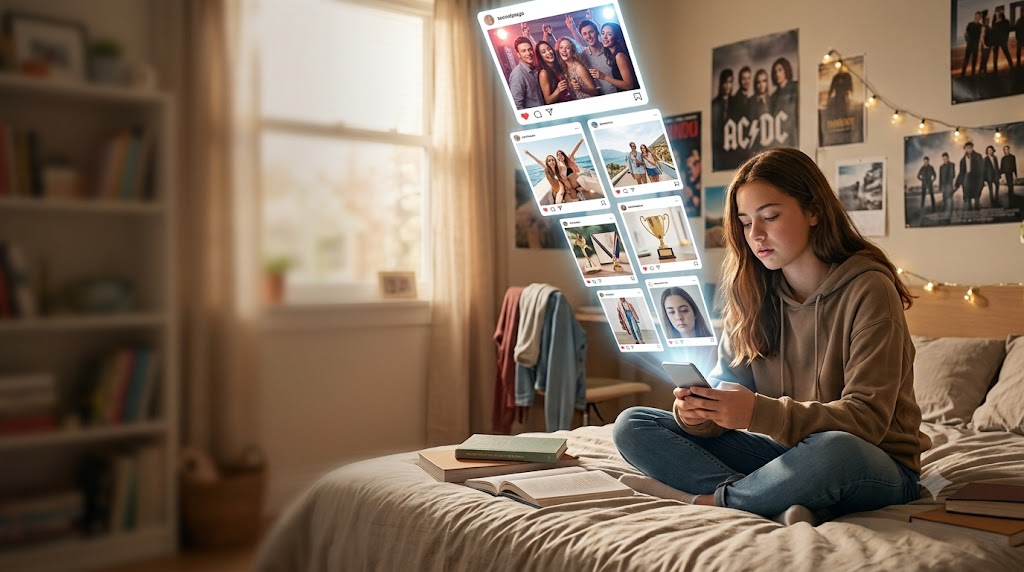
Social comparison — the tendency to evaluate ourselves by measuring against others — is a normal human process. We all do it. But social media changes comparison in two significant ways that make it far more damaging than ordinary peer comparison in everyday life. First, the people your child is comparing themselves to are not ordinary peers. They're filtered, curated, often professionally staged versions of people showing their best moments. The vacation, the body, the group of friends, the achievement — these posts represent the top 1% of someone's life presented as if it's the whole thing. Your child is comparing their inner life — how they actually feel, all the ordinary and difficult parts — to the highlight reel of everyone else's. Second, the volume and speed of comparison on social media is unlike anything in human history. A child in the 1990s might compare themselves to twenty or thirty people in their immediate environment. A child today can make hundreds of implicit comparisons before finishing breakfast, across peers, influencers, celebrities, and strangers whose lives look aspirational. Research comparing adolescents today to those in the late 1990s found that young people now make comparisons automatically, compare upward far more often, and consistently feel worse about themselves in the process.
Research note: A 2024–2025 study comparing social comparison patterns across generations found that young people today compare with distant others (influencers, celebrities) far more than previous generations did, report more upward comparison overall, and report feeling worse about themselves during those comparisons — even when the comparison was not consciously noticed. (Comprehensive Results in Social Psychology, 2025)
This is a developmental issue, not a character one
Self-worth in adolescence is less stable than in adulthood. The sense of who a child is — whether they are good enough, likeable, attractive, talented — is still forming and highly responsive to external feedback. This is normal. It's part of the developmental work of adolescence. But it also means the adolescent brain is more sensitive to social evaluation than the adult brain. When a teenager receives positive feedback — likes, affirming comments, recognition — the reward circuits in their brain respond more intensely. And when the feedback is negative or absent, the emotional impact is proportionally sharper. A post that doesn't perform, an image that gets fewer responses than a peer's, being left out of a tagged photo — these register as genuine threats to belonging at a neurological level. This is not weakness. It is the adolescent brain doing exactly what it is built to do at this stage of development. The problem is that social media puts that sensitive system in contact with an endless stream of comparison data, much of it curated to look unattainably good, at a volume and frequency the brain was never designed to process.
What this looks like from the outside
- Coming away from social media sessions seeming deflated, irritable, or withdrawn without being able to explain why
- Sudden self-criticism about appearance, clothes, body, friendships, or life circumstances that seemed fine before
- Checking how many likes or comments a post received repeatedly, visibly anxious about the number
- Comparing their social life, appearance, or achievements unfavorably to specific peers or influencers
- A pattern of feeling good about something until they go online, then feeling bad about the same thing
- Avoiding posting or participating because they don't think their content is good enough
- For girls especially: negative body image comments, dissatisfaction with appearance, or comparing their body to images they've seen
When it's about the body
Body image is one of the most consistent places social comparison plays out online. Platforms like Instagram and TikTok are heavily weighted toward appearance content — fitness, beauty, fashion, bodies. The images that surface most often are not average bodies; they're aspirational ones, frequently filtered, edited, or lit professionally. Research consistently shows that exposure to idealized body images online is linked to lower body satisfaction, increased self-criticism about appearance, and higher rates of disordered eating attitudes — particularly in girls, but also increasingly in boys. The mechanism is direct: seeing an image, comparing yourself to it unfavorably, and feeling worse. When this happens once or twice it's manageable. When it happens dozens of times a day, across years of adolescence, it compounds into a sustained pattern of viewing one's body as inadequate. If your child is making negative comments about their body more frequently, expressing dissatisfaction with their appearance that seems tied to what they're seeing online, or becoming restrictive about eating or compulsive about exercise in ways that feel new, these are worth paying attention to regardless of what else is happening with their screen use.
It's not just about how they look
Body image gets the most research attention, but social comparison online affects self-worth in other areas too. A child who sees peers at parties they weren't invited to learns something about their social standing. A child who watches peers post achievements — athletic records, acceptances, performances — is implicitly measuring where they fall. A child who presents a version of themselves online and watches it receive limited response may update their sense of who they are. For children who are working through questions of identity — their sexuality, gender, cultural background, sense of purpose, or where they belong — social media adds a layer of public performance to that private developmental work. They may encounter content that affirms them or content that makes them feel more isolated. The sense of being watched and evaluated while still figuring out who they are is a particular pressure that previous generations did not face in the same way.
Signs self-worth may be affected beyond appearance
- Statements like "everyone else has more friends than me" or "my life is boring compared to everyone else's"
- Reluctance to share anything about themselves online because "it's not interesting enough"
- Apparent shame or withdrawal after social events that didn't generate the social media response they hoped for
- Increased rigidity about what they share or how they're seen — excessive editing of posts, unwillingness to be in candid photos
- A general sense that others' lives are fuller, richer, or more meaningful than their own
What actually helps
You cannot remove social media from your child's life without removing them from their social world — and for most adolescents, that cost is too high. What you can do is help them build the internal resources that make comparison less destabilizing, and have the kind of ongoing conversations that reduce its power.
Name the mechanism
One of the most useful things a parent can do is simply explain how social comparison works on these platforms — that what your child is seeing is curated, filtered, and not representative of anyone's actual life. This doesn't make the feelings go away, but it gives children a frame for interpreting them. Research suggests that adolescents who understand the constructed nature of social media content show more resilience to its effects on self-worth.
Stay curious, not alarmed
When your child comes away from social media seeming deflated, the most effective response is usually curiosity rather than intervention: "You seem a little quiet after being on your phone — what were you looking at?" This opens the conversation without making them defensive. Alarm or criticism tends to shut the conversation down.
Build identity outside the feed
Self-worth that is anchored in skills, relationships, and values is more stable than self-worth that depends on social validation. A child who has a strong sense of being competent at something — sports, art, music, cooking, a part-time job, a community role — has a source of self-worth that social media cannot reach. Investing in those activities is not a workaround; it's building the foundation that makes online comparison less threatening.
Audit the feed together
Not everything on social media is equally harmful. Accounts that post aspirational appearance content or that generate comparison and inadequacy are different from accounts that inspire, inform, or connect. Helping your child notice which accounts leave them feeling worse and which leave them feeling okay — and making changes accordingly — is a practical, non-punitive intervention. This works best as a collaborative conversation, not a parental decree.
Don't minimize the feelings
"Just don't compare yourself" is not helpful advice. The comparison is often not conscious. Acknowledging that what your child is experiencing makes sense given what they're being exposed to — and that it doesn't mean something is wrong with them — is more useful than telling them to feel differently.
When the conversation isn't enough
For many children, parent conversations and feed adjustments are enough to manage the impact of social comparison. But if the patterns below describe what you're seeing, professional support is worth considering.
Seek help if
- Your child's self-worth seems consistently low regardless of positive experiences
- Negative body image is persistent, intensifying, or affecting eating or exercise behavior
- Social media comparison has become a source of significant distress or is contributing to anxiety or depression symptoms
- Your child is avoiding social situations, school, or activities because of social media-driven feelings of inadequacy
- Repeated reassurance from you has no lasting effect and seems to provide only brief relief
Crisis Note: If your child is expressing thoughts of self-harm or not wanting to be alive, do not wait. Call or text 988 (Suicide & Crisis Lifeline), available 24/7.
How Idaho Youth Ranch Can Help
Idaho Youth Ranch works with children and young people ages 9–24 across Idaho. If social media comparison is contributing to anxiety, depression, low self-worth, or body image concerns, our team can help you understand what your child is experiencing and what kind of support would actually help. Therapy with a skilled clinician can help your child build the internal foundation that makes comparison less destabilizing — and address underlying anxiety or depression if that's part of the picture.