What to Do When Your Child Seems Addicted to Screens

When limits, arguments, and taking the phone away haven't worked

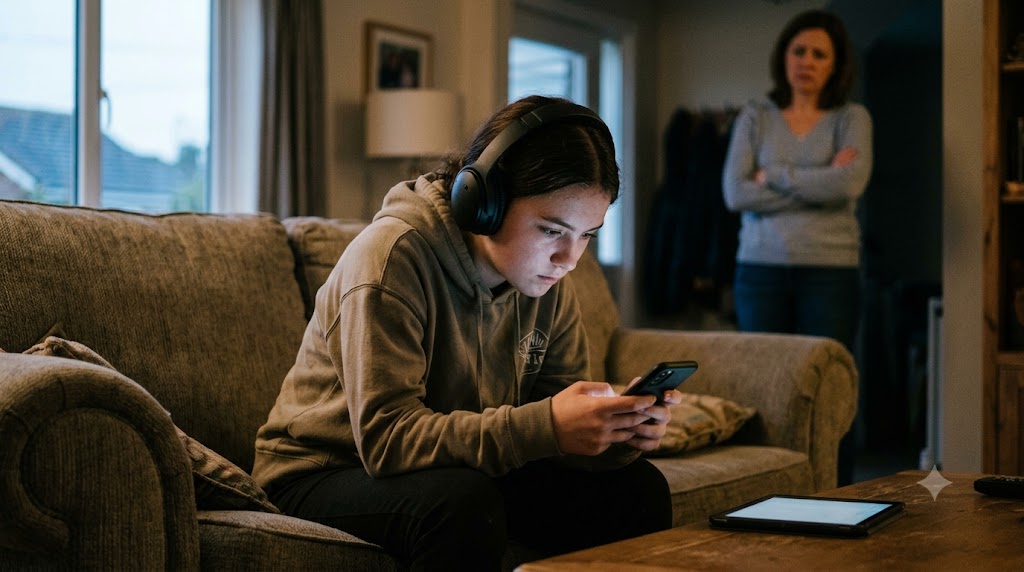
You've tried setting limits. You've had the arguments. You've taken the phone and watched the fallout. And then, gradually or quickly, everything returned to the same pattern. Your child is on screens constantly, resists every attempt to pull them away, and becomes a different person when that access is interrupted — angry, anxious, shut down. You're not sure if this is normal teenage behavior, a mental health issue, or something closer to an addiction. You're probably right that something is wrong. This page is for families where ordinary limit-setting has stopped working, and where the pattern of screen use has started to look compulsive.
"Addiction" is the parent's word; the clinical frame is compulsive or problematic use — a pattern that's hard to control, continues despite negative consequences, and organizes a significant part of the child's life around itself. A habit responds to structure and consistency; a pattern serving an emotional-regulation function requires addressing what the screens are doing for the child, not just reducing access. Taking the phone away can make things worse for children whose screen use is a primary coping mechanism, producing a crisis-level reaction and entrenching the cycle. For many children, problematic screen use is the most visible symptom of an underlying condition — anxiety, depression, ADHD, or social difficulty — and treating only the screen use is treating the smoke rather than the fire. When the pattern is entrenched, professional support is the appropriate next step, not a sign of failure; gradual reduction and collaborative agreements work better than cold-turkey removal or coercive surveillance.

Beyond the Argument

What "addiction" actually means here

What to try when limits and taking the phone away haven't worked

"Addiction" is not the clinical term used for problematic screen or social media use. The clinical framework talks about compulsive or problematic use — a pattern where the behavior is difficult to control, continues despite negative consequences, and organizes a significant amount of the child's life around itself. Whether or not that meets a formal diagnostic threshold, it describes something real that parents are right to take seriously. For most children, heavy screen use is a habit driven by boredom, social connection, or enjoyment — not compulsion. But for a meaningful subset, particularly those with underlying anxiety, depression, ADHD, or significant social difficulty, screen use shifts into a pattern that looks more like dependence: the child uses screens to regulate emotional states they can't otherwise manage, and cannot tolerate interruption without distress that goes beyond ordinary frustration. The practical distinction matters because the intervention is different. A habit responds to structure and consistency. A pattern that's serving an emotional regulation function requires addressing what the screens are doing for the child — not just reducing access to them.

Signs that suggest compulsive rather than heavy use

  • Severe emotional reactions when screens are removed — not just frustration, but rage, panic, or complete shutdown
  • Preoccupation with screens even when not using them — constantly thinking about what they're missing, counting down to access
  • Using screens to manage uncomfortable emotions — going straight to a device when anxious, sad, or after any conflict
  • Declining performance at school, withdrawal from offline friendships, and abandonment of activities they used to care about
  • Lying or hiding screen use, including secret devices or staying up after lights-out
  • Inability to stop when they say they will, despite genuinely intending to
  • Physical symptoms when separated from devices — restlessness, agitation, sleep disruption beyond normal adjustment

Research context: Studies consistently link problematic smartphone use in adolescents to anxiety, depression, ADHD, social phobia, and poor emotional regulation — suggesting that for many children, the screen use is a symptom of an underlying difficulty, not the cause. Addressing only the screen use without the underlying driver tends to produce limited results.

Why taking the phone away makes things worse

For children whose screen use is primarily a habit or a preference, limits work reasonably well. There's resistance, negotiation, pushback — but the child adjusts. For children whose screen use is serving an emotional function — managing anxiety, filling a painful social void, escaping from depression, coping with a home environment that feels overwhelming — removing that access creates a crisis. The device isn't just entertainment. It's the primary coping mechanism. Taking it produces distress that looks wildly disproportionate to the situation, because from the child's internal perspective, it is. This explains a pattern many parents describe: limits are set, the child reacts intensely, the conflict becomes so severe that the limit is abandoned to restore peace, the child returns to the device, and the cycle repeats. Each cycle tends to make the pattern more entrenched. It also explains why strict surveillance alone tends to backfire with older adolescents. Research on parental mediation consistently finds that coercive monitoring — locking devices, tracking apps, strict controls without conversation — tends to increase conflict and resentment without producing lasting change in use patterns. What does work is more demanding: active engagement, conversation about what the screens are doing for the child, and addressing the underlying emotional need.

A different approach

If your child's screen use has reached the point where ordinary limits aren't working, a different approach is needed. These strategies are not ordered by importance — the right starting point depends on your child's situation. If underlying anxiety, depression, or ADHD is driving the pattern, professional support should be part of the picture early, not as a last resort.

1. Get curious before getting restrictive

The most important question is not "how do I reduce their screen time" but "what are the screens doing for them?" When does your child reach for the device? After conflicts? When bored? When anxious? When they come home from school? Understanding the emotional function helps you address it directly rather than simply removing the mechanism. A child who uses screens to escape social anxiety needs help with the anxiety, not just reduced phone access.

2. Replace, don't just remove

Abrupt removal of a primary coping mechanism without offering an alternative tends to fail. More sustainable change happens when screen time is gradually replaced by other activities that meet the same underlying need — connection, stimulation, identity, relaxation. This is easier said than done, especially with adolescents who have withdrawn from offline activities. But even small investments in physical activity, in-person friendships, creative pursuits, or structured routines create competing sources of engagement that make screens less dominant over time.

3. Make agreements, not rules

Research on parental mediation is consistent: active, collaborative conversations about screen use produce better outcomes than unilateral restrictions, especially with teenagers. This doesn't mean the child sets the terms. It means involving them in building the structure — which hours, which contexts, what the phone-free periods look like — so that the agreement is something they have a stake in rather than something imposed on them. A plan they helped design is harder to undermine.

4. Establish non-negotiable baselines

While the collaborative approach works for most of the structure, some things should be non-negotiable regardless of pushback: no devices in bedrooms overnight (see the sleep resource), no screens during meals, and no devices during the first hour of the morning and the hour before bed. These baselines create protected time without being punitive and are supported by the strongest evidence for improving mood, sleep, and family connection.

5. Use incremental reduction, not cold turkey

For children with compulsive patterns, sudden complete removal tends to intensify distress without producing lasting change. Gradual reduction — progressively shorter access windows, expanding non-screen periods over weeks rather than days — allows the nervous system to adjust without triggering a crisis response. This is the approach used in clinical habit reversal and behavioral interventions for compulsive use.

6. Seek professional support when the pattern is entrenched

If your child's screen use meets the markers for compulsive use — severe reactions to limits, declining function, inability to stop despite intention — family-level strategies are unlikely to be sufficient on their own. A therapist who understands adolescent screen use can help identify the underlying emotional driver, work with your child on developing alternative coping strategies, and support the family in implementing changes that actually stick.

When screens are a symptom, not the problem

The research on compulsive screen use in adolescents consistently shows a strong association with anxiety, depression, ADHD, and social difficulty. This association runs in both directions — these conditions increase the pull toward screens, and heavy screen use worsens their symptoms — but it also suggests something important: for many children, problematic screen use is not the core problem. It's the most visible symptom of something underneath. A child with undiagnosed ADHD who struggles to sustain attention and manage boredom will find screens almost irresistible — they provide the stimulation, novelty, and feedback the ADHD brain seeks. A child with social anxiety who finds in-person interaction painful may turn to screens as their only accessible form of social connection. A child in a depressive episode may use screens to numb out from feelings they have no other way to manage. In each of these cases, addressing the screen use without identifying and treating the underlying condition is treating the smoke rather than the fire. Parents who are seeing compulsive screen use alongside other signs — persistent low mood, anxiety, extreme social withdrawal, significant academic decline — should consider a professional evaluation as part of the picture.

When this is beyond a parenting problem

If your child's screen use has reached the point where family-level strategies have not produced lasting change, professional support is the appropriate next step, not a sign of failure. A therapist can help identify whether an underlying condition is driving the pattern, work with your child on developing internal regulation skills, and support your family in making changes that hold.

Seek Help If

  • Screen use is severe enough to cause significant impairment at school, in friendships, or in family functioning
  • Your child shows signs of anxiety, depression, or ADHD alongside the screen pattern
  • Limits trigger disproportionate emotional reactions that have become a significant family issue
  • Your child is unable to stop despite repeated genuine attempts
  • You are unsure whether what you're seeing is normal development or something that needs clinical attention

Crisis Note: If your child is expressing thoughts of self-harm or not wanting to be alive, do not wait. Call or text 988 (Suicide & Crisis Lifeline), available 24/7.

How Idaho Youth Ranch Can Help

Idaho Youth Ranch works with children and young people ages 9–24 across Idaho. If your child's screen use has become a source of significant concern — and especially if you're seeing signs of anxiety, depression, ADHD, or other mental health challenges alongside it — our team can help you understand what's driving the pattern and what kind of support would actually help. A first conversation doesn't commit you to anything.


Frequently asked questions

Common questions
parents may have

Answers to some of the questions families often ask when trying to understand these challenges.

Why don’t coping skills always work?

The most common reasons: the skill does not match the function (a calming technique offered to a teen seeking sensation), the skill was introduced during a crisis rather than practiced beforehand, or the emotional intensity exceeded the skill’s capacity. When skills fail, it usually means the match or the timing needs adjustment — not that the teen is failing.

Why don’t coping skills always work?

The most common reasons: the skill does not match the function (a calming technique offered to a teen seeking sensation), the skill was introduced during a crisis rather than practiced beforehand, or the emotional intensity exceeded the skill’s capacity. When skills fail, it usually means the match or the timing needs adjustment — not that the teen is failing.

Why don’t coping skills always work?

The most common reasons: the skill does not match the function (a calming technique offered to a teen seeking sensation), the skill was introduced during a crisis rather than practiced beforehand, or the emotional intensity exceeded the skill’s capacity. When skills fail, it usually means the match or the timing needs adjustment — not that the teen is failing.

Frequently asked questions

Common questions

parents may have

Answers to some of the questions families often ask when trying to understand these challenges.

How long will it take to see improvement?
Blue plus sign icon with rounded edges on a white background.

It depends significantly on whether the compulsive pattern has an underlying driver that's being addressed. Families who make structural changes — device-free bedrooms, consistent limits, agreed routines — without addressing underlying anxiety or depression often see initial improvement followed by a return to the same pattern. When professional support is also in place, change tends to be more durable. Expect weeks, not days, before patterns meaningfully shift, and expect setbacks to be part of the process rather than signs that the approach isn't working.

Should I track their phone or use parental controls?
Blue plus sign icon with rounded edges on a white background.

Monitoring tools and parental controls can be useful as one part of a broader approach, particularly for younger children. For teenagers, the research on coercive surveillance — monitoring without conversation or consent — consistently shows that it tends to increase conflict and secrecy rather than change behavior. A more effective approach combines transparent monitoring (your child knows what you can see and why) with active conversation and collaborative agreements. If you're using controls as a substitute for engagement, they're unlikely to produce the change you're hoping for. If you're using them as a support structure within a broader approach, they can be a useful tool.

My teenager uses screens to connect with their only friends. If I limit their phone I'm cutting off their social life.
Blue plus sign icon with rounded edges on a white background.

This is a real tension and worth taking seriously. For some adolescents — particularly those who are socially anxious, neurodivergent, or in rural or isolated communities — online relationships are genuine, meaningful, and may be their primary source of social connection. A blanket restriction that removes that connection can do real harm. The goal is not to eliminate online socializing but to ensure it isn't the only form of social contact, and to distinguish between healthy connection and compulsive use. If your child's online friendships are their sole source of belonging, that's worth exploring with a therapist — both because it deserves support and because building any offline connection reduces the intensity of the dependency.

My child has no other interests. All they want to do is be on screens. What do I do?
Blue plus sign icon with rounded edges on a white background.

This is one of the most common and most distressing things parents describe. When a child has completely abandoned offline interests and activities, it's often because screens have outcompeted everything else — they're more stimulating, more rewarding, more immediately satisfying than anything in the offline world. The path back to offline engagement is usually slow and requires meeting them where they are. Starting with activities that have a low bar — walking with you, cooking together, a very short outing they don't have to commit to — and building from there is more effective than trying to revive old interests that may feel distant. If your child is also showing signs of depression, that is worth addressing professionally, as depression significantly narrows the range of activities that feel accessible.

Practical steps for when limits and taking the phone away have not worked:

Get Curious Before Getting Restrictive — and Replace, Don't Just Remove

The most important question is not "how do I reduce their screen time" but "what are the screens doing for them?" Notice when your child reaches for the device — after conflicts, when bored, when anxious, when they come home from school — and address that emotional function directly. Then replace rather than simply remove: gradually build competing sources of engagement (physical activity, in-person friendships, creative pursuits, structured routines) that meet the same underlying need for connection, stimulation, identity, or relaxation.

Make Agreements, Not Rules — With Non-Negotiable Baselines

Active, collaborative conversations about screen use produce better outcomes than unilateral restrictions, especially with teenagers. Involve your child in building the structure — which hours, which contexts, what phone-free periods look like — so the plan is something they have a stake in. Within that, keep a few baselines non-negotiable regardless of pushback: no devices in bedrooms overnight, no screens during meals, and no devices in the first hour of the morning or the hour before bed.

Reduce Gradually and Bring in Professional Support When Entrenched

For children with compulsive patterns, sudden complete removal tends to intensify distress without lasting change. Use incremental reduction — progressively shorter access windows, expanding non-screen periods over weeks rather than days — so the nervous system can adjust without triggering a crisis. When the pattern meets the markers for compulsive use (severe reactions to limits, declining function, inability to stop despite intention), a therapist who understands adolescent screen use can identify the underlying driver and help the family make changes that stick.

Look at the Whole Family's Screen Habits

It is hard to ask a child to change their screen habits if the rest of the household lives on devices too. Take an honest look at your own phone use and the family's shared routines, and notice where screens have crept into meals, conversations, and downtime. Set a few screen-free zones or times that apply to everyone, including the adults. When your child sees that the goal is a healthier home and not just controlling them, the changes meet less resistance.

Explore helpful resources

Helpful guides and articles for families seeking more information and support.

should connect to any other Parent Resources articles.

When screen use looks more like a compulsion than a habit, professional support can help you understand what is driving it. At Idaho Youth Ranch, our therapists help kids and families address the emotional needs that screens have been filling.

Talk With Our Team

How Idaho Youth Ranch Can Help

Idaho Youth Ranch works with children and young people ages 9–24 across Idaho. If your child's screen use has become a source of significant concern — and especially if you're seeing signs of anxiety, depression, ADHD, or other mental health challenges alongside it — our team can help you understand what's driving the pattern and what kind of support would actually help. A first conversation doesn't commit you to anything.

Outline of Idaho state inside a heart behind three person icons representing community or support.

For more than 70 years, we've stood beside Idaho's youth and families.

Hope. Healing. Resilience.

Blue phone handset icon with two curved lines indicating sound or call signal.

Call Now

Speak with our Team directly.

Best for families who want to talk through next steps, ask questions, or connect with admissions for the Residential Center for Healing & Resilience.