Panic Attacks in Teens: What Parents Need to Know

When anxiety feels like a medical emergency — and how to respond in the moment.

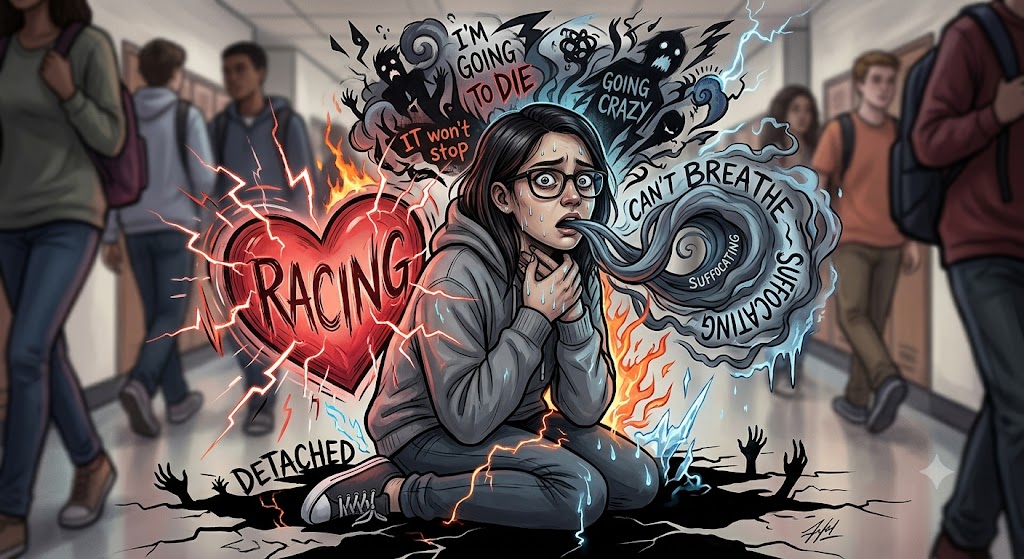
Your teen says they can't breathe. Their heart is racing. They feel dizzy, shaky, or like they're about to pass out — or even die. For many parents, a panic attack looks like a medical crisis. And in the moment, it feels like one to your teen too. Panic attacks are intense surges of fear that trigger real physical symptoms. They can come out of nowhere or build from underlying anxiety. While they are not dangerous, they are deeply distressing — and without the right response, they can lead to avoidance patterns that make anxiety worse over time. This page gives you what you need: what to do if your teen just had their first panic attack, how to help during one, what to say afterward, and when it's time for professional support.
Panic attacks are intense but not dangerous — even when they feel like a medical emergency to both teens and parents. Symptoms are physical (racing heart, dizziness, chest tightness, hyperventilation) because the body's alarm system has been activated at full intensity. How you respond in the moment matters more than what you say. Your calm, steady presence helps your teen's nervous system regulate. Avoidance after a panic attack (skipping school, leaving situations) reinforces the cycle and increases future attacks. With CBT, most teens learn to manage and significantly reduce panic attacks. It is one of the most treatable anxiety presentations.

The Panic Response

What a panic attack looks like, and how to respond when it happens

A panic attack is a sudden surge of intense fear that peaks within minutes and hits the body hard. It can feel like a heart attack, like not being able to breathe, or like something is seriously wrong. For a teen in the middle of one, the fear is real and physical — not dramatic, not attention-seeking, and not something they can simply talk themselves out of.

Panic attacks are more common in adolescence than most parents realize. They often show up for the first time during the teen years, and the first one is usually the most frightening because your teen has no idea what is happening to them.

What a Panic Attack Feels Like

Panic attacks come on fast and tend to peak within about ten minutes. Your teen may experience a pounding or racing heart, shortness of breath or a feeling of being unable to get enough air, chest tightness or chest pain, dizziness or lightheadedness, shaking or trembling, sweating or chills, nausea, numbness or tingling, and a sense of unreality or feeling detached from their body. Many teens also describe an overwhelming fear that they are dying, losing control, or "going crazy." That fear is one of the hallmarks that separates a panic attack from ordinary anxiety.

Why Panic Attacks Are So Frightening

The symptoms of a panic attack are the body's fight-or-flight system firing at full strength when there is no actual danger present. The heart races to move blood to the muscles. Breathing speeds up to take in more oxygen. The result is a cascade of physical sensations that feel genuinely alarming.

Because the sensations mimic a medical emergency, many teens — and many parents — end up in urgent care or the emergency room the first time, convinced something is physically wrong. Being told "it was just a panic attack" can feel dismissive when the experience was so physical and so scary. It was not "just" anything. It was real. It simply was not dangerous.

Panic Attacks vs. Panic Disorder

Having a panic attack does not mean your teen has panic disorder. Many people have one or two panic attacks during a stressful stretch and never have another. Panic disorder is different: it involves repeated, unexpected panic attacks combined with ongoing worry about when the next one will come.

That second part — the fear of the fear — is what turns isolated panic attacks into a larger problem. A teen who starts avoiding places or situations where they had a panic attack, or where they worry one might happen, is beginning a cycle worth taking seriously.

The Fear-of-Fear Cycle

After a frightening panic attack, many teens become watchful for the next one. They monitor their heartbeat, their breathing, and every small body sensation for signs that panic is coming. Ironically, that hypervigilance makes panic more likely, not less: noticing a skipped heartbeat sparks worry, the worry triggers the alarm system, and the alarm produces the very symptoms they were dreading.

Avoidance deepens the cycle. When a teen skips school, parties, or car rides because that is where a panic attack happened, they get short-term relief but teach the brain that those places are genuinely dangerous. Over time, the teen's world can shrink around the places panic has touched.

What Parents Can Do During a Panic Attack

In the moment, your calm is the most useful thing you have. Your teen's nervous system is looking for cues about whether the situation is safe, and a steady parent is a powerful signal. Stay with them, keep your voice low and even, and let them know this will pass. Remind them that a panic attack cannot actually harm them and always ends on its own, usually within a few minutes.

Help them slow their breathing rather than fight it — breathing out for longer than they breathe in helps switch off the alarm response. Avoid crowding them with questions or rushing to the emergency room once you know it is panic and not a medical event. What helps most is a message that communicates: "I'm here. You're safe. This will pass. We'll get through it together."

When to Seek Professional Help

Consider a professional evaluation when your teen has had more than one panic attack, is worrying between attacks about when the next one will come, is starting to avoid places, people, or activities because of panic, or is frightened of the physical sensations themselves. It is also worth checking in with your pediatrician the first time, so a medical cause can be ruled out and your teen can be reassured that their heart and lungs are healthy.

The encouraging news is that panic responds very well to treatment. Cognitive behavioral therapy is the gold-standard approach: it helps teens understand what panic actually is, learn that the sensations are uncomfortable but not dangerous, and gradually face the situations they have been avoiding. Most teens see meaningful improvement, and many stop having panic attacks altogether.

A panic attack feels like an emergency, but it is not one. It is a false alarm — and with the right support, teens can learn to turn the alarm back off.

Sources: NIMH Panic Disorder Statistics; CDC Youth Mental Health Data; Child Mind Institute — Panic Attacks and Panic Disorder in Teens; ADAA — Panic Disorder Facts & Statistics.


Frequently asked questions

Common questions
parents may have

Answers to some of the questions families often ask when trying to understand these challenges.

Why don’t coping skills always work?

The most common reasons: the skill does not match the function (a calming technique offered to a teen seeking sensation), the skill was introduced during a crisis rather than practiced beforehand, or the emotional intensity exceeded the skill’s capacity. When skills fail, it usually means the match or the timing needs adjustment — not that the teen is failing.

Why don’t coping skills always work?

The most common reasons: the skill does not match the function (a calming technique offered to a teen seeking sensation), the skill was introduced during a crisis rather than practiced beforehand, or the emotional intensity exceeded the skill’s capacity. When skills fail, it usually means the match or the timing needs adjustment — not that the teen is failing.

Why don’t coping skills always work?

The most common reasons: the skill does not match the function (a calming technique offered to a teen seeking sensation), the skill was introduced during a crisis rather than practiced beforehand, or the emotional intensity exceeded the skill’s capacity. When skills fail, it usually means the match or the timing needs adjustment — not that the teen is failing.

Frequently asked questions

Common questions

parents may have

Answers to some of the questions families often ask when trying to understand these challenges.

Will my teen grow out of panic attacks?
Blue plus sign icon with rounded edges on a white background.

Without treatment, panic attacks often continue or worsen because avoidance patterns become more entrenched over time. With evidence-based treatment — specifically CBT with interoceptive exposure — most teens learn to manage and significantly reduce panic attacks. Panic disorder is one of the most responsive anxiety conditions to treatment. Early intervention produces the best outcomes.

What triggers panic attacks in teens?
Blue plus sign icon with rounded edges on a white background.

Triggers vary widely. Some panic attacks are linked to specific fears (social situations, school stress, test anxiety). Others seem to come out of nowhere — what clinicians call "uncued" attacks. Internal sensations can also trigger attacks: a teen notices their heart rate increase during exercise, interprets it as the beginning of a panic attack, and the fear of the sensation produces the very attack they feared. This is the panic cycle in action.

Should I take my teen to the ER during a panic attack?
Blue plus sign icon with rounded edges on a white background.

If it is the first time and you are unsure whether symptoms are medical, it is reasonable to seek medical evaluation. A pediatrician or ER visit can rule out cardiac or respiratory issues. Once panic attacks are identified, repeated ER visits are usually not necessary unless symptoms change significantly or new symptoms appear. Having the medical clearance actually helps — you can tell your teen with confidence that their heart is healthy and their lungs are fine.

Are panic attacks dangerous for teens?
Blue plus sign icon with rounded edges on a white background.

No. Panic attacks are not physically dangerous, even though they feel intense and frightening. The symptoms come from the body's fight-or-flight response, which cannot harm the body. The body cannot sustain that level of activation indefinitely — it will always come back down, typically within 20–30 minutes. However, panic attacks are distressing and can lead to avoidance patterns that significantly impact daily life if not addressed.

What helps in the moment a panic attack hits, and how to support your teen afterward:

Stay calm — your regulation matters

Your nervous system sets the tone. If you escalate, their panic escalates. If you stay steady and speak slowly, their body has something to regulate toward. This is not passive — it is the single most powerful thing you can do in the moment.

Normalize the experience

Explain that panic attacks are common and highly treatable. Reducing the fear of the symptoms is a key part of breaking the cycle. Your teen needs to hear: "This is your body's alarm system. It misfired. You are not in danger."

Don't reinforce avoidance

It is tempting to remove your teen from any situation where panic occurred. But avoidance teaches the brain that the situation is truly dangerous. Instead, support gradual re-engagement so their world does not shrink.

Guide their breathing back to slow and steady

During a panic attack, your teen's breathing turns fast and shallow, which keeps the alarm firing. You can gently help by breathing slowly and out loud beside them so they have a rhythm to follow. Try a longer exhale than inhale, something like in for four and out for six, and count it together. You are not stopping the panic by force; you are giving their nervous system a steadier signal to settle toward.

Explore helpful resources

Helpful guides and articles for families seeking more information and support.

should connect to any other Parent Resources articles.

Panic attacks are frightening, but they respond well to treatment, and your teen does not have to brace through them alone. At Idaho Youth Ranch, our therapists help teens understand what is happening in their bodies and learn skills that make panic less frequent and less scary.

Get Started

When It Feels Scary, You Don't Have to Navigate It Alone

Panic attacks can make both teens and parents feel helpless. With the right support, your teen can learn to manage anxiety and regain confidence. We're here to help.

Outline of Idaho state inside a heart behind three person icons representing community or support.

For more than 70 years, we've stood beside Idaho's youth and families.

Hope. Healing. Resilience.

Blue phone handset icon with two curved lines indicating sound or call signal.

Call Now

Speak with our Team directly.

Best for families who want to talk through next steps, ask questions, or connect with admissions for the Residential Center for Healing & Resilience.