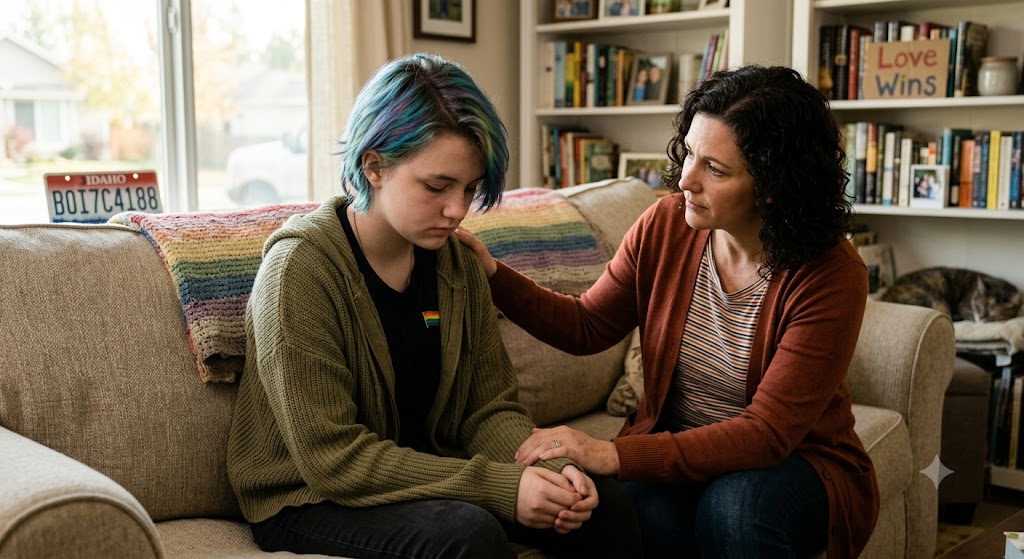
Depression in LGBTQ+ Teens: What Parents Should Know

Your support is the single most powerful factor in your teen's mental health.

LGBTQ+ teens experience depression at significantly higher rates than their peers — not because of who they are, but because of what they face. Stigma, discrimination, bullying, and fear of rejection create layers of stress that compound the already-difficult work of adolescence. According to the Trevor Project's 2024 survey of over 18,000 LGBTQ+ young people, 53% reported recent symptoms of depression. But the research is equally clear on what helps: family acceptance is the single most powerful protective factor against depression and suicide in LGBTQ+ youth. This page is for parents who want to understand what their teen is facing and how to show up for them.
53% of LGBTQ+ young people report recent depression symptoms. Transgender and nonbinary youth are at even higher risk. The elevated risk comes from minority stress — stigma, discrimination, and rejection — not from being LGBTQ+ itself. Family acceptance is the strongest protective factor. LGBTQ+ youth with high family support attempt suicide at less than half the rate of those without it. Half of LGBTQ+ youth who wanted mental health care in the past year were unable to access it. Parents don't need to have all the answers. Showing up with love, curiosity, and a willingness to learn matters more than getting everything right.

A Higher Risk

Why LGBTQ+ Teens Face Higher Rates of Depression

Why LGBTQ+ teens face higher rates of depression, and what helps most

It's important to understand what's driving the disparity. Being LGBTQ+ does not cause depression. What causes depression is the stress that comes from navigating a world that too often responds to LGBTQ+ identity with rejection, hostility, or silence. Researchers call this "minority stress" — the cumulative toll of stigma, discrimination, and the constant need to evaluate whether it's safe to be yourself.

For LGBTQ+ teens, that stress shows up in many forms: fear of coming out, family rejection or uncertainty about acceptance, bullying at school, discrimination in community or religious settings, and the psychological weight of navigating political debates about their right to exist. Nearly half of LGBTQ+ teens aged 13–17 reported being bullied in the past year, and 60% reported experiencing discrimination because of their sexual orientation or gender identity.

Factors That Increase Depression Risk in LGBTQ+ Teens

  • Family rejection or lack of acceptance — the single strongest risk factor for depression and suicide.
  • Bullying, harassment, or victimization at school based on sexual orientation or gender identity.
  • Lack of safe spaces — no GSA, no affirming adults, no LGBTQ+-inclusive curriculum.
  • Social isolation — feeling like the only one, especially in rural or conservative communities.
  • Internalized shame — absorbing negative societal messages about LGBTQ+ identity.
  • Political climate — 90% of LGBTQ+ youth reported that recent politics negatively impacted their well-being.
  • Barriers to mental health care — 50% who wanted care couldn't access it.
  • Intersecting identities — LGBTQ+ youth of color and LGBTQ+ youth with disabilities face compounded risk.

What Depression May Look Like in LGBTQ+ Teens

Depression in LGBTQ+ teens shares the same core symptoms as depression in any adolescent — persistent sadness, withdrawal, sleep changes, loss of interest, fatigue. But some patterns are worth specific attention:

Pulling back from identity expression. A teen who was beginning to express their identity openly — through clothing, pronouns, social circles — and suddenly retreats may be experiencing depression driven by rejection or fear. This withdrawal from identity can be mistaken for "growing out of a phase" when it's actually a depression symptom.

Intense self-criticism or shame. LGBTQ+ teens who have internalized negative messages about their identity may express feelings of being "broken," "wrong," or fundamentally flawed. This goes deeper than typical adolescent self-doubt — it's an identity-level wound that depression amplifies.

Substance use as self-medication. LGBTQ+ teens use substances at higher rates than their peers, often as a way to manage emotional pain that feels otherwise inescapable. If your teen's substance use has increased, depression may be the underlying driver.

Heightened suicide risk. LGBTQ+ teens are four times more likely to attempt suicide than their heterosexual peers. Among transgender youth, the rate is even higher. Any expression of hopelessness, self-harm, or suicidal thinking in an LGBTQ+ teen should be treated as an emergency.

Why Your Acceptance Matters More Than Anything Else

The research on this is unambiguous: LGBTQ+ youth who experience high levels of family acceptance have dramatically better mental health outcomes. They are less likely to be depressed, less likely to use substances, and attempt suicide at less than half the rate of those who feel rejected or unsupported at home.

Acceptance doesn't mean you have to understand everything about your teen's identity right away. It means your teen knows that your love is not conditional on who they are. It means they see you trying — using their name and pronouns, asking questions with genuine curiosity rather than judgment, not treating their identity as a problem to be solved.

For many parents, this is a process. You may have your own fears, questions, or grief about what your teen's identity means for their future. Those feelings are valid — and they're best explored with your own support system (a therapist, a parent support group, a trusted friend) rather than placed on your teen's shoulders. Your teen needs to know you're in their corner. Everything else can be figured out together.

Finding Affirming Mental Health Care

Not all therapists are equipped to work with LGBTQ+ teens effectively. When seeking care, look for providers who have specific training in LGBTQ+ youth issues, who create a visibly affirming office environment, and who focus on building self-acceptance and coping skills rather than attempting to change orientation or identity. A good therapist will meet your teen where they are — supporting their exploration without rushing or redirecting it.

Ask potential therapists directly about their experience with LGBTQ+ youth, their approach to identity-related issues, and whether they stay current on best practices for gender and sexuality-diverse care. Your teen's comfort and trust with their therapist matters more than any credential.

When Parents Should Seek Help

Consider reaching out to a mental health professional if:

  • Your teen is showing signs of depression — withdrawal, sadness, sleep changes, loss of interest — lasting two weeks or more.
  • They've pulled back from expressing their identity after previously being open about it.
  • They express shame, self-hatred, or feelings of being fundamentally flawed.
  • You've noticed increased substance use.
  • They've experienced bullying, harassment, or discrimination at school.
  • They've expressed hopelessness or any thoughts of self-harm or suicide.

Crisis Note: If your teen is expressing suicidal thoughts, call 988 (Suicide & Crisis Lifeline), the Trevor Project Lifeline at 1-866-488-7386, or text START to 678-678. Don't leave them alone.

Sources: The Trevor Project 2024 U.S. National Survey on LGBTQ+ Youth Mental Health; CDC 2024 Youth Risk Behavior Survey (YRBS); PrairieCare LGBTQ+ youth statistics (2025); Journal of Research on Adolescence, LGBTQ+ youth policy and mental health (2025); Newport Academy, LGBTQ+ teen suicide rates (2025).


Frequently asked questions

Common questions
parents may have

Answers to some of the questions families often ask when trying to understand these challenges.

Why don’t coping skills always work?

The most common reasons: the skill does not match the function (a calming technique offered to a teen seeking sensation), the skill was introduced during a crisis rather than practiced beforehand, or the emotional intensity exceeded the skill’s capacity. When skills fail, it usually means the match or the timing needs adjustment — not that the teen is failing.

Why don’t coping skills always work?

The most common reasons: the skill does not match the function (a calming technique offered to a teen seeking sensation), the skill was introduced during a crisis rather than practiced beforehand, or the emotional intensity exceeded the skill’s capacity. When skills fail, it usually means the match or the timing needs adjustment — not that the teen is failing.

Why don’t coping skills always work?

The most common reasons: the skill does not match the function (a calming technique offered to a teen seeking sensation), the skill was introduced during a crisis rather than practiced beforehand, or the emotional intensity exceeded the skill’s capacity. When skills fail, it usually means the match or the timing needs adjustment — not that the teen is failing.

Frequently asked questions

Common questions

parents may have

Answers to some of the questions families often ask when trying to understand these challenges.

Does family acceptance really make a difference in LGBTQ+ teen depression?
Blue plus sign icon with rounded edges on a white background.

Yes — dramatically. Research shows that LGBTQ+ youth with high levels of family support attempt suicide at less than half the rate of those who feel rejected. Family acceptance is consistently identified as the single most powerful protective factor against depression, anxiety, and suicidal behavior in LGBTQ+ young people.

How do I find an LGBTQ+-affirming therapist for my teen?
Blue plus sign icon with rounded edges on a white background.

Ask potential therapists directly about their experience with LGBTQ+ youth, their training in gender and sexuality-diverse care, and their approach to identity-related issues. Look for providers who focus on self-acceptance and coping skills rather than attempting to change orientation or identity. A visibly affirming environment — inclusive materials, welcoming language — signals that your teen will be safe.

How can I support my LGBTQ+ teen if I'm still processing my own feelings about their identity?
Blue plus sign icon with rounded edges on a white background.

It's okay to have your own questions and emotions. What matters is that your teen sees your love as unconditional while you work through your process. Use their preferred name and pronouns, ask questions with curiosity rather than judgment, and seek your own support — a therapist, a parent group, or a trusted friend — for the feelings you're navigating. Your teen needs your presence, not your perfection.

Why are LGBTQ+ teens more likely to be depressed?
Blue plus sign icon with rounded edges on a white background.

The elevated risk comes from minority stress — the cumulative impact of stigma, discrimination, bullying, and fear of rejection — not from being LGBTQ+ itself. When these external stressors are reduced through family acceptance, affirming communities, and safe school environments, depression rates improve significantly.

Concrete ways your support can protect your LGBTQ+ teen's mental health:

Use Their Name and Pronouns — Consistently

This is one of the simplest and most powerful things you can do. Using your teen's chosen name and pronouns communicates that you see them and respect who they are. Mistakes will happen — correct yourself calmly and move on. The effort matters more than perfection.

Make Home the Safest Place They Have

Your teen may face hostility or judgment at school, in their community, or online. Home needs to be the place where they can exhale. That doesn't mean avoiding difficult conversations — it means having them from a foundation of unconditional love rather than conditional acceptance.

Educate Yourself — but Don't Make Your Teen Your Teacher

Read, listen to podcasts, connect with other parents of LGBTQ+ youth. Your teen shouldn't have to carry the burden of educating you about their identity. Doing your own learning shows them you care enough to invest the effort — and it takes the emotional labor off their plate.

Find Affirming People and Spaces Beyond Your Home

Your acceptance matters most, and it goes further when your teen also has affirming connections outside the house. Help them find a supportive friend group, a school club like a GSA, an inclusive faith community, or a vetted online space where they are not the only one. You do not have to manage these relationships, just open doors and let your teen choose what fits. Knowing they are not alone in the world can ease the isolation that often deepens depression.

Explore helpful resources

Helpful guides and articles for families seeking more information and support.

should connect to any other Parent Resources articles.

Your support is powerful, and the right professional support can strengthen it further. At Idaho Youth Ranch, our therapists provide affirming care for LGBTQ+ teens, meeting them as they are and helping your family navigate this together.

Get Started

Your Teen Deserves to Be Seen — and Supported

If your LGBTQ+ teen is struggling, you don't have to navigate this alone. Our therapists are here to support your teen and your family with affirming, compassionate care.

Outline of Idaho state inside a heart behind three person icons representing community or support.

For more than 70 years, we've stood beside Idaho's youth and families.

Hope. Healing. Resilience.

Blue phone handset icon with two curved lines indicating sound or call signal.

Call Now

Speak with our Team directly.

Best for families who want to talk through next steps, ask questions, or connect with admissions for the Residential Center for Healing & Resilience.