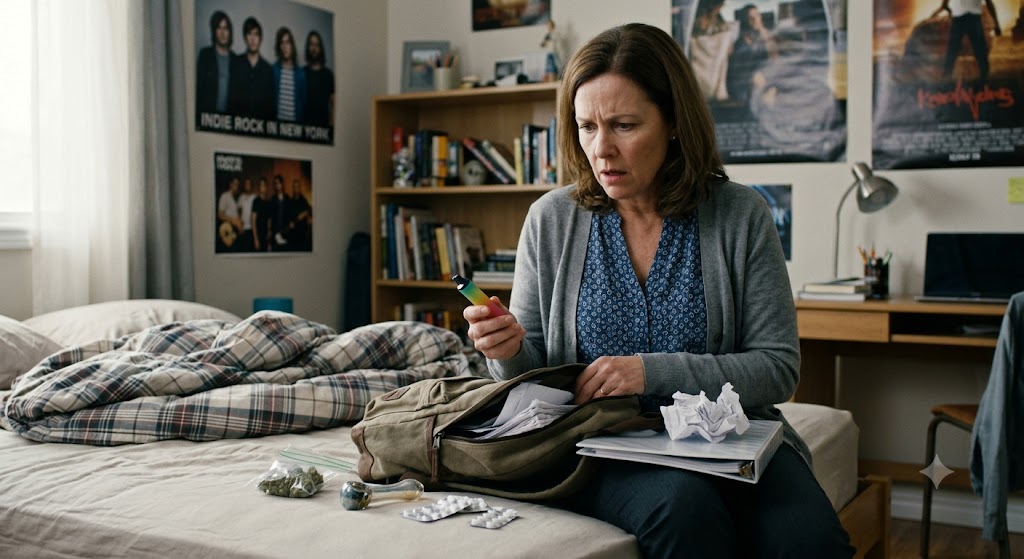
The First 24 Hours
A calm, step-by-step guide for what to do right after the discovery
Counterfeit prescription-looking pills containing fentanyl are widely available through social media and e-commerce channels, and the Idaho Department of Health and Welfare has documented teen deaths from pills that looked exactly like Adderall, Xanax, Percocet, or Oxycodone. For that reason, unknown pills deserve special caution.
Emergency triage — check immediate safety first. If any of these apply, act on this before reading further; the rest of the page can wait a few minutes.
- Trouble breathing, blue lips, unresponsiveness, choking or gurgling sounds, limp body, or possible overdose: Call 911.
- An unknown pill may have been taken: Call 911 if any symptoms are present; if no symptoms, call Poison Help at 1-800-222-1222 for guidance.
- Your teen is talking about suicide or self-harm: Call or text 988 (Suicide and Crisis Lifeline).
- No immediate danger, but you found something concerning: Continue with the steps below.
If what you found is a pill: Treat any pill that did not come from your family's own pharmacy as potentially dangerous. Counterfeit pills can look like prescription medications and may contain fentanyl. If your teen may have taken it and shows any breathing change, confusion, severe drowsiness, blue lips, or unresponsiveness, call 911. The fuller pill-safety information is below; this callout is here because pills carry the highest medical risk among common discoveries.
The next twenty-four hours are more important than the discovery itself. The discovery tells you something is happening. The response tells your teen whether they can ever bring something hard to you again. Here is how to navigate the next few hours without making the situation worse.
Pause. Take Ten Minutes Before You Say Anything.
Your nervous system is in the worst possible state for a productive conversation right now. Your stress response is telling you to act immediately, while you are still angry, scared, or in shock. That instinct is wrong. The conversation you have after ten minutes of breathing will be ten times more productive than the conversation you have in the first ninety seconds. If a co-parent is involved, talk to them first. If you cannot talk to anyone, take a walk around the block. Splash cold water on your face. Sit in the car for a minute. Your teen will pick up on your emotional state when you walk in the room; the calmer you can be, the more likely you are to actually learn what is going on. Pausing is not the same as ignoring. It is the opposite. It is taking the situation seriously enough to handle it well.
Assess Immediate Safety: Three Paths
Before any conversation, check the following. The right action depends on which of these three situations you are in.
Path A: Symptoms present. Call 911. If your teen is currently showing signs of overdose or severe impairment, call 911 before anything else. Signs include: slow or stopped breathing, blue lips or fingertips, unresponsiveness, choking or gurgling sounds, limp body, severe confusion, or inability to wake. If naloxone (Narcan) is available, administer it. Place your teen on their side and stay with them until emergency responders arrive.
Path B: Substance found, no symptoms. Call Poison Help. If you found a substance you cannot identify but your teen has not used it or is not showing symptoms, call Poison Help at 1-800-222-1222. The national Poison Help line routes you to your local poison center anywhere in the U.S. and is staffed 24 hours a day. They can help you identify what the substance might be, what risk it carries, and what to do with it.
Path C: No immediate danger. Continue with the conversation. If your teen is safe right now, the substance is secured, and there are no symptoms, the right next step is the conversation. For most parents finding most things, this is the path.
Lead With Calm, Not Interrogation
The first sentence sets the tone. A version that tends to work: "I found this, and I am concerned about your safety. I am not going to yell, but we do need to talk about what has been going on." Notice what this sentence does. It names the discovery. It expresses concern, not rage. It commits to staying calm. It frames the conversation as a conversation, not a verdict. What tends not to work: leading with "How could you," leading with consequences ("You are grounded," "You have lost your phone"), or leading with what other people will think. Your teen does not need to be convinced you are upset; they can see your face. Save the consequences for after the conversation, when you actually understand what is going on.
Name What You Found Plainly. Do Not Ambush.
If you have been tracking your teen for weeks and you know about three things, do not stack them up and unload all at once. Pick the specific thing in front of you and name it. "I found this vape in your backpack. I want to understand what has been going on." Then stop talking. Let them respond. Resist the urge to add five more things or to pre-empt their explanation. Ambush questioning, where you bring up everything you know at once, triggers defensiveness, not honesty. A single specific item followed by quiet space is more likely to produce real information than a confrontation that feels like a setup.
If they deny it: Denial is common, especially in the first conversation. If your teen denies the substance is theirs, avoid cross-examining or trying to corner them. Try: "I hear you are saying it is not yours. I am still responsible for safety in our home, so we are going to talk through what I found, what changes for now, and what support might be needed." This response does three things: it does not call them a liar, it does not get pulled into proving who owns the substance, and it asserts the legitimate role of the parent in a safety conversation. The truth of who the substance belongs to often comes out later, sometimes much later. The conversation that matters is the one about safety, regardless of whose substance it is.
Listen for the Emotional Driver Underneath
Once your teen starts talking, listen for what they are not saying explicitly. Are they anxious? Lonely? Trying to sleep? Trying to fit in? Trying to escape something specific at school or at home? Are they bored? Are they grieving someone? The behavior is usually a symptom of a need, and the need is usually nameable once you slow down enough to hear it. You do not have to solve the emotional driver in this conversation. You just have to hear it. Naming it without judgment ("so the vaping helps when you cannot sleep") often does more work than parents expect. This is the part of the conversation that determines whether what comes next is a single conversation, ongoing support, therapy, or specialized care. The substance is information. The driver is the story.
Set a Safety Boundary, Not a Punishment
Boundaries communicate "I need to know you are safe." Punishments communicate "You are bad." Both create consequences, but they create different relationships. A boundary version: "I am not okay with you using this. Here is what changes for the next two weeks: phone on the counter at nine, you are not driving with friends in the car, and we are going to figure out together what to do about the nicotine. We will check in on Sunday." A punishment version: "You are grounded for a month and I am taking your phone." The boundary version is time-limited, transparent about its purpose, and includes a check-in. The punishment version is open-ended and adversarial. The boundary version preserves connection while still creating real consequences. The punishment version tends to drive the behavior underground.
Secure What You Found. Get Professional Guidance on What to Do With It.
Put the substance somewhere your teen cannot access it again. If you do not know what it is, avoid handling it more than necessary and call Poison Help at 1-800-222-1222, your pediatrician, or local law enforcement for guidance on what to do with it. If a professional asks you to describe or identify it, follow their instructions. If your teen may have used it and is showing symptoms, call 911. Treat any pill that did not come from your family's own pharmacy as potentially dangerous; counterfeit pills made to look like Adderall, Xanax, Percocet, or Oxycodone may contain fentanyl. Idaho law enforcement and Idaho's Department of Health and Welfare have documented widespread availability of counterfeit pills sold through social media. If your teen has friends who might have access to the same source, this is information that may matter for other families.
Decide What Comes Next
Most discoveries do not require a permanent change in family life. Some require a single conversation, ongoing monitoring, and time. Some require therapy. Some require specialized substance-use assessment. Some require emergency care. Sorting which level you are looking at helps you choose the response:
- Experimentation (one-time, peer context, no escalation, no major impairment): a calm conversation with clear expectations and a safety plan is often enough.
- Concerning pattern (repeated use, secrecy, mood change, using to cope): a therapy assessment is often the right next step.
- High risk (using alone, cannot stop, unknown pills, overdose risk): urgent professional help is the move.
- Specialized substance-use level (dependence, withdrawal, daily heavy use): specialized substance-use treatment is the right call.
What Not to Do in the First 24 Hours
- Threaten before you understand what happened.
- Shame your teen.
- Post or share what you found, including with extended family.
- Interrogate them while you are still angry.
- Make consequences so large that your teen feels they have nothing left to lose.
- Search every device or location in retaliation.
- Promise punishments you will not enforce.
- Discuss the discovery in front of younger siblings before you and your teen have processed it.
- Confront them in public, in front of friends, or in the middle of school.
About Unknown Pills (Full Safety Information)
If what you found is a pill that did not come from your family's own pharmacy, treat it as potentially life-threatening. Counterfeit pills can look exactly like prescription Adderall, Xanax, Percocet, or Oxycodone, and some contain enough fentanyl to be fatal to a teen who has never used opioids before. There is no reliable way to tell by looking, smelling, or breaking the pill. The Idaho Department of Health and Welfare reports that fentanyl-containing pills are widely available through social media and e-commerce platforms.
If your teen may have taken an unknown pill: call 911 if symptoms are present. Call Poison Help at 1-800-222-1222 if there are no symptoms but you need help understanding the risk. If you have naloxone (Narcan) available, administer it when overdose is suspected. Naloxone is available through many pharmacies and community harm-reduction programs in Idaho; availability and cost can vary.
If You Already Reacted in a Way You Regret
Repair is possible. You can go back and say: "I was scared, and I reacted too strongly. I still have serious concerns, and we still need boundaries, but I want to have this conversation in a way that helps us understand what is going on." Repair does not mean removing consequences. It means returning to the relationship so the consequences can actually work. Almost every parent has had at least one moment they wish they could redo. Repair is almost always available, even with teens who feel out of reach.
Sources: Poison Help / America's Poison Centers (1-800-222-1222) — national network routing callers to their local poison center, staffed 24 hours a day, for unknown-substance identification and exposure guidance; Idaho Department of Health and Welfare fentanyl public-health guidance — Idaho-specific counterfeit-pill prevalence, social-media distribution patterns, and fentanyl risk; Centers for Disease Control and Prevention opioid overdose response and naloxone guidance — the overdose-symptom list and naloxone harm-reduction framing; Substance Abuse and Mental Health Services Administration (SAMHSA) National Helpline (1-800-662-HELP) — free, confidential, 24/7 treatment referral and information for mental health and substance use disorders.