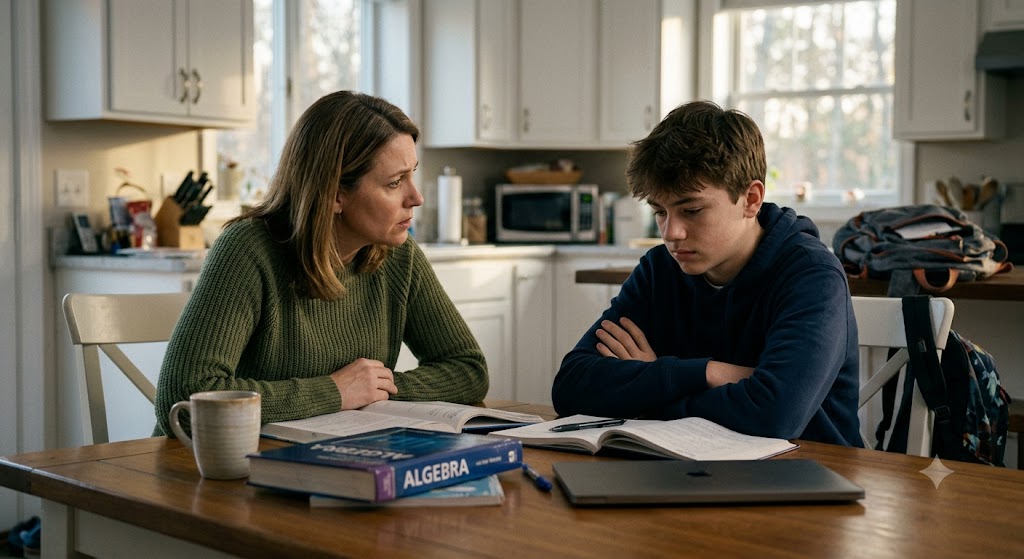
Is This Normal Pushback or Something More?

How to tell the difference between healthy developmental resistance and defiance that needs professional attention — from age 8 through the teen years.

Every child pushes back. A 9-year-old who argues about bedtime, a 12-year-old who rolls their eyes at every request, a 15-year-old who tests curfew — these are not signs that something is wrong. They are signs that your child is developing normally. The drive for autonomy, the need to challenge authority, and the testing of limits are how children practice becoming independent people. But there is a line. When the pushback is constant, when it shows up everywhere, when nothing you try changes the pattern, and when the household is organized around managing or avoiding the next conflict — something more than normal development is at work. This page will help you sort the two. It is not a diagnostic tool. It is a framework for deciding whether what you are seeing warrants a professional conversation or simply more patience.
Normal pushback is situational, temporary, proportionate, and does not involve aggression or lasting harm to relationships or functioning. Concerning defiance is persistent, pervasive across settings, disproportionate, and accompanied by other changes in behavior, mood, or functioning. What "normal" looks like changes with age. A 9-year-old's normal resistance looks different from a 14-year-old's, and both look different from a problem. Five questions can help you sort normal from concerning: How long? How often? How intense? Where does it show up? What comes with it? When in doubt, a professional evaluation is the fastest way to clarity. The best outcome is hearing your child is fine. The worst outcome of not asking is missing something treatable.

Normal vs. Concerning

What Normal Pushback Looks Like at Each Age

What healthy resistance looks like at each age, and when it's more

Normal resistance is not the absence of conflict. It is conflict that serves a developmental purpose, stays within bounds, and resolves. Here is what to expect:

What Normal Resistance Looks Like at Each Age

Ages 8–10

At this age, normal pushback includes negotiating about rules they find unfair, protesting transitions (especially from preferred activities to non-preferred ones like homework or bedtime), testing whether rules are enforced consistently, occasional emotional outbursts when frustrated or tired, and wanting to do things "their way." The key marker of normal: the resistance is connected to specific situations, passes within a reasonable timeframe, and does not involve aggression or property destruction. Your child can still be redirected, and the relationship recovers after the conflict.

Ages 11–13

Preteens add verbal sophistication to their resistance. Normal at this age includes arguing about rules and questioning the reasoning behind them, wanting more privacy and pulling away from family activities, preferring peer opinions over parent opinions, using sarcasm, eye-rolling, and dramatic sighing as communication tools, and testing boundaries around independence (screen time, social plans, unsupervised time). The key marker of normal: the pushback is intermittent, the child can still be engaged in positive interactions, they function at school and with friends between episodes, and they are not hostile or aggressive — just annoying.

Ages 14–17

Adolescent pushback is more targeted and ideological. Normal includes disagreeing with family values or rules on principle, seeking autonomy over decisions about their body, social life, and time, selectively complying with rules they see as reasonable while pushing against rules they do not, expressing frustration with what they perceive as unfair restrictions, and periodic emotional intensity around identity, relationships, and future plans. The key marker of normal: the teen can still function across settings, is not engaging in dangerous behavior, maintains some positive connection with the family (even if it is less frequent), and the resistance is about independence, not hostility.

What Concerning Defiance Looks Like at Each Age

Concerning defiance has a different quality. It is not about independence or development. It is about a child whose needs are exceeding their capacity, and the resistance has become their default response to a world that feels overwhelming.

Ages 8–10

Concerning at this age: daily meltdowns that last 30 minutes or more and do not respond to comfort or redirection; physical resistance (hitting, kicking, throwing objects, going limp, running away) that goes beyond occasional frustration; refusal to attend school or complete any task that requires sustained effort; hostility toward parents or siblings that feels personal, not situational; inability to transition between activities without a fight, every single time. What it may signal: ADHD, anxiety, sensory processing issues, a learning disability that makes school demands feel impossible, or early-onset depression.

Ages 11–13

Concerning at this age: every interaction becomes a power struggle regardless of topic; passive resistance that extends to all expectations (the child agrees to nothing and does nothing); escalating contempt toward parents — not occasional sarcasm but persistent hostility and dismissiveness; withdrawal from all activities, friends, and family; grades dropping with no apparent cause; mood that does not improve — the child seems angry, irritable, or flat as a baseline. What it may signal: emerging depression (irritability is the most common presentation in this age group), anxiety that has become overwhelming, trauma, bullying, or a family dynamic that has become locked in conflict.

Ages 14–17

Concerning at this age: refusal to follow any household expectations, not just ones the teen finds unreasonable; covert defiance that includes lying, sneaking out, or sustained deception; substance use that is escalating; aggressive or threatening behavior toward family members; complete withdrawal from the family relationship (not just reduced contact, but active hostility or indifference); risk-taking that puts their safety at stake; encounters with law enforcement. What it may signal: depression, substance use disorder, trauma, untreated ADHD that has been masked by coping strategies that are now failing, family system breakdown, or the emergence of conduct-related concerns that require professional evaluation.

Five Questions to Help You Sort It Out

If you are unsure where your child's behavior falls, ask yourself these five questions:

1. How long has this been going on?

A rough week after a schedule change or a bad grade is different from a pattern that has persisted for a month or more. Duration is one of the strongest indicators of whether resistance is situational or symptomatic. If the pattern has been present for more than three to four weeks without improvement, it is more likely to reflect something beyond normal development.

2. How often is it happening?

A blowup once or twice a week may be within the range of normal intensity for your child's age. Daily confrontations — or a constant baseline of irritability and hostility between confrontations — suggest something more. Pay attention not just to the frequency of episodes but to whether your child ever returns to a genuinely calm, cooperative state between them.

3. How intense is it?

Arguing and door-slamming are normal-intensity expressions of frustration. Throwing objects, hitting, threatening, destroying property, or screaming for extended periods are beyond normal intensity. Any physical aggression toward people or animals crosses the line regardless of age, frequency, or apparent trigger.

4. Where does it show up?

Pushback that is limited to one setting — usually home — is more likely to be relational or situational. It may reflect a specific dynamic between parent and child that can be addressed. Defiance that shows up at home, at school, with peers, and with other adults is more likely to be driven by an internal condition (ADHD, anxiety, depression, trauma) rather than an external relationship.

5. What comes with it?

Defiance by itself is just defiance. Defiance accompanied by sleep changes, appetite changes, mood shifts, social withdrawal, declining grades, loss of interest in activities, physical complaints, or hopelessness is almost certainly part of a larger picture. The more accompanying symptoms you see, the more likely the defiance is a surface expression of an underlying condition that needs professional assessment.

What If You Are Still Not Sure?

Some situations genuinely fall in a gray zone. The defiance is more than you expected but maybe not alarming. It has been going on for a while but has not crossed into aggression. You are tired and frustrated but not scared. You wonder if you are overreacting — or underreacting.

In those cases: get a professional opinion. A therapist or psychologist experienced with children and adolescents can evaluate what you are seeing and tell you whether it falls within the normal developmental range or whether it warrants closer attention. An evaluation is not a commitment to treatment. It is not labeling your child. It is getting clarity so you can make informed decisions.

The cost of overreacting — getting an evaluation that confirms your child is fine — is minimal. The cost of underreacting — missing ADHD, anxiety, depression, or trauma during a critical developmental window — is significant. When the sorting questions on this page do not give you a clear answer, a professional can.

Sources: AACAP oppositional defiant disorder practice parameter; CDC National Survey of Children's Health (NSCH), behavior and conduct problem prevalence; DSM-5 criteria for oppositional defiant disorder; Greene (2014), The Explosive Child; American Academy of Pediatrics developmental behavior guidelines.


Frequently asked questions

Common questions
parents may have

Answers to some of the questions families often ask when trying to understand these challenges.

Why don’t coping skills always work?

The most common reasons: the skill does not match the function (a calming technique offered to a teen seeking sensation), the skill was introduced during a crisis rather than practiced beforehand, or the emotional intensity exceeded the skill’s capacity. When skills fail, it usually means the match or the timing needs adjustment — not that the teen is failing.

Why don’t coping skills always work?

The most common reasons: the skill does not match the function (a calming technique offered to a teen seeking sensation), the skill was introduced during a crisis rather than practiced beforehand, or the emotional intensity exceeded the skill’s capacity. When skills fail, it usually means the match or the timing needs adjustment — not that the teen is failing.

Why don’t coping skills always work?

The most common reasons: the skill does not match the function (a calming technique offered to a teen seeking sensation), the skill was introduced during a crisis rather than practiced beforehand, or the emotional intensity exceeded the skill’s capacity. When skills fail, it usually means the match or the timing needs adjustment — not that the teen is failing.

Frequently asked questions

Common questions

parents may have

Answers to some of the questions families often ask when trying to understand these challenges.

At what point should I stop trying to handle this on my own?
Blue plus sign icon with rounded edges on a white background.

If your best strategies have not produced improvement within three to four weeks, if the defiance involves any safety concern (aggression, threats, property destruction, self-harm), if other changes are present (mood, sleep, grades, social withdrawal), or if you are exhausted and the parent-child relationship is eroding, it is time to involve a professional. Seeking help is not admitting defeat. It is recognizing that the problem is more complex than home strategies alone can address.

Could this just be a phase?
Blue plus sign icon with rounded edges on a white background.

It might be. But "phase" is not a helpful framework when the behavior is causing real impairment. A phase implies it will resolve on its own with time. Some defiance does resolve as children mature. But defiance driven by ADHD, anxiety, depression, or trauma does not resolve without intervention — it often intensifies. If the pattern has been present for more than a month and is not improving, waiting to see if it is a phase carries more risk than getting an evaluation.

My child is only defiant at home. Is that normal?
Blue plus sign icon with rounded edges on a white background.

It can be. Many children express their strongest emotions at home because it is the safest place to do so. Home-only defiance may reflect a specific parent-child dynamic, a stressor the child is processing, or the fact that home is where demands are highest. However, if home-only defiance is intense, persistent, involves aggression or safety concerns, or is significantly damaging family relationships, it still warrants attention — even if your child is a model student at school.

Is it normal for a 10-year-old to argue about everything?
Blue plus sign icon with rounded edges on a white background.

Some arguing is normal at this age as children develop reasoning skills and test boundaries. But arguing about literally everything — every request, every rule, every transition — with no capacity for redirection and no recovery between episodes is beyond typical. If the arguing is persistent, pervasive, and significantly impairing your household's ability to function, it warrants a professional conversation to rule out ADHD, anxiety, or other contributing factors.

Practical ways to tell developmental pushback apart from something that needs more attention:

Track the Pattern for Two to Three Weeks

Keep a brief daily log: What triggered the defiance? How long did it last? How intense was it? What other symptoms did you notice (mood, sleep, appetite, energy)? Did your child recover afterward or stay activated? Two to three weeks of data replaces gut feelings with observable patterns and gives any professional you consult a much clearer picture.

Check With Other Adults in Your Child's Life

Ask teachers, coaches, school counselors, or the parents of your child's close friends whether they are seeing similar behavior. If the defiance is showing up at home only, the driver may be relational. If it is showing up everywhere, the driver is more likely an internal condition. This information is diagnostically valuable.

Use the Five Sorting Questions on This Page

Duration, frequency, intensity, pervasiveness, and accompaniment. If three or more of these point toward concerning, a professional evaluation is warranted. If they point toward normal, your parenting strategies may need adjustment but professional help may not yet be needed.

Notice Whether Your Child Can Repair Afterward

One useful signal is what happens once the conflict is over. A child going through normal development usually cools down, reconnects, and may even feel bad about how things went. A child whose defiance is driven by something deeper often stays activated, struggles to come back to baseline, or seems unable to repair the moment. For a few weeks, pay attention to the recovery, not just the blowup, and note which pattern you tend to see.

Explore helpful resources

Helpful guides and articles for families seeking more information and support.

should connect to any other Parent Resources articles.

If you are weighing whether your child's defiance has crossed a line, you do not have to make that call by yourself. At Idaho Youth Ranch, our team can help you sort normal pushback from a concern worth addressing, and point you toward the right next step.

Get Started

Not Sure If Your Child's Defiance Is Normal? We Can Help You Find Out.

A conversation with our team can give you the clarity you need. If everything is fine, we will tell you. If your child could benefit from support, we will help you understand what kind.

Outline of Idaho state inside a heart behind three person icons representing community or support.

For more than 70 years, we've stood beside Idaho's youth and families.

Hope. Healing. Resilience.

Blue phone handset icon with two curved lines indicating sound or call signal.

Call Now

Speak with our Team directly.

Best for families who want to talk through next steps, ask questions, or connect with admissions for the Residential Center for Healing & Resilience.