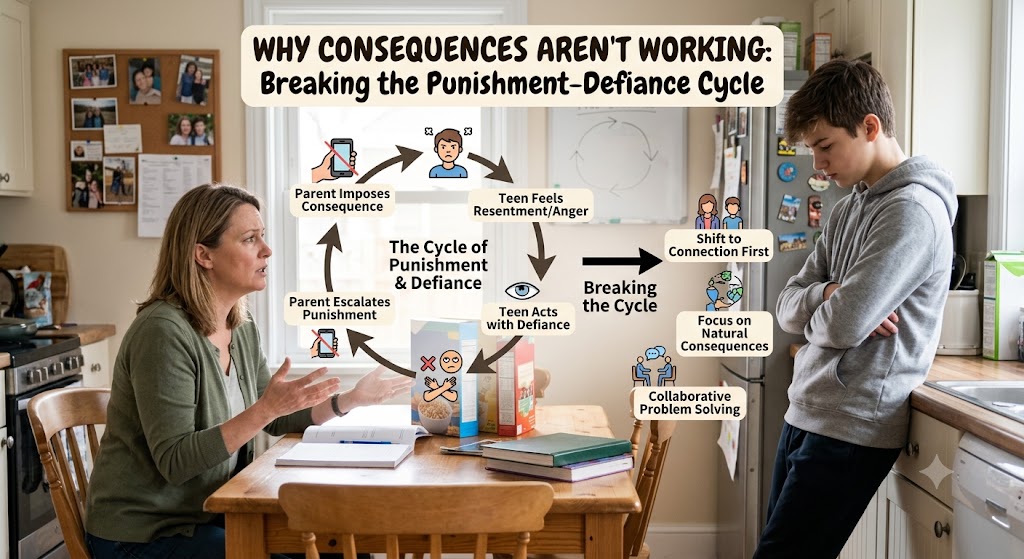
Breaking the Cycle
When Consequences Work — and Why
Why consequences stop working, and what tends to work in their place
Consequences are not inherently wrong. They are a valid parenting tool that works well in a specific context: a well-regulated child who is testing a boundary, has the capacity to comply, and needs a clear signal that the boundary is real.
A 10-year-old who knows the rule about screen time, has the ability to follow it, and is testing whether you will enforce it today — that child may benefit from the natural consequence of losing screen time when the rule is broken. The consequence provides information: this boundary is real, and breaking it has a predictable cost. The child adjusts.
This is how consequences are supposed to work. And for many children, in many situations, they do work. The problem begins when consequences stop working and parents do the only thing the model allows: escalate.
The Punishment-Defiance Cycle: How Escalation Makes It Worse
Psychologist Gerald Patterson documented this pattern decades ago and called it the coercive cycle. It works like this:
- Step 1: The parent makes a request. Something reasonable: do your homework, clean up your dishes, get ready for school.
- Step 2: The child resists. Argues, refuses, ignores, or escalates. The parent interprets this as defiance.
- Step 3: The parent escalates. Repeats the instruction louder. Threatens a consequence. Invokes authority. The emotional temperature rises.
- Step 4: The child escalates in response. Yells, argues harder, says something hurtful, slams a door, or shuts down entirely. Now both parent and child are dysregulated.
- Step 5: One of two things happens. Either the parent backs down (to end the fight) — which teaches the child that escalation works. Or the parent forces compliance through overwhelming authority — which produces resentment, damages the relationship, and teaches the child that the person with more power wins.
- Step 6: The cycle resets. The same interaction occurs the next day, often with both parties starting at a higher baseline of frustration. Each turn of the cycle makes the next turn faster, louder, and more entrenched.
Over weeks and months, this cycle produces exactly the opposite of what the parent wants: the child becomes more resistant to authority, the parent becomes more reactive, the relationship erodes, and the household organizes around conflict. The consequences are no longer teaching anything. They are just part of the fight.
What Escalating Consequences Actually Teaches Your Child
When the primary response to defiance is bigger consequences, the child learns specific lessons that work against the parent's goals:
Relationships are about power. The child learns that the person with more authority controls the outcome. This does not teach cooperation. It teaches either submission (compliance without internal agreement, which collapses as soon as the authority is absent) or resistance (the child decides they would rather endure the punishment than submit). Neither outcome is what you want.
Emotional regulation does not matter. When the parent escalates emotionally alongside the consequences, the child sees that adults also lose control when frustrated. The implicit message: it is acceptable to be reactive and punitive when someone does not do what you want. The child mirrors this in their own interactions.
Their experience does not matter. When consequences are the only response, the child's internal experience — the anxiety, the overwhelm, the inability to do what is being asked — is never addressed. The child learns that their feelings are irrelevant to the people with power over them. This produces disconnection, not compliance.
Endurance is a viable strategy. Many defiant children discover that if they can endure the consequence — sit through the grounding, survive without the screen, wait out the restriction — the situation eventually passes and nothing fundamental has changed. The child has learned to outlast the consequence rather than change the behavior. Some children even begin to view consequences as a cost of doing business: they have priced in the punishment and decided the defiance is worth it.
When Consequences Are Still the Right Tool
This page is not arguing that all consequences are wrong. It is arguing against relying on consequences as the primary or only strategy for persistent defiance. Here is when consequences are appropriate and effective:
The child can comply but is choosing to test the boundary. If you are confident that your child has the capacity to do what is being asked — the skill, the regulation, the understanding — and is choosing to test whether the rule is enforced, a clear, proportionate, predictable consequence is appropriate.
The consequence is natural and connected to the behavior. A child who refuses to come home on time loses the privilege of going out unsupervised the next day. A child who breaks a sibling's toy is expected to replace it with their own money or effort. These consequences teach cause-and-effect. They are not punitive — they are logical.
The consequence is delivered calmly, not in anger. A consequence delivered during a power struggle is a weapon. A consequence delivered after both parties are regulated is a teaching tool. The content is the same. The emotional context changes everything about how it lands.
The consequence is proportionate and enforceable. "You're grounded for a month" is not proportionate and you will not enforce it. "You lost screen time for tonight" is proportionate and you will follow through. Small, consistent, enforceable consequences are more effective than large, dramatic, unsustainable ones.
The consequence exists within a larger strategy. The consequence is one tool in a toolkit that also includes understanding what is driving the behavior, reducing unnecessary power struggles, building the child's missing skills, and maintaining the relationship. When consequences are the only tool, they fail. When they are one element of a comprehensive approach, they can support change.
The Alternative: From "Make Them Comply" to "Understand What Is in the Way"
The shift is not from discipline to permissiveness. It is from a compliance-first model to an understanding-first model. The expectations do not disappear. The homework still needs to happen. The chores still need to be done. The rules still apply. What changes is the intervention:
Instead of "Why won't you do what I asked?" ask "What is making this hard for you?" This single question shifts the entire dynamic. It communicates that you are interested in the obstacle, not just the outcome. It gives the child an opportunity to tell you something they may not have the language to volunteer. And it gives you information that makes your intervention more precise.
Instead of escalating the consequence, address the skill deficit. If the child cannot organize the task, help them break it into steps. If they cannot tolerate the demand, adjust the demand to something they can tolerate and build from there. If they are overwhelmed, reduce the number of demands to the ones that actually matter. This is not lowering your standards. It is matching your expectations to your child's current capacity and building from there.
Instead of winning the power struggle, exit the power struggle. State the expectation once. Do not repeat it. Do not argue about it. Do not engage in the back-and-forth that gives the power struggle its energy. If the child refuses, you can say: "I've told you what I need. I'm not going to argue. We can talk about it when you're ready." Then walk away. The expectation stands. The fight does not happen.
Instead of fixing the child, change the system. If the defiance has been entrenched for months, changing your individual responses may not be enough. The family interaction pattern — how you and your child and your co-parent and your other children all respond to each other — may need professional help to restructure. Parent coaching and family therapy are designed for exactly this. They change the system, and when the system changes, the child's behavior changes because the context they are responding to has changed.
If consequences were going to work, they would have worked by now. The fact that they have not is not a failure of your parenting. It is information.
Sources: Patterson (1982), coercive family process; Kazdin (2005, 2008), parent management training; Greene (2014), The Explosive Child (lagging skills model); AACAP oppositional defiant disorder practice parameter; Dishion & Patterson (2006), escalation dynamics.