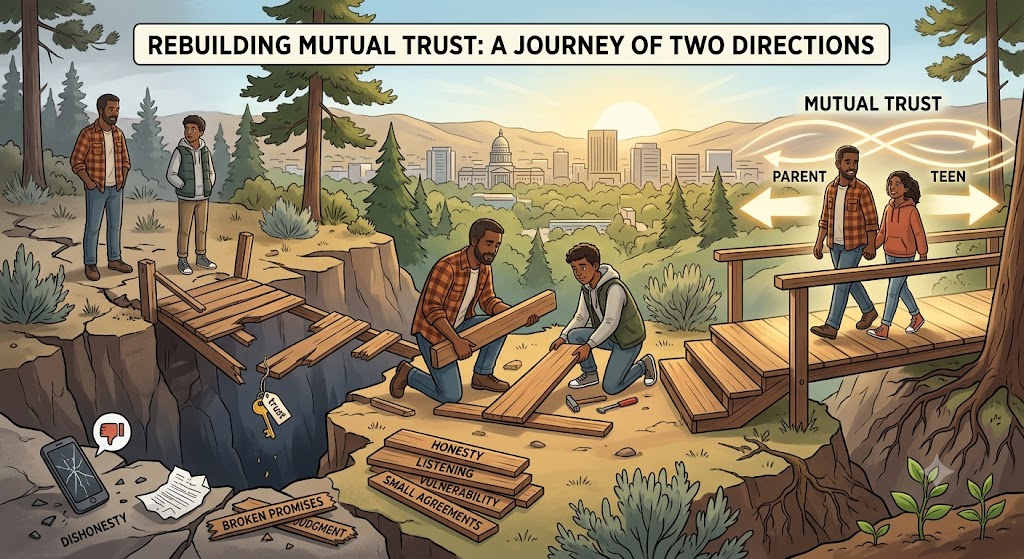
Rebuilding Trust With Your Teen

Why trust between parents and teens runs in both directions, what breaks it, and how to do the slow work of earning it back

Most articles about parent-teen trust assume the teen broke it. Reality is more complicated. Parents break trust with their teens regularly, often without realizing, and the work of rebuilding flows in both directions. This guide treats trust as the two-way thing it actually is, names the different ways it breaks, and walks through what rebuilding looks like in either direction. It is rarely fast. It is almost always possible.
Trust between parents and teens runs in both directions, and most articles only address one of them. Different kinds of trust violations need different responses. A single dramatic breach is different from gradual erosion, and both are different from trust that was never fully built. Trust rebuilds slowly, in small consistent actions over weeks and months, not in single conversations. When you are the parent who broke trust, the rebuild starts with naming specifically what you did, not with proving you've changed. Trust and autonomy are linked: teens earn freedom by demonstrating reliability, and parents earn their teen's trust by being safe to share with.

A Two-Way Street

Trust Is Two-Way

What breaks trust between parents and teens, and the slow work of earning it back

Most parenting content about trust starts with the assumption that the teen has done something to break it. That framing leaves out half of what's actually happening in most families. Parents break trust with their teens regularly. They share confidences with other adults that the teen thought were private. They make promises they don't keep, often for legitimate reasons. They side with a teacher or another adult against their teen without hearing the full story. They embarrass the teen in front of someone. They prioritize work or a younger sibling for stretches that the teen experiences as abandonment.

None of those make the parent a bad parent. They are normal parts of family life. They also break trust, and the breakage adds up. By the time a teen says "I don't trust you," they often mean something specific that started years ago and has been building.

The work of rebuilding trust requires honesty about which direction the trust gap is running. In many families, it runs in both directions at once. The teen has done things the parent struggles to trust. The parent has done things the teen has stopped trusting. Each side typically only sees their own grievance clearly.

The Different Ways Trust Breaks

Trust doesn't break in one way, and the type of breakage matters because each kind requires a different response.

The single dramatic violation. A teen gets caught lying about where they were. A parent learns about a substance use issue they weren't told about. Something specific happened, and both sides know what it was. Repair starts with naming the event and working through it.

The gradual erosion. Small disappointments accumulate over months or years. No single moment broke trust, but the pattern has. This is the harder one to repair because there is no single thing to address. The repair requires identifying the pattern and changing it consistently over time.

Trust that was never fully built. After a divorce, a separation, a long absence, or in a blended family, sometimes trust hasn't had the chance to develop. The teen may be polite but cautious. The parent may sense distance without knowing why. The work here isn't repair; it's foundational construction.

Cultural or generational drift. The teen feels that their parent doesn't understand who they are, what they care about, or what their life is like. The teen has stopped sharing not because of a specific incident but because they have concluded that what they would share won't be received well. This is one of the most common trust gaps and one of the least named.

When Your Teen Broke Trust

If your teen has done something that broke your trust, the most useful starting place is the long view. Lifelong trust between parents and adult children is not built in a single dramatic teenage incident. It is built in how families come back together after such incidents.

A few principles that consistently help:

Don't pretend it didn't happen. Naming the breach honestly, without minimization or escalation, is the foundation. "What you did was a real problem and we need to talk about how we get past it" is more useful than either ignoring it or making it the only thing you talk about for weeks.

Don't make the consequence permanent. Trust needs a ladder back up. A consequence with no path back teaches your teen that trust is a binary thing they can lose forever, which usually leads to further disengagement rather than reform. Time-bound consequences with clear conditions for restoring trust work better than indefinite ones.

Trust is earned back through repetition. Your teen will need to demonstrate reliability over time, in small ways, before larger trust returns. Watch what they do. Don't require them to perform contrition.

Don't bring it up repeatedly. Once the breach has been named and the path forward has been agreed on, raising it again every few weeks turns the original incident into an open wound. Hold your end of the rebuild by not relitigating.

When You Broke Your Teen's Trust

This is the part most articles skip. If you are the parent who broke trust, the work looks different, and it lasts longer. An apology can land in a single conversation. Trust returns over a season.

The starting move is to name specifically what you did. Generic regret ("I haven't been the parent I wanted to be") is much less useful than specific naming ("I shared what you told me with your aunt without asking you, and I shouldn't have done that"). Specificity tells your teen you actually know what you did.

After the apology, the rebuild is about consistent demonstration. Do the thing differently next time. Keep small promises. Don't share private things. Don't repeat the pattern. Your teen will be watching, and the watching will go on for longer than the conversation suggested. That is appropriate. Trust earned in conversation alone isn't trust; it's hope.

(For more on the apology piece specifically, see our resource on how to apologize to your teen.)

What Trust Rebuilding Actually Looks Like

Trust rebuilds in ordinary moments, not in big declarations. Watch for these signs:

Your teen tells you something small and low-stakes that they didn't have to tell you. The disclosure itself, regardless of content, is the signal. They're testing whether you can hold a small thing well.

Your teen comes to you with a problem rather than handling it alone. Even if the problem is minor, the choice to bring it to you is information.

Your teen's body language changes around you. They sit down rather than passing through. They linger in shared spaces. They make eye contact more often.

None of this happens because you said the right thing in a single conversation. It happens because you have been steady, present, and safe over a stretch of time.

When Professional Help Becomes Useful

Some trust gaps need more than what a parent can do alone.

When the violation was significant. Substance use, dangerous behavior, abuse history, or large unresolved family events often benefit from a third party who can help both sides find footing.

When the gap was created by trauma. Divorce, loss, abuse, or chronic conflict can damage trust in ways that require a therapist who understands trauma's effect on the nervous system.

When you've tried and it isn't working. Months of consistent effort without movement is a signal that something else is in the way. A family therapist can often see what the family can't.

Sources: Center for Parent and Teen Communication; Search Institute — developmental relationships research.


Frequently asked questions

Common questions
parents may have

Answers to some of the questions families often ask when trying to understand these challenges.

Why don’t coping skills always work?

The most common reasons: the skill does not match the function (a calming technique offered to a teen seeking sensation), the skill was introduced during a crisis rather than practiced beforehand, or the emotional intensity exceeded the skill’s capacity. When skills fail, it usually means the match or the timing needs adjustment — not that the teen is failing.

Why don’t coping skills always work?

The most common reasons: the skill does not match the function (a calming technique offered to a teen seeking sensation), the skill was introduced during a crisis rather than practiced beforehand, or the emotional intensity exceeded the skill’s capacity. When skills fail, it usually means the match or the timing needs adjustment — not that the teen is failing.

Why don’t coping skills always work?

The most common reasons: the skill does not match the function (a calming technique offered to a teen seeking sensation), the skill was introduced during a crisis rather than practiced beforehand, or the emotional intensity exceeded the skill’s capacity. When skills fail, it usually means the match or the timing needs adjustment — not that the teen is failing.

Frequently asked questions

Common questions

parents may have

Answers to some of the questions families often ask when trying to understand these challenges.

My teen says "I don't trust you" but I haven't done anything wrong. What's going on?
Blue plus sign icon with rounded edges on a white background.

This phrase rarely points to a specific incident. More often, it points to a feeling that has been building, perhaps for years. The teen may be telling you they don't feel safe sharing certain kinds of things with you, or that they feel judged when they have shared in the past, or that they don't feel known by you. The instinct is to defend or to ask for specifics. Try this instead: "Tell me more about that. What would help you feel safer being honest with me?" The question signals you're taking the statement seriously without immediately defending. Whatever your teen says next is the most important information you'll get about what's been going on underneath.

How do I know if trust is actually being rebuilt?
Blue plus sign icon with rounded edges on a white background.

Watch behavior, not words. Look for small unprompted disclosures, willingness to share when they don't have to, and a teen who comes to you with low-stakes information again. The first time your teen tells you something they didn't have to is usually the clearest sign. Don't make a big deal of it when it happens. The biggest mistake at this stage is overreacting to a small disclosure, which can teach your teen that sharing small things gets too much response. Receive it. Move on. Trust grows from there.

My teen broke a major trust. How much consequence is too much?
Blue plus sign icon with rounded edges on a white background.

Permanent loss of privileges rarely teaches what parents hope. It teaches that trust is binary and unwinnable, which usually pushes teens further away. Time-bound consequences with a clear path back work better. A useful test: can your teen describe what they need to do to begin earning the privilege back? If yes, the consequence is doing its job. If they cannot, the consequence is mostly punishment, and punishment alone rarely rebuilds trust. The goal is not to make the consequence painful enough to deter. It is to give your teen a path to demonstrate what you need to see.

Steps for doing the slow, two-way work of rebuilding trust with your teen:

Watch Behavior, Not Words

The most reliable signal of whether trust is rebuilding is what your teen does, not what they say. Look for small unprompted disclosures, willingness to share when they don't have to, and a return to the ordinary comfort you remember from before. Don't ask your teen to assess how the rebuilding is going. Watch. Their behavior will tell you the truth before their words will.

Build the Trust Ladder Incrementally

After a trust violation, restoration happens in steps. Return privileges in small increments, tied to specific demonstrated reliability. The first level back might be loosening a curfew by thirty minutes. The next might be returning driving privileges. Each step should be earned through demonstrated reliability at the previous level. Skipping the ladder usually pushes both sides back to where they started.

Name Your Own Trust Violations Specifically

If you broke your teen's trust, name what you did specifically. Generic regret doesn't land. "I shared what you told me with your aunt without your permission, and I shouldn't have done that" is the kind of naming your teen needs. The specificity tells your teen that you know what you did, not just that you regret some abstract failure of parenthood.

Keep Small Promises Without Fail

Trust is rebuilt in ordinary moments more than dramatic ones. Pay close attention to the small commitments you make to your teen, like picking them up on time, keeping something they told you in confidence private, or following through on a plan you mentioned. Each small promise kept is a deposit, and missed ones cost more than they did before. Reliability in the little things is what slowly convinces your teen that your word can be counted on again.

Explore helpful resources

Helpful guides and articles for families seeking more information and support.

should connect to any other Parent Resources articles.

Rebuilding trust after it has broken is patient work, and you do not have to navigate it alone. At Idaho Youth Ranch, our therapists help families understand what broke down and find a steady path back to each other.

Talk With Our Team

Ready to Start the Rebuild?

If trust has been frayed for long enough, or broken in ways that conversation alone hasn't repaired, we'd be glad to talk. There is no minimum level of difficulty before reaching out makes sense.

Outline of Idaho state inside a heart behind three person icons representing community or support.

For more than 70 years, we've stood beside Idaho's youth and families.

Hope. Healing. Resilience.

Blue phone handset icon with two curved lines indicating sound or call signal.

Call Now

Speak with our Team directly.

Best for families who want to talk through next steps, ask questions, or connect with admissions for the Residential Center for Healing & Resilience.