Do Well If They Can
Where Collaborative Problem Solving Came From
Dr. Ross Greene's framework for solving recurring problems together, not against each other
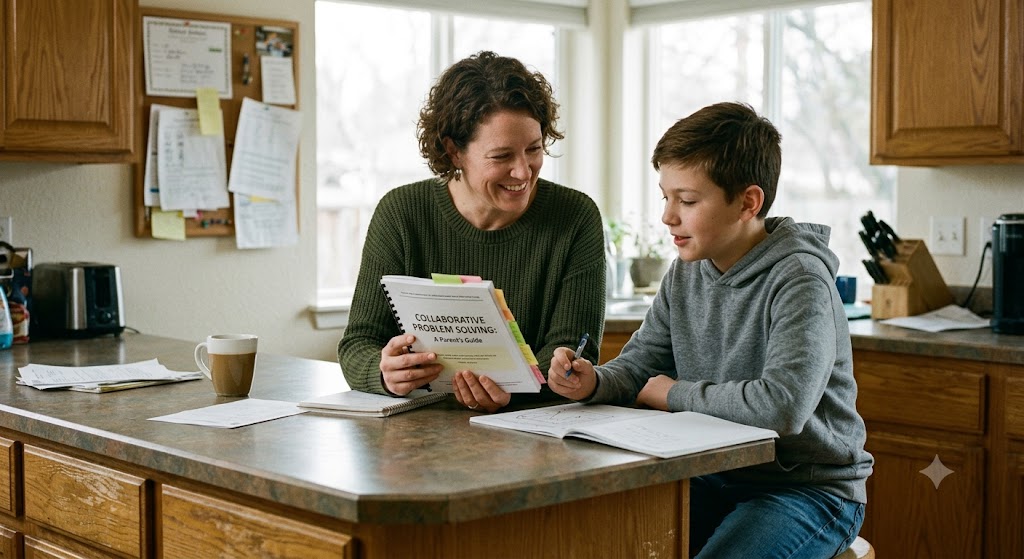
Collaborative Problem Solving was developed by Dr. Ross Greene, a clinical psychologist whose work began with kids and teens who had what professionals called "significant behavioral challenges." Greene's first book, The Explosive Child, was published in 1998. Later books, including Lost at School and Raising Human Beings, expanded the framework to apply to all kids and to school settings. The model is also referred to as Collaborative and Proactive Solutions; the acronym CPS stays the same.
What set Greene's work apart was a simple but radical observation. The traditional assumption behind nearly all behavioral interventions, in homes and in schools, was that kids who misbehave do so because they choose to, and the solution is to change their motivation through rewards or consequences. Greene's research showed something different: for many recurring behavioral problems, the kid is not choosing to misbehave. The kid is failing to meet the expectation because the skills required to do so are still developing. The required skills (frustration tolerance, flexibility, emotional regulation, social cognition) are not equally distributed in any group of kids and develop on different timelines.
"Kids Do Well If They Can"
The five-word version of CPS's premise is the title of this section: kids do well if they can. The implication is enormous. If a teen is repeatedly failing at something, the most useful question is not "how do I motivate them to do better" but "what skill is getting in the way, and what is our shared plan to address it."
This reframe changes everything about how parents respond. If a teen "won't" consistently complete homework, the question shifts from "how do we make them want to" to "what is making this hard for them, and what would help." The shift sounds small. In practice, it changes the conversation completely.
Greene's framing matters most for the situations that have been frustrating both sides for a long time. Most recurring parent-teen conflicts (over chores, screens, schoolwork, sibling friction, curfew) have continued to recur precisely because traditional motivation-and-consequence approaches haven't worked. The reason they haven't worked is that the underlying issue isn't motivation. It's a skill gap, an environmental fit issue, or a feeling the teen hasn't been able to name.
The Three Steps
CPS works through three sequential steps. Each one needs to be done well. The most common reason CPS fails in real households is that parents rush or skip the first step.
Step 1: The Empathy Step
Gather the teen's perspective on the problem. Not your solution. Not your judgment. Their view of what is going on. The phrasing parents most commonly use is some version of: "I've noticed [observable pattern]. What's up with that?" The work is then to listen, without interrupting, without defending, without fixing. Restate what you heard. Get curious. The empathy step is often the longest of the three, and most teens have not had a parent ask this kind of question in a long time, if ever.
Step 2: The Adult Concern Step
State your own concern clearly and briefly. One or two sentences. Not a lecture. Not an opening argument. The phrasing: "My concern is that [specific impact]." The work is to name your concern without piling on judgment, history, or what the teen "should" want.
Step 3: The Invitation Step
Invite the teen into shared problem-solving. The phrasing: "I'm wondering if there's a way to [address what they raised] and [address what I raised]. Got any ideas?" The work is to take their suggestions seriously. The solution should address both sides, not just yours.
Common Misunderstandings
Four objections come up almost every time parents are introduced to CPS:
"This is just letting them get their way." It is not. The adult concern stays on the table. The parent still holds authority. The difference is that the solution emerges from a real conversation rather than from a top-down rule. Many parents discover that solutions arrived at collaboratively actually hold better than the ones they would have imposed.
"This won't work on big behavioral issues." CPS was developed for kids with significant behavioral challenges. The depth of the empathy step is what makes it work in those cases. For smaller issues, parents can sometimes get by with traditional methods. For bigger and recurring issues, CPS is often the only thing that works.
"This is just negotiation." Different. Negotiation is two parties trading concessions. CPS is two parties solving a problem together. The empathy step explicitly comes before any solution-finding, which means both sides understand what the problem actually is before anyone tries to fix it.
"My teen won't engage with this." Sometimes they will not, at first. CPS works best when basic communication is already in place. If your teen is in shutdown or you are in active conflict, start with active listening or basic repair and work up to CPS over time.
When CPS Is the Right Tool (and When It Isn't)
CPS works best for recurring problems that have not been solved by traditional approaches. Daily friction over chores, screen time, school work, sibling conflict, curfew, friend choices. The pattern: the problem keeps coming back, both sides are frustrated, and the conversations that have happened so far have not produced a durable solution.
CPS is the wrong tool for safety emergencies (the teen is in danger now), for situations requiring immediate compliance (the car is in the driveway and you are leaving in two minutes), or for moments when either party is too emotionally activated to think. A useful test: if you have had the same fight three times in three weeks, CPS is probably the right tool. If you are in the middle of one of those fights right now, CPS is the wrong tool for this moment. Use it after both sides are calm.
How Idaho Youth Ranch Uses CPS in Family Work
At Idaho Youth Ranch, our therapists draw on CPS principles in our work with parents and teens. Two patterns consistently show up in real families. First, parents who fully take in the "kids do well if they can" reframe see different results than parents who treat CPS as a technique while still believing the underlying problem is willingness. The technique works because of the mindset behind it. Without the mindset, the three steps become another set of words. Second, the empathy step almost always needs more time than parents expect. Teens who are being asked their view by a parent for the first time often need a few minutes to even know what to say. Sitting with that silence is often where the real work happens.
Sources: Greene, R. The Explosive Child (1998); Lost at School (2008); Raising Human Beings (2016); Lives in the Balance (livesinthebalance.org); CPS Connection (cpsconnection.com).