How Trauma Affects the Body, Stress, and Health

Why your teen's headaches, stomachaches, and exhaustion may not be "just physical" — and what toxic stress is doing beneath the surface.

You have taken your teen to the doctor for the headaches. For the stomachaches before school. For the fatigue that does not go away no matter how much they sleep. The tests come back normal. Nothing is physically wrong. But the symptoms are real, and they keep coming back. If your teen has experienced adversity or trauma, the explanation may not be in their body — it may be in their stress response system. Trauma does not just affect the mind. It gets under the skin. Chronic stress from adverse experiences changes how the body produces hormones, fights infection, processes inflammation, and expresses genes. This page explains the physical pathway from trauma to symptoms, why your teen's body may be speaking a language their words cannot, and what can be done about it.
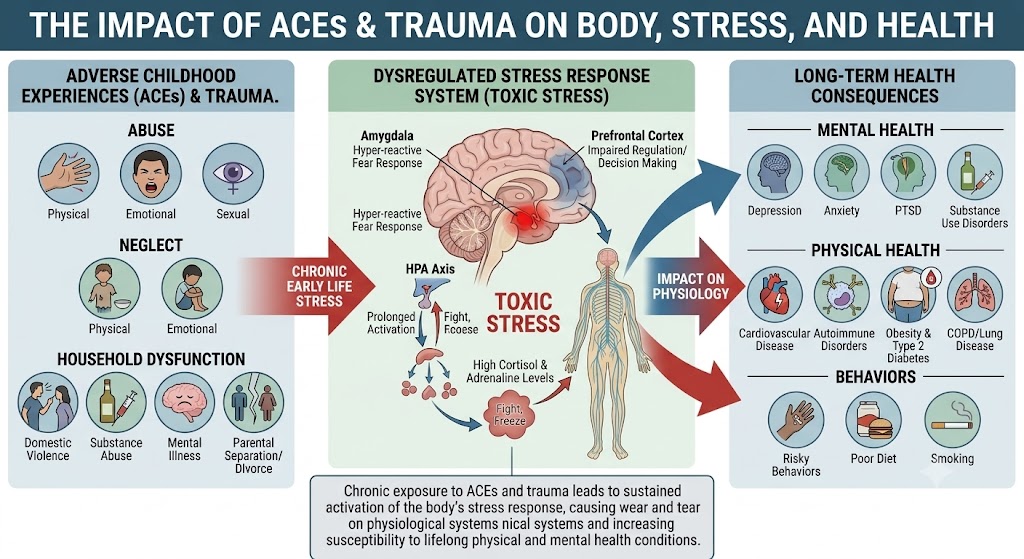
Trauma does not just affect the brain. It changes how the entire body functions — including the stress hormone system, the immune system, and gene expression. Toxic stress — chronic activation of the stress response without adequate buffering — is the mechanism by which adversity "gets under the skin." Common physical symptoms in trauma-affected teens include headaches, stomachaches, fatigue, sleep disruption, frequent illness, and chronic tension — often without medical explanation. ACEs significantly increase the risk of long-term health conditions including heart disease, autoimmune disease, chronic inflammation, and metabolic disorders. The physical changes are real but not permanent. Evidence-based therapy, safe relationships, and stable environments can begin to reverse the biological impact of toxic stress.

Not All Stress Is Equal

Not All Stress Is the Same

Why headaches, stomachaches, and exhaustion may not be just physical

Stress is a normal part of life and even a necessary part of development. But not all stress affects the body the same way. Understanding three types of stress helps explain why some adversity strengthens children and other adversity harms them:

Positive stress is brief and manageable. A difficult test, a sports competition, the first day at a new school. The heart rate rises, stress hormones spike briefly, and then the system returns to normal. Positive stress builds coping capacity when the child has supportive adults nearby.

Tolerable stress is more serious but still temporary. A family illness, a natural disaster, the death of a grandparent. The body's stress response activates for longer, but with the buffering of a caring, stable adult relationship, the system eventually returns to baseline. The experience is hard but does not cause lasting biological damage.

Toxic stress is what happens when adversity is severe, chronic, or repeated — and the child does not have adequate protective relationships to buffer the impact. The stress response system stays activated for weeks, months, or years. Without a "shut-off" signal, the body's systems are flooded with stress hormones continuously — and this prolonged activation begins to damage the very systems it was designed to protect.

Toxic stress is the bridge between adverse experiences and physical health problems. It is how trauma gets into the body.

How Toxic Stress Changes the Body

When the brain detects a threat, it activates the hypothalamic-pituitary-adrenal (HPA) axis — the body's central stress command system. This system floods the body with cortisol and adrenaline: the heart rate increases, breathing quickens, muscles tense, and the immune system shifts into emergency mode. This is the fight-or-flight response, and it is designed to be temporary.

Under toxic stress, the HPA axis stays activated. Cortisol stays elevated. The body remains in emergency mode for extended periods. Over time, this chronic activation produces measurable changes across multiple body systems:

The immune system

Chronic cortisol exposure suppresses normal immune function while simultaneously increasing inflammatory markers. The result: trauma-affected teens may get sick more often (weakened immunity) while also developing conditions driven by excessive inflammation — including asthma, autoimmune responses, eczema, and heightened allergic sensitivity.

The endocrine system

Prolonged stress hormone exposure disrupts the hormones that regulate growth, metabolism, and puberty. This can contribute to weight changes, disrupted growth patterns, and in some cases accelerated or delayed puberty. The body is diverting resources from development to survival.

The cardiovascular system

Sustained elevation of cortisol and adrenaline raises blood pressure and heart rate chronically. Over years, this increases the risk of cardiovascular disease. The original ACE study found that adults with four or more ACEs had double the risk of heart disease — even after controlling for traditional risk factors like smoking, diabetes, and cholesterol.

The digestive system

The gut has its own nervous system (the enteric nervous system) that is directly connected to the brain's stress response. Chronic stress disrupts gut function, producing the stomachaches, nausea, appetite changes, and digestive issues that are among the most common physical complaints in trauma-affected children. Research shows that stomachaches are one of the most prevalent somatic symptoms in adolescents with ACE exposure.

The Symptoms Parents Are Seeing Right Now

While the long-term health risks are serious, the symptoms parents notice today are usually the everyday physical complaints that bring them to the pediatrician:

  • Chronic headaches — the most commonly reported somatic symptom in adolescents with ACE exposure
  • Persistent fatigue and exhaustion — even with adequate sleep, because the body is spending energy on chronic stress activation
  • Stomachaches, nausea, and digestive issues — especially before school or stressful situations
  • Sleep disruption — difficulty falling asleep, staying asleep, nightmares, or sleeping too much
  • Frequent illness — colds, infections, and other signs of suppressed immune function
  • Chronic muscle tension, jaw clenching, or back/neck pain — the body holding stress physically
  • Unexplained skin conditions — rashes, eczema flares, or hives associated with stress

The critical point for parents: these symptoms are real. They are not imagined, exaggerated, or "all in their head." The body is genuinely in distress because the stress response system is chronically activated. The medical tests come back normal because the cause is not a disease — it is a stress response that has become the body's default mode.

How Trauma Changes Gene Expression: The Epigenetics Story

One of the most striking discoveries in ACE research is that trauma changes not just how the body functions today, but how genes are expressed going forward. Epigenetics refers to chemical modifications that attach to DNA and turn specific genes on or off — without changing the DNA sequence itself. These modifications respond to environmental conditions, including chronic stress.

Yale researchers found that children exposed to chronic toxic stress showed changes in gene expression across the entire genome — affecting not just stress-related genes but genes implicated in immune function, inflammation, and a wide array of diseases. Animal studies have shown that these epigenetic changes can even be passed to the next generation, meaning trauma's biological legacy can extend beyond the person who experienced it.

But here is the critical finding for parents: epigenetic changes are reversible. Studies of adults who received successful trauma-focused therapy showed measurable restoration of epigenetic markers in genes affected by chronic stress. The implication is profound: therapy does not just change how your teen feels. It can begin to reverse the biological changes that trauma caused at the genetic level.

The Long-Term Health Risks of ACEs

The original ACE study and hundreds of studies since have documented a dose-response relationship between ACEs and long-term health outcomes. Among adults with four or more ACEs, the risk increases are striking:

  • Heart disease: 2x the risk
  • Stroke: 2.4x the risk
  • Chronic lung disease: 2.6x the risk
  • Depression: 4.5x the risk
  • Substance dependence: significantly elevated
  • Autoimmune disorders: elevated risk

People with an ACE score of seven or higher who do not smoke, do not drink, are not diabetic, and do not have high cholesterol still have a 360% greater risk of heart disease. This means the health impact of ACEs operates independently of lifestyle choices — the toxic stress itself changes the body's baseline risk.

Understanding this long-term picture is not about alarming parents. It is about making clear why addressing trauma now — during adolescence, when the brain and body are still developing and still plastic — is one of the most important investments in your teen's lifelong health.

Sources: Felitti et al. 1998 — original ACE study health outcomes; ACEs Aware / California — toxic stress framework; PMC 2024 — ACEs and somatic symptoms in adolescence; Yale — genome-wide gene expression changes; Burke Harris — The Deepest Well; epigenetic reversal with TF-CBT.


Frequently asked questions

Common questions
parents may have

Answers to some of the questions families often ask when trying to understand these challenges.

Why don’t coping skills always work?

The most common reasons: the skill does not match the function (a calming technique offered to a teen seeking sensation), the skill was introduced during a crisis rather than practiced beforehand, or the emotional intensity exceeded the skill’s capacity. When skills fail, it usually means the match or the timing needs adjustment — not that the teen is failing.

Why don’t coping skills always work?

The most common reasons: the skill does not match the function (a calming technique offered to a teen seeking sensation), the skill was introduced during a crisis rather than practiced beforehand, or the emotional intensity exceeded the skill’s capacity. When skills fail, it usually means the match or the timing needs adjustment — not that the teen is failing.

Why don’t coping skills always work?

The most common reasons: the skill does not match the function (a calming technique offered to a teen seeking sensation), the skill was introduced during a crisis rather than practiced beforehand, or the emotional intensity exceeded the skill’s capacity. When skills fail, it usually means the match or the timing needs adjustment — not that the teen is failing.

Frequently asked questions

Common questions

parents may have

Answers to some of the questions families often ask when trying to understand these challenges.

Should I mention ACEs to my teen’s pediatrician?
Blue plus sign icon with rounded edges on a white background.

Yes. If your teen has unexplained physical symptoms and a history of adverse experiences, sharing that context with the pediatrician can change the clinical picture entirely. Many pediatricians are increasingly ACE-aware and can screen for toxic stress, refer to trauma-informed mental health providers, and coordinate care that addresses both the physical symptoms and their underlying cause.

Can the physical health effects of ACEs be reversed?
Blue plus sign icon with rounded edges on a white background.

Many of them can be reduced or reversed, especially with early intervention. Trauma-focused therapy can lower cortisol levels, reduce inflammatory markers, and restore epigenetic changes. Safe, stable relationships help the stress response system recalibrate. The adolescent body and brain retain significant plasticity, which means the window for intervention during the teen years is valuable. The earlier the support begins, the more the body can recover.

What is the difference between stress and toxic stress?
Blue plus sign icon with rounded edges on a white background.

All children experience stress, and some stress is healthy for development. Toxic stress occurs when the stress response system is activated severely, chronically, or repeatedly without adequate buffering from supportive relationships. It is the absence of protection — not just the presence of adversity — that makes stress toxic. A child facing serious adversity with a stable, caring adult nearby experiences tolerable stress. The same adversity without that buffer becomes toxic.

Why does my teen have headaches and stomachaches when the doctor says nothing is wrong?
Blue plus sign icon with rounded edges on a white background.

Because the symptoms are being generated by the stress response system, not by a disease process. When the body is in chronic stress activation, it produces real physical symptoms — headaches, digestive distress, fatigue, tension — that are genuinely painful and disruptive. Medical tests designed to detect disease will come back normal because the cause is physiological stress, not pathology. These symptoms are real, and they respond to treatment that addresses the underlying stress.

Steps you can take when your teen's physical symptoms may be rooted in stress and trauma:

Take the physical symptoms seriously

Do not dismiss headaches, stomachaches, or fatigue as "in their head" or attention-seeking. The symptoms are real. Acknowledge them, seek appropriate medical evaluation, and if tests are normal, consider whether trauma or chronic stress may be the underlying cause.

Talk to the pediatrician about ACEs

Share what you know about your teen's history of adverse experiences. This gives the medical team essential context for understanding symptoms that have no apparent medical cause. Ask about ACE screening and referrals to trauma-informed mental health providers.

Support the basics that help the body regulate

Consistent sleep schedules, regular physical activity, nutrition, time outdoors, and reduced screen time before bed all support the body's stress response system. These are not cures for toxic stress, but they create the physical conditions that help the body begin to recalibrate.

Build calm into the day, not just the crisis

A body stuck in chronic stress needs regular signals that it is safe to power down, not just rescue in the hard moments. Look for small, repeatable ways to bring your teen's stress response back to baseline during ordinary days: a walk after dinner, a few minutes of slow breathing, time with a pet, music, or simply being outside. You are not trying to fix the symptoms in a single sitting. You are giving an overworked stress system frequent, brief chances to recover.

Explore helpful resources

Helpful guides and articles for families seeking more information and support.

should connect to any other Parent Resources articles.

When the medical tests come back normal but the symptoms persist, the cause may be one a therapist is trained to address. At Idaho Youth Ranch, our trauma-informed clinicians help teens whose bodies are carrying stress that words alone have not been able to reach.

Get Started

If Your Teen's Body Is in Distress, the Cause May Be Deeper Than the Symptoms

Our therapists help calm the stress response system that is driving the physical symptoms — addressing the trauma underneath so the body can begin to heal.

Outline of Idaho state inside a heart behind three person icons representing community or support.

For more than 70 years, we've stood beside Idaho's youth and families.

Hope. Healing. Resilience.

Blue phone handset icon with two curved lines indicating sound or call signal.

Call Now

Speak with our Team directly.

Best for families who want to talk through next steps, ask questions, or connect with admissions for the Residential Center for Healing & Resilience.