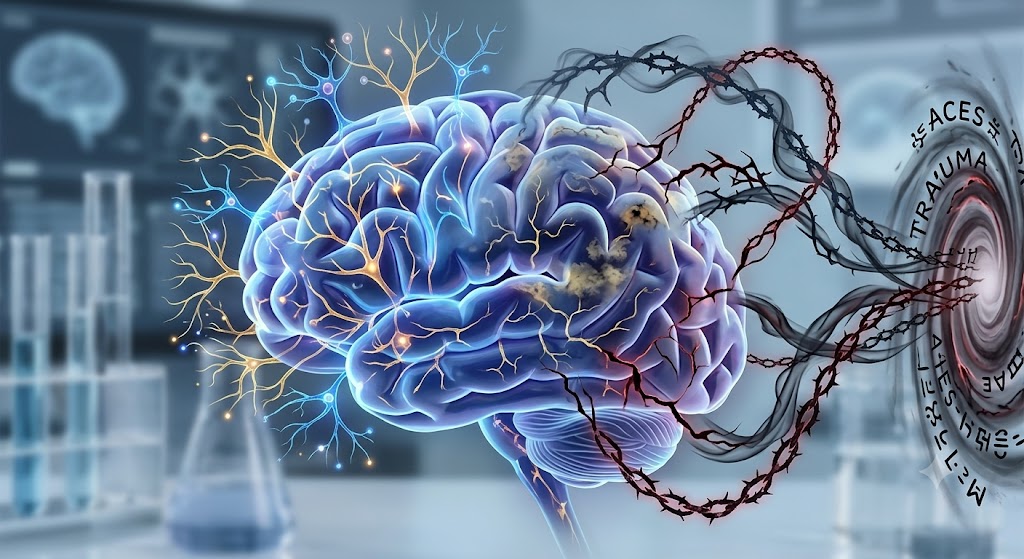
How Trauma and ACEs Affect Brain Development

Why your teen's brain is stuck in survival mode — and why that changes everything about how you understand their behavior.

If your teen has experienced adversity or trauma, their brain may be developing differently than you expect. Not because something is wrong with them. Because their brain did exactly what it was designed to do: it adapted to survive a threatening environment. The problem is that the adaptations that protected your teen during danger are now interfering with their ability to learn, regulate emotions, build relationships, and think clearly in everyday life. Understanding what is happening inside your teen's brain helps you see their behavior not as a choice but as a consequence of how their nervous system was shaped. And the most important thing to know: the same brain plasticity that allowed adversity to change the brain also allows healing to change it back.
Childhood trauma shifts the brain from "learning mode" to "survival mode" — prioritizing threat detection over thinking, learning, and emotional regulation. Three brain structures are most affected: the amygdala (alarm system), the prefrontal cortex (thinking brain), and the hippocampus (memory center). These changes explain why your teen may struggle with focus, impulse control, emotional regulation, memory, and overreaction to minor triggers. The changes are biological adaptations, not character flaws. Your teen is not choosing to be difficult — their brain is operating the way it was wired by experience. The brain retains plasticity throughout adolescence. With the right support, the neural pathways can be rewired — therapy can literally change the brain.

Two Operating Modes

The Learning Brain vs. the Survival Brain

The difference between the learning brain and the survival brain, and why it matters

Every brain has two operating modes. Think of them as the learning brain and the survival brain.

The learning brain is curious, focused, and flexible. It can pay attention in class, solve problems, manage emotions, read social cues, and plan ahead. It is the brain that learns, grows, makes friends, and builds a future. The learning brain is powered primarily by the prefrontal cortex — the most evolved part of the brain, responsible for reasoning, impulse control, and emotional regulation.

The survival brain is vigilant, reactive, and rigid. It is scanning for danger, bracing for the next threat, and ready to fight, flee, or freeze at any moment. It does not care about homework, social norms, or long-term consequences. Its only job is to keep the teen alive right now. The survival brain is powered primarily by the amygdala — the brain's alarm system, designed to detect threats and trigger protective responses.

In a healthy developing brain, the learning brain is in charge most of the time, with the survival brain activating only when there is a genuine threat. But when a child grows up in an environment of chronic adversity — abuse, neglect, family instability, violence, or unpredictability — the survival brain takes over. It becomes the default operating mode because the brain has learned that the world is dangerous and staying alert is the only way to stay safe.

This is not a malfunction. It is an adaptation. The brain is doing exactly what it was designed to do in a threatening environment. The problem is that the adaptation persists long after the threat has passed, and it interferes with everything the learning brain needs to do.

Three Brain Structures That Change Under Trauma

Research consistently identifies three regions most affected by childhood adversity. Understanding what each one does — and how trauma changes it — helps explain the specific struggles parents see in their teens.

The Amygdala: The Alarm System

The amygdala's job is to detect threats and trigger the body's protective response. In a trauma-affected teen, the amygdala becomes hyperactive — enlarged, hair-trigger sensitive, constantly scanning for danger. It fires in response to situations that are not actually threatening: a raised voice, a closed door, an unexpected change in plans, a teacher's stern look.

What parents see: A teen who startles easily, overreacts to small provocations, seems perpetually on edge, or has explosive emotional reactions that are out of proportion to the situation. The alarm is ringing constantly, even when nothing is wrong.

The Prefrontal Cortex: The Thinking Brain

The prefrontal cortex handles the brain's highest functions: impulse control, planning, decision-making, problem-solving, and emotional regulation. It is also the last brain region to fully develop, not maturing until the mid-20s. In teens who have experienced trauma, research shows reduced gray matter volume and decreased activity in the prefrontal cortex. The thinking brain is both structurally smaller and functionally less active.

What parents see: A teen who cannot control impulses, cannot think before acting, makes poor decisions under pressure, struggles to plan or organize, and seems unable to regulate their emotions. Teachers may describe them as "not applying themselves" or "not thinking." The truth is that the part of the brain responsible for those functions is compromised.

The Hippocampus: The Memory Center

The hippocampus processes and stores memories, especially contextual memories — the "when and where" of experience. It also helps distinguish between past and present, telling the brain "that was then; this is now." Under chronic stress, the hippocampus can be damaged by elevated cortisol levels, leading to reduced volume and impaired function.

What parents see: Difficulty concentrating. Poor working memory. Trouble retaining information. Academic decline that does not match the teen's ability. And critically: the teen's brain may struggle to distinguish a current safe situation from a past dangerous one, which is why everyday moments can trigger reactions that belong to the past.

What This Means for Your Teen's Daily Life

When the survival brain is running the show and the learning brain is suppressed, the effects touch everything:

  • School: the teen cannot focus, retain information, or manage the cognitive demands of the classroom — not because they are lazy, but because their brain is allocating resources to threat detection instead of learning
  • Emotions: reactions are intense, rapid, and difficult to control — the amygdala fires before the prefrontal cortex can assess whether the reaction is proportionate
  • Relationships: mistrust, hypervigilance, and difficulty reading social cues make forming and maintaining connections harder
  • Sleep: the survival brain does not want to rest — staying alert feels safer, which is why many trauma-affected teens have insomnia, nightmares, or disrupted sleep
  • Decision-making: with the prefrontal cortex compromised, impulse control is reduced and risk assessment is impaired

None of these are choices. They are the predictable outputs of a brain that was rewired by adversity. Understanding this changes the question parents ask from "Why won't they just try harder?" to "What does their brain need in order to function differently?"

The Brain Can Change Back: Neuroplasticity and Healing

The same brain plasticity that allowed trauma to change the developing brain also creates the opportunity for healing. Neuroplasticity — the brain's ability to form new connections and rewire existing ones — does not end in childhood. The adolescent brain retains significant plasticity, which means the window for intervention is open.

Evidence-based therapies like TF-CBT and EMDR help the brain reprocess traumatic memories, reduce amygdala reactivity, and strengthen prefrontal cortex functioning. Research on trauma-focused therapy has shown measurable restoration of epigenetic changes — meaning therapy does not just change how the teen feels; it can begin to reverse the biological changes that trauma caused.

Safe, stable relationships also reshape the brain. A consistently calm, regulated adult presence helps the teen's nervous system gradually learn that the world can be safe. Predictable routines reduce the amygdala's need to stay on alert. Experiences of success rebuild prefrontal cortex confidence. Over time, the learning brain reclaims territory from the survival brain.

This is not a metaphor. It is neuroscience. Your teen's brain was changed by what happened to them. And it can be changed again by what happens next.

Sources: Teicher et al. 2016 — brain regions most affected by maltreatment; PMC — neurobiological development in childhood trauma context; Nature 2025 — PFC development and mental illness; Yale — gene expression changes under toxic stress; epigenetics reversal with TF-CBT.


Frequently asked questions

Common questions
parents may have

Answers to some of the questions families often ask when trying to understand these challenges.

Why don’t coping skills always work?

The most common reasons: the skill does not match the function (a calming technique offered to a teen seeking sensation), the skill was introduced during a crisis rather than practiced beforehand, or the emotional intensity exceeded the skill’s capacity. When skills fail, it usually means the match or the timing needs adjustment — not that the teen is failing.

Why don’t coping skills always work?

The most common reasons: the skill does not match the function (a calming technique offered to a teen seeking sensation), the skill was introduced during a crisis rather than practiced beforehand, or the emotional intensity exceeded the skill’s capacity. When skills fail, it usually means the match or the timing needs adjustment — not that the teen is failing.

Why don’t coping skills always work?

The most common reasons: the skill does not match the function (a calming technique offered to a teen seeking sensation), the skill was introduced during a crisis rather than practiced beforehand, or the emotional intensity exceeded the skill’s capacity. When skills fail, it usually means the match or the timing needs adjustment — not that the teen is failing.

Frequently asked questions

Common questions

parents may have

Answers to some of the questions families often ask when trying to understand these challenges.

Can therapy actually change the brain?
Blue plus sign icon with rounded edges on a white background.

Yes. Neuroimaging studies show measurable changes in brain structure and function after successful trauma-focused therapy. Specifically, TF-CBT and EMDR have been shown to reduce amygdala hyperactivity, strengthen prefrontal cortex functioning, and in some cases restore epigenetic changes caused by chronic stress. The brain is not fixed. It is an organ that adapts to experience — and therapeutic experience is still experience.

Does trauma affect learning and school performance?
Blue plus sign icon with rounded edges on a white background.

Significantly. When the brain is in survival mode, it prioritizes threat detection over learning. The hippocampus (memory center) and prefrontal cortex (attention and planning) are both compromised, which directly affects concentration, working memory, information retention, and the ability to plan and organize. Many trauma-affected teens are capable learners whose brain architecture is working against them. Addressing the trauma often improves academic performance as a downstream effect.

Why can’t my teen just “calm down” or “try harder”?
Blue plus sign icon with rounded edges on a white background.

Because the brain structures responsible for calming down (prefrontal cortex) and thinking clearly (hippocampus) are the very structures compromised by trauma. Asking a trauma-affected teen to calm down is like asking someone with a broken leg to run. The capacity is genuinely impaired, not just suppressed. Building that capacity requires therapeutic support, not willpower.

Is the brain damage from trauma permanent?
Blue plus sign icon with rounded edges on a white background.

Not necessarily. The brain retains plasticity throughout adolescence and into adulthood. With the right intervention — therapy, safe relationships, and stable environments — the neural pathways affected by trauma can be strengthened and new connections formed. Research shows measurable brain changes after successful trauma-focused therapy. The earlier the intervention, the better the outcomes, but it is never too late to begin.

Ways to support a brain that learned to survive, so it can begin to feel safe again:

Be the regulated adult your teen's brain needs

The most powerful input for a survival-mode brain is a calm, regulated adult presence. Your teen's nervous system co-regulates with yours. When you are steady, their system begins to learn that the environment is safe. This does not mean being emotionless — it means managing your own activation so you can be the anchor rather than another source of threat.

Create predictability

The survival brain is on alert because it learned that the world is unpredictable and dangerous. Consistent routines, reliable follow-through, and advance notice of changes all reduce the amygdala's need to stay activated. Predictability is brain medicine.

Replace "Why won't you try harder?" with "What does your brain need?"

This reframe changes the entire dynamic. Your teen is not failing to try. Their brain is functioning in survival mode, which limits the cognitive and emotional resources available for learning, regulation, and decision-making. The question is not effort — it is capacity. Therapy builds capacity.

Make the home feel physically safe and calm

A survival-mode brain is constantly scanning the environment for threat, so the sensory world around your teen matters more than you might expect. Pay attention to the things that quietly keep their guard up: a chaotic, loud, or unpredictable household, sudden noise, or constant tension between adults. Where you can, lower the volume, reduce the chaos, and keep conflict away from your teen. A calmer environment gives an over-alert brain fewer reasons to stay braced and more room to settle.

Explore helpful resources

Helpful guides and articles for families seeking more information and support.

should connect to any other Parent Resources articles.

A brain changed by what happened can also change with the right support, and that is what good therapy is built to do. At Idaho Youth Ranch, our trauma-informed therapists help teens move out of survival mode and back toward learning, connection, and calm.

Get Started

Your Teen's Brain Was Changed by What Happened. Therapy Can Help Change It Back.

Our clinicians use evidence-based approaches that directly target the brain pathways affected by trauma — helping your teen's brain shift from survival mode to learning mode.

Outline of Idaho state inside a heart behind three person icons representing community or support.

For more than 70 years, we've stood beside Idaho's youth and families.

Hope. Healing. Resilience.

Blue phone handset icon with two curved lines indicating sound or call signal.

Call Now

Speak with our Team directly.

Best for families who want to talk through next steps, ask questions, or connect with admissions for the Residential Center for Healing & Resilience.