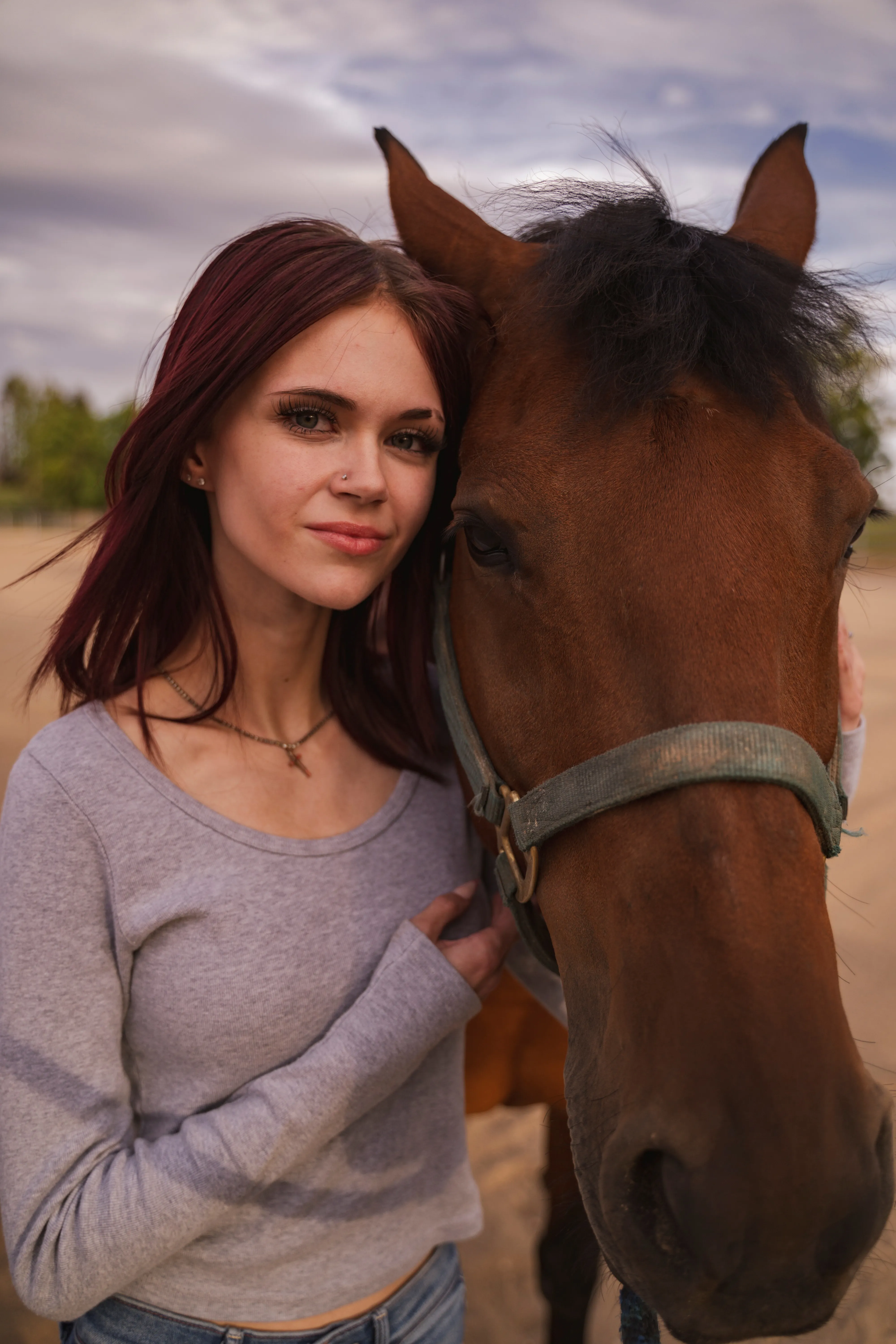
EAP sessions are different from anything else we offer. Sessions take place outdoors or in a covered arena. They typically run 60 to 90 minutes. Your young person works in jeans and closed-toe shoes, and is welcome to interact with the horses however the work calls for, petting, grooming, observing, walking alongside, or simply sharing space.
First Session / Assessment
The first session is part orientation and part observation. The clinician and equine specialist meet your young person, walk through what to expect, and introduce the horses they’ll be working with. There’s no pressure to "do" anything specific. Some young people are eager to be in the arena right away; others need time to acclimate. Both are fine. The first session usually runs 60 to 90 minutes and often includes the parent or caregiver for at least part of it.
Early Sessions
The first few sessions focus on building familiarity, with the horses, the space, the clinician, and the equine specialist. Activities may be simple: choose a horse to spend time with, notice what they do, what you notice about yourself. The clinician helps your young person begin to make connections between what’s happening in the arena and what’s happening in their life. Pace varies. Some young people open up quickly; others take weeks.
Middle Sessions
As trust builds, the work tends to deepen. Activities may become more specific, building obstacle courses that represent challenges, working through scenarios that connect to family dynamics, navigating relationships between horses that mirror relationships in your young person’s life. The horses respond to whatever’s actually happening, which often surfaces things that have been hard to access in talk therapy. Sessions are unpredictable; that’s part of how the work moves.
Later Sessions
In the later phase of an EAP program, the work consolidates. Your young person becomes able to apply what they’ve experienced with the horses to situations outside the arena. The clinician helps name the patterns, identify which strategies are useful in daily life, and prepare for what will support continued growth after sessions end. Some young people transition to a less frequent maintenance schedule; some step down to a different therapy approach for ongoing care.
Parent/Caregiver Role
Parent and caregiver involvement varies depending on the format. In individual EAP, parents typically have separate check-ins with the clinician but aren’t in the arena during sessions. In family EAP, parents are participants alongside their young person, sometimes the family works with the horses together; sometimes parents observe specific activities that surface family dynamics. The clinician will be clear about your role from the start.
Between-Session Practice
EAP doesn’t typically involve homework in the way CBT or DBT does. What carries forward between sessions is what your young person noticed in the arena, and the clinician may suggest brief reflection prompts or invite your young person to watch for the patterns in everyday situations. Some clinicians use journaling between sessions; others don’t. The work is experiential first.