Why Teens Go Quiet
Why Teens Go Quiet
What's usually behind the silence, and how to invite conversation without pushing
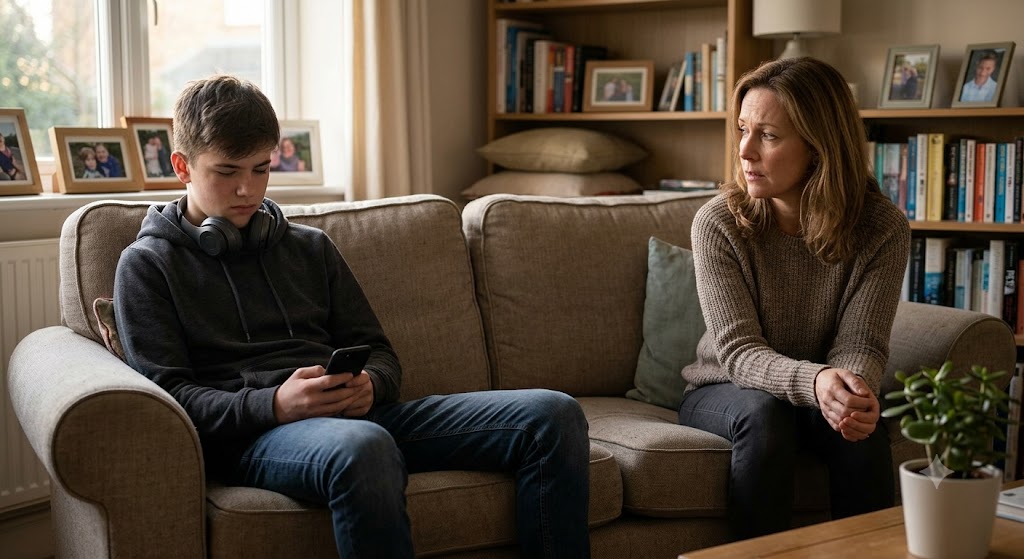
Teen silence rarely shows up out of nowhere. Most of the time, it's the surface of something underneath: a teen who's overloaded and has nothing left to give, a teen who's worried about how a parent will react, a teen who's protecting a friend or hiding a mistake, or a teen who's still processing something they don't have language for yet. The silence isn't the problem. It's the signal that something else is going on, and that your teen has decided, consciously or not, that staying quiet is safer than risking the conversation.
Understanding that distinction changes what to do. If you treat silence as the problem to solve, you'll keep pushing on the door. If you treat it as a signal, you'll start asking what's behind it, and the methods that work are almost always indirect.
The Different Kinds of Teen Silence
Not all silence is the same. Five patterns show up most often:
Depleted silence. Your teen has used up their social and emotional energy at school, and they have nothing left for conversation when they get home. Most common in the first hour after school, after social events, or during periods of high academic load. It's not personal. It's a fuel gauge.
Protective silence. Your teen is avoiding a topic because they're worried about how you'll react. Often shows up around grades, friend dynamics, a romantic relationship, a mistake they made, or a feeling they don't think you'll understand. The silence is specifically content-based. They'll talk about plenty of other things, just not this.
Selective silence. Your teen will talk to your partner, a sibling, an aunt, a coach, a friend's parent, but not you. This usually points to a specific relational dynamic between you and your teen, not a global communication problem. Sometimes it's about who happens to be around at the right time. Sometimes it's about who lectures less. It's worth paying attention to without taking it personally.
Distrustful silence. Your teen has shared something honestly in the past and gotten lectured, corrected, judged, or dismissed. They've learned that sharing doesn't lead anywhere good. This kind of silence often shows up after a specific incident the parent may not even remember, but the teen does.
Distressed silence. Your teen has gone quiet across the board. With you, with friends, with people they used to be close to. Things they used to enjoy aren't bringing the same response. This pattern is different from the others and warrants a closer look. (See the deep guide FAQ on the difference between normal withdrawal and concerning withdrawal.)
What Doesn't Work, and Why
Most of what parents instinctively reach for makes silence worse:
The big sit-down talk. Announcing "we need to talk" puts a teen on the defensive before the conversation starts. The setup signals you've prepared, they haven't, and something they may not like is coming.
The interrogation. Stacking questions on top of one-word answers ("how was your day, what did you do, who were you with, why don't you ever tell me anything") feels to a teen like being cornered. It produces more one-word answers, not fewer.
The blanket invitation. "You can always talk to me about anything" is meant kindly. To a teen, it can land as pressure and a tacit accusation that they aren't. A teen who isn't talking knows they aren't talking. They don't need it pointed out.
The phone confiscation. Taking the phone in hopes of forcing connection almost always backfires. It punishes the symptom, raises the conflict temperature, and gives the teen another reason to retreat.
The family meeting. Calling everyone together to talk about how no one is talking is a Trojan horse for a parent's monologue. Teens know what these meetings are. They show up, wait it out, and leave.
What Does Work: The Low-Stakes Invitation
The methods that work share a feature: they don't require the teen to perform a conversation. They lower the cost of saying something.
Get side-by-side. Research on adolescent communication consistently shows that teens open up more easily when they aren't facing direct eye contact. Cars are famous for this. So are walks, kitchens, late-night drives, and any activity where attention is on something else. Side-by-side conversation feels lower-stakes because either person can stop talking and the moment doesn't collapse.
Be the predictable one. Teens who don't want to talk now often start talking later, if a parent has stayed consistently warm, present, and non-pushy in the meantime. Showing up at games, offering rides, asking about something the teen actually cares about, leaving the door open without commenting on it being open. The quiet investment is doing more work than it looks.
Ask the small question, not the big one. "How was your day" produces "fine." "What's something funny that happened today" produces something more. Specific, low-pressure, non-evaluative questions get past the autopilot.
Let the silence happen. When your teen says something that opens a door, the most powerful move is often to say very little. A nod, a "hm," or a single quiet question lets them keep going. Filling the space with your own thoughts shuts it down.
When Silence Means More
Most teen silence is normal adolescent development. Some isn't. If your teen has gone quiet across the board (with friends and family and previously enjoyed activities) for more than a couple of weeks, that's a different pattern. Loss of energy, changes in sleep or appetite, dropping interests, and pulling away from people they used to be close to are the patterns that warrant a closer look. The deep guide and the parent concern page both cover this in more detail.
Sources: Search Institute — Developmental Relationships Framework; CDC — research on adolescent connectedness as a protective factor.