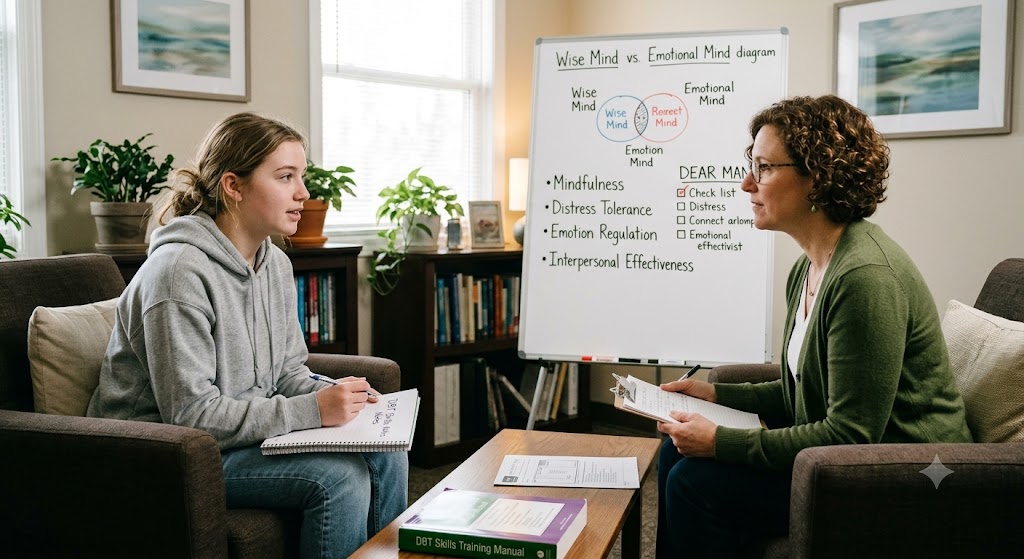
DBT for Suicidal Youth: How It Works and What Parents Should Know

Dialectical behavior therapy is the strongest evidence-based treatment for recurrent suicidality in young people. Here is what it involves, what the evidence shows, and what your role is as a parent.

When your child's suicidal thinking is not a one-time crisis but a recurring pattern — when the urges come back, when previous interventions have not held, when you live in fear of what each day might bring — you need a treatment that was designed specifically for this. Dialectical behavior therapy (DBT) is that treatment. Over two decades of research demonstrates that DBT significantly reduces suicide attempts, suicidal thinking, self-harm, and depression in young people with chronic suicidality. In multiple studies, 70–80% of suicidal youth receiving DBT achieved complete remission of suicidal thoughts. This page explains how DBT works, what your child will experience in treatment, and what you can do as a parent to support the process.
DBT was specifically designed to treat chronic suicidality. It is the most evidence-based therapy for young people with recurrent suicidal thinking and behavior. In multiple studies, 70–80% of suicidal youth receiving DBT achieved complete remission of suicidal thoughts and urges. DBT has four components: individual therapy, multi-family skills group, phone coaching during crises, and a therapist consultation team. All four work together. The four skill modules — mindfulness, distress tolerance, emotion regulation, and interpersonal effectiveness — give your child real alternatives to suicide when pain feels unbearable. Parent involvement is essential. DBT-A (the adolescent adaptation) includes families in skills training so the language and techniques are reinforced at home.

A Different Approach

Why DBT Is Different from Other Therapies

Why DBT was built for suicidality in a way other therapies were not

Most therapies were not designed specifically for suicidality. Traditional talk therapy helps with many conditions, but when a young person is in a recurring cycle of suicidal crises, standard approaches often fall short. DBT was built from the ground up for exactly this population.

The core philosophy of DBT rests on a dialectic — a balance between two truths that seem contradictory but are both valid. For suicidal youth, the dialectic is: your pain is real and makes sense (validation) AND you need to learn new ways to manage it (change). Most suicidal young people have experienced one extreme or the other — either their pain is dismissed ("You have nothing to be upset about") or they are pushed to change without acknowledgment of how they feel ("Just stop thinking that way"). DBT holds both: your feelings are valid, and we are going to build the skills that make them survivable.

The Four Components of DBT

DBT is not a single weekly therapy session. It is a comprehensive treatment structure with four interlocking components, each serving a specific function:

1. Individual therapy (weekly)

Your child meets with a DBT-trained therapist for 50-minute sessions one to two times per week. These sessions focus on the specific situations that triggered suicidal thinking since the last session, what skills were used (or could have been used), and what comes next. The therapist also conducts regular suicide risk assessments. Individual therapy is where the personal work happens — applying the skills to your child's specific life circumstances.

2. Multi-family skills training group (weekly)

Your child attends a 2–2.5-hour skills training class each week alongside other young people and their families. The group format is educational, not confessional — nobody is asked to share their personal crises. The focus is learning and practicing the four skill modules together. The family component is what makes DBT-A (the adolescent adaptation) different from adult DBT: parents learn the same skills so they can reinforce them at home and communicate in a shared language.

3. Phone coaching (as needed)

Your child has access to their individual therapist between sessions for in-the-moment coaching during crises. When a suicidal urge strikes at 10 pm on a Tuesday, your child can call their therapist for real-time help applying skills to the situation. This bridges the gap between weekly sessions and real life — the place where crises actually happen.

4. Therapist consultation team (weekly)

The DBT therapists meet weekly to review cases, problem-solve, and support each other in providing effective treatment. This component is invisible to families but essential to quality: it prevents therapist burnout and ensures consistent, high-quality care for a population that is demanding to treat.

The Four Skill Modules: What Your Child Will Learn

The skills curriculum is the engine of DBT. Each module teaches specific techniques that give your child alternatives to suicide when pain feels unbearable:

Mindfulness

The foundation skill. Mindfulness teaches your child to observe their emotions without being controlled by them — to notice "I am feeling intense pain right now" without immediately acting on the urge to make it stop. It introduces the concept of Wise Mind: the balance between emotional mind (pure feeling) and rational mind (pure logic). Suicidal crises happen in emotional mind. Mindfulness creates the pause that allows Wise Mind to engage.

Distress tolerance

These are the survival skills for moments of acute crisis — the techniques your child uses when the pain is at its worst and the urge to act is strongest. Distress tolerance does not make the pain go away. It makes the pain survivable long enough for the crisis to pass. Techniques include TIPP (changing body temperature, intense exercise, paced breathing, paired muscle relaxation), distraction skills, self-soothing through the five senses, and radical acceptance.

Emotion regulation

While distress tolerance addresses acute crises, emotion regulation addresses the ongoing vulnerability to emotional overwhelm. Your child learns to identify and name emotions accurately, reduce vulnerability to emotional extremes (through sleep, nutrition, exercise, and routine), and change emotional responses when they are not serving them. Over time, emotion regulation reduces the frequency and intensity of the crises that trigger suicidal thinking.

Interpersonal effectiveness

Many suicidal young people feel unable to get their needs met in relationships, to say no without destroying the relationship, or to maintain self-respect while navigating conflict. Interpersonal effectiveness teaches specific scripts and frameworks for asking for what you need, saying no, and managing conflict — reducing the relational pain that often fuels suicidal thinking.

What the Evidence Shows

The research base for DBT with suicidal youth is extensive and consistent:

  • In multiple studies, 70–80% of suicidal youth receiving DBT achieved complete remission of suicidal thoughts and urges.
  • DBT significantly reduces suicide attempts, self-harm, depression, and anger in adolescents with recurring suicidality.
  • Young people receiving DBT are far less likely to require psychiatric hospitalization compared to those receiving standard care.
  • DBT consistently outperforms routine clinical care and general talk therapy for suicidal youth in controlled studies.
  • The gains from DBT tend to be durable — improvements in suicidal thinking and behavior are maintained after treatment ends.

These outcomes give parents something that is difficult to find when your child is suicidal: evidence-based hope. DBT does not just manage the crisis. It builds the skills that make crises less frequent, less intense, and more survivable over time.

What to Expect as a Parent

The first weeks may be uncomfortable

Starting DBT means your child is engaging with emotions they have been trying to escape through suicidal thinking. The early weeks can surface intense feelings. This is not a sign that DBT is making things worse. It is a sign that the process is reaching the material that needs to be addressed. The phone coaching component exists precisely for these moments.

Progress is gradual, not dramatic

You will not see a sudden transformation. What you will see, over weeks and months, is a gradual shift: your child using a skill instead of spiraling, recognizing an urge without acting on it, tolerating distress for a few minutes longer than before. These shifts are the evidence that treatment is working.

Setbacks are expected and informative

A suicidal crisis during DBT is not a failure of treatment. It is data. The therapist will analyze what happened, what skills were available, what got in the way, and what can be done differently next time. DBT treats setbacks as learning opportunities, not evidence that the treatment is not working.

Your participation is not optional

DBT-A includes families for a reason: the skills your child learns in group need to be reinforced at home. If your child uses a distress tolerance skill and you respond with "Stop being dramatic," the skill is undermined. If you learn the same language and support the skill use, it becomes exponentially more effective. Attend every family skills session. Learn the vocabulary. Practice alongside your child.

The commitment is significant but finite

A standard DBT program runs 16–20 weeks. Some young people benefit from a second cycle. The time investment — individual sessions, group sessions, between-session practice — is substantial. But for a young person whose alternative is recurring suicidal crises and potential hospitalization, DBT represents a structured path forward that routine care does not provide.

DBT does not just manage the crisis. It builds the skills that make crises less frequent, less intense, and more survivable over time.

Sources: Linehan 1993 — original DBT development; Miller, Rathus, & Linehan 2007 — DBT-A adaptation; Kothgassner et al. 2021 — meta-analysis (g=−0.44); McCauley et al. 2018 — DBT vs. individual/group supportive therapy for suicidal adolescents; Mehlum et al. 2014, 2019 — DBT-A RCT.


Frequently asked questions

Common questions
parents may have

Answers to some of the questions families often ask when trying to understand these challenges.

Why don’t coping skills always work?

The most common reasons: the skill does not match the function (a calming technique offered to a teen seeking sensation), the skill was introduced during a crisis rather than practiced beforehand, or the emotional intensity exceeded the skill’s capacity. When skills fail, it usually means the match or the timing needs adjustment — not that the teen is failing.

Why don’t coping skills always work?

The most common reasons: the skill does not match the function (a calming technique offered to a teen seeking sensation), the skill was introduced during a crisis rather than practiced beforehand, or the emotional intensity exceeded the skill’s capacity. When skills fail, it usually means the match or the timing needs adjustment — not that the teen is failing.

Why don’t coping skills always work?

The most common reasons: the skill does not match the function (a calming technique offered to a teen seeking sensation), the skill was introduced during a crisis rather than practiced beforehand, or the emotional intensity exceeded the skill’s capacity. When skills fail, it usually means the match or the timing needs adjustment — not that the teen is failing.

Frequently asked questions

Common questions

parents may have

Answers to some of the questions families often ask when trying to understand these challenges.

How long does DBT take to show results?
Blue plus sign icon with rounded edges on a white background.

Most families begin to see measurable shifts within the first 8–12 weeks: fewer crises, use of skills during difficult moments, and gradual reduction in suicidal thinking. Full treatment typically runs 16–20 weeks. Some young people benefit from a second cycle. The timeline depends on the severity and complexity of your child’s situation, but the evidence consistently shows that DBT produces meaningful change within a standard treatment course.

What if my child has already tried therapy and it did not work?
Blue plus sign icon with rounded edges on a white background.

Many young people who enter DBT have tried other therapies without success. DBT is specifically designed for this population. If previous therapy involved general talk therapy, CBT for depression, or supportive counseling, it may not have included the structured skills training and between-session crisis coaching that DBT provides. The evidence shows that DBT works for young people for whom other approaches have not been sufficient.

How is DBT different from regular therapy?
Blue plus sign icon with rounded edges on a white background.

Standard therapy typically involves weekly individual sessions focused on processing feelings and gaining insight. DBT is a comprehensive program with four components (individual therapy, skills group, phone coaching, and consultation team), a structured skills curriculum, and a specific focus on building behavioral alternatives to suicidal action. The skills training component — especially the multi-family group — has no equivalent in standard talk therapy.

Is DBT only for teens, or does it work for younger children too?
Blue plus sign icon with rounded edges on a white background.

DBT-A was originally designed for adolescents ages 12–18, but adaptations exist for younger children as well. The core principles — validation, skills training, and balancing acceptance with change — are developmentally appropriate across a range of ages when delivered by trained clinicians. If your child is younger than 12 and experiencing suicidal thinking, a DBT-informed approach may still be appropriate. Discuss options with a provider who specializes in this age group.

Ways to support your child's DBT treatment and reinforce the work at home:

Attend every family skills session

The multi-family skills group is not optional parent education. It is a core treatment component. When you learn the same skills your child is learning, you create a shared language and a home environment that reinforces the therapeutic work. Your attendance directly impacts your child's outcomes.

Learn the skills vocabulary

DBT uses specific terms: Wise Mind, TIPP, radical acceptance, distress tolerance, opposite action. When your child says "I need to use TIPP right now," you need to know what that means and how to support it. When they are practicing opposite action, you need to recognize and encourage it rather than questioning the behavior.

Validate before you problem-solve

DBT teaches that validation must come before change. When your child expresses pain, the first response should acknowledge the pain ("That sounds really hard"), not fix it ("Have you tried..."). This is one of the hardest shifts for parents because your instinct is to make the pain stop. But validation is what creates the safety your child needs to engage with change.

Use the skills yourself, in front of your child

DBT skills are not only for your child. When you are stressed or upset, name what you are doing out loud: "I'm feeling overwhelmed, so I'm going to use some slow breathing," or "I need to find Wise Mind before I answer that." Modeling the skills shows your child they are normal tools for everyone, not a sign that something is wrong with them. It also helps you stay regulated, which makes you a steadier presence in the moments your child needs you most.

Explore helpful resources

Helpful guides and articles for families seeking more information and support.

should connect to any other Parent Resources articles.

DBT works best when the whole family is part of it, and you do not have to learn it alone. At Idaho Youth Ranch, our therapists guide parents and young people through these skills together so the safety they build extends from the session into your home.

Get Help Now

When Other Approaches Haven't Been Enough, DBT Offers a Path Forward

Our DBT-trained clinicians work with young people whose suicidal thinking is chronic and recurring. If your child needs this level of care, we can help.

Outline of Idaho state inside a heart behind three person icons representing community or support.

For more than 70 years, we've stood beside Idaho's youth and families.

Hope. Healing. Resilience.

Blue phone handset icon with two curved lines indicating sound or call signal.

Call Now

Speak with our Team directly.

Best for families who want to talk through next steps, ask questions, or connect with admissions for the Residential Center for Healing & Resilience.