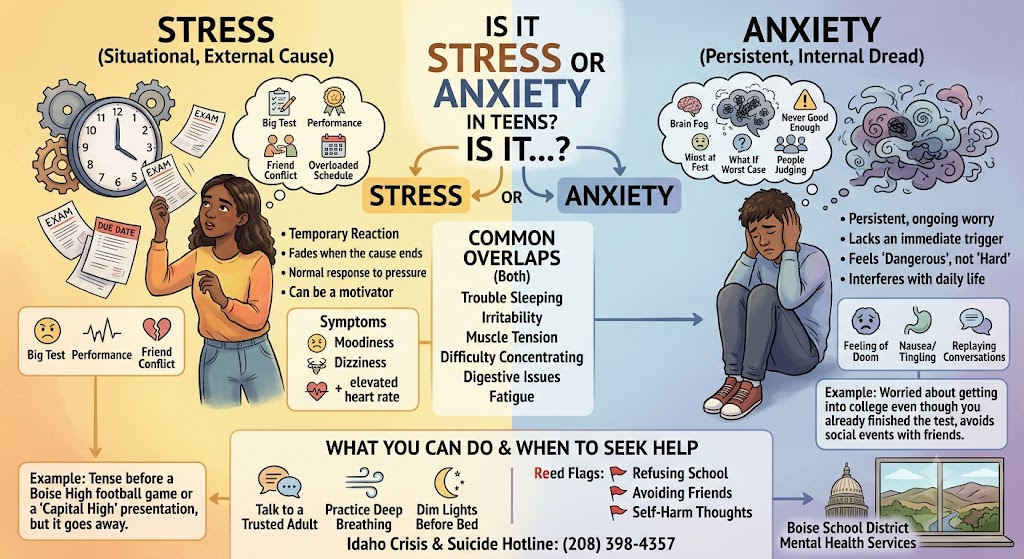
Is This Stress or Anxiety in Teens?

How to tell the difference between normal stress and something more serious — and what parents should do next.

Every teen experiences stress. Tests, friendships, sports, social pressure, and the future all create pressure. Some level of stress is normal — even helpful. But sometimes what looks like stress is actually anxiety. The difference matters. Stress usually comes and goes with a situation. Anxiety lingers, grows, and begins to interfere with daily life. For many parents, the challenge isn't noticing something is wrong — it's knowing how serious it is and whether it requires more than support at home. This guide helps you distinguish between stress and anxiety so you can respond with the right level of action.
Stress is tied to a specific situation and usually fades when the situation passes. Anxiety is persistent, often disproportionate, and continues even when there is no immediate threat. Avoidance, physical symptoms, and interference with daily life are key signs stress may have become anxiety. Many teens move from stress into anxiety gradually — not suddenly. Knowing the difference helps parents decide when to support, when to adjust, and when to seek help.

Stress vs. Anxiety

The Core Difference

The core difference between the two, and what to do about each

The clearest distinction: Stress is a response to a situation. Anxiety is a response that doesn't turn off. Stress says: "This test matters." Anxiety says: "What if I fail? What if I ruin everything? What if I can't handle it?" — and keeps saying it even after the test is over.

What Normal Stress Looks Like

Stress is a healthy, temporary response to pressure. A stressed teen may feel overwhelmed before a test, game, or event, be irritable or emotional in the moment, complain about pressure or workload, and feel relief once the situation passes. The key pattern: tied to a specific trigger, time-limited, and does not significantly disrupt daily functioning. Stress rises, the situation passes, stress decreases.

What Anxiety Looks Like

Anxiety goes beyond the situation and starts to generalize. An anxious teen may worry excessively across multiple areas, struggle to stop thinking about "what if" scenarios, avoid situations (school, social events, activities), have physical symptoms (stomachaches, headaches, chest tightness), need constant reassurance, and remain distressed even after the situation is over. The key pattern: persistent, disproportionate, and interferes with daily life. Anxiety rises, stays elevated, and spreads to other areas.

The Gray Area (Where Most Parents Get Stuck)

Most teens don't move from stress to anxiety overnight. It usually looks like a gradual progression: normal stress, then increased pressure, then difficulty recovering, then avoidance begins, then anxiety patterns take hold. This gradual shift is why parents often second-guess: "Is this just a tough phase… or something more?"

A Practical Decision Framework

Use these three questions:

  1. Does it pass, or does it linger? If it passes, more likely stress. If it lingers or spreads, more likely anxiety.
  2. Is your teen still functioning? Still going to school and activities — likely stress. Avoiding, withdrawing — possible anxiety.
  3. Is the reaction proportional? Matches the situation — stress. Feels bigger than the situation — anxiety.

If two or more answers point toward anxiety, it's worth paying closer attention.

A Simple Severity Ladder

  • Mild (likely stress): Situation-specific, temporary, no avoidance, functioning intact.
  • Moderate (possible anxiety emerging): Repeated worry, some avoidance, physical symptoms appear, recovery takes longer.
  • High (likely anxiety disorder): Persistent worry, clear avoidance patterns, physical symptoms common, daily functioning impacted.

This helps parents decide whether to monitor, adjust, or act.

What Parents Should Do Based on What You See

  • If it looks like stress: support and normalize, help with problem-solving, maintain routines, avoid over-intervening.
  • If it looks like emerging anxiety: start tracking patterns, reduce avoidance gently, limit excessive reassurance, begin conversations about support.
  • If it looks like clear anxiety: consider professional evaluation, avoid accommodating avoidance, support gradual exposure, involve a therapist.

Common Parent Mistakes

  1. Dismissing anxiety as "just stress" — this delays support and allows patterns to deepen.
  2. Overreacting to normal stress — this can increase pressure and signal to the teen that something is wrong.
  3. Focusing only on the situation — anxiety is about the response, not just the trigger.
  4. Waiting too long because it might pass — sometimes it does, often it doesn't.

When to Seek Professional Help

Consider evaluation when symptoms last more than a few weeks, avoidance is increasing, physical symptoms are frequent, school, sleep, or relationships are affected, or your teen seems stuck and not recovering. Early support is more effective than waiting for things to escalate.

Stress is part of growing up. Anxiety is when the stress doesn't turn off.

Sources: NIMH Anxiety Statistics; CDC Youth Mental Health Data; Child Mind Institute — Stress vs Anxiety in Teens.


Frequently asked questions

Common questions
parents may have

Answers to some of the questions families often ask when trying to understand these challenges.

Why don’t coping skills always work?

The most common reasons: the skill does not match the function (a calming technique offered to a teen seeking sensation), the skill was introduced during a crisis rather than practiced beforehand, or the emotional intensity exceeded the skill’s capacity. When skills fail, it usually means the match or the timing needs adjustment — not that the teen is failing.

Why don’t coping skills always work?

The most common reasons: the skill does not match the function (a calming technique offered to a teen seeking sensation), the skill was introduced during a crisis rather than practiced beforehand, or the emotional intensity exceeded the skill’s capacity. When skills fail, it usually means the match or the timing needs adjustment — not that the teen is failing.

Why don’t coping skills always work?

The most common reasons: the skill does not match the function (a calming technique offered to a teen seeking sensation), the skill was introduced during a crisis rather than practiced beforehand, or the emotional intensity exceeded the skill’s capacity. When skills fail, it usually means the match or the timing needs adjustment — not that the teen is failing.

Frequently asked questions

Common questions

parents may have

Answers to some of the questions families often ask when trying to understand these challenges.

What if I’m not sure which it is?
Blue plus sign icon with rounded edges on a white background.

Uncertainty is common. Start by observing patterns over time. If you’re seeing persistence, avoidance, or interference with daily life, it’s reasonable to seek professional input. Early evaluation can provide clarity and direction.

How long should stress last before I worry?
Blue plus sign icon with rounded edges on a white background.

Short-term stress tied to a specific situation is normal. If symptoms persist beyond a few weeks, spread to other areas, or begin interfering with daily life, it may be anxiety.

Is it normal for teens to feel this stressed?
Blue plus sign icon with rounded edges on a white background.

Yes, to a degree. Teens face significant academic, social, and developmental pressures. The key question is not whether stress exists, but whether your teen can recover from it and continue functioning.

Can stress turn into anxiety?
Blue plus sign icon with rounded edges on a white background.

Yes. Stress can evolve into anxiety when the body and mind don’t return to baseline after a stressful event. Over time, the response becomes more persistent, generalized, and harder to control.

Simple ways to read what you are seeing and tell stress apart from anxiety:

Watch patterns, not just moments

One stressful day means less than repeated patterns over time. Look for trends.

Focus on recovery

The key difference is whether your teen returns to baseline after stress. Recovery matters more than intensity.

Avoid solving everything

Reducing all stress can prevent teens from building resilience. Support without removing every challenge.

Watch whether daily life is still working

One of the clearest signals is whether your teen can still do the ordinary things. Stress may make a week harder, but they keep eating, sleeping, going to school, and seeing friends. Anxiety starts pulling those threads loose, so meals get skipped, sleep frays, and activities drop away. When the basics of daily life begin to slip, you are likely looking at more than stress.

Explore helpful resources

Helpful guides and articles for families seeking more information and support.

should connect to any other Parent Resources articles.

If you are not sure whether you are seeing ordinary stress or something more, you do not have to make that call alone. At Idaho Youth Ranch, our therapists can help you sort out what is going on and recommend the right level of support.

Get Started

When You're Not Sure What You're Seeing

If you're wondering whether your teen's stress has become something more, you're not alone. The right support can help you understand what's happening and what to do next.

Outline of Idaho state inside a heart behind three person icons representing community or support.

For more than 70 years, we've stood beside Idaho's youth and families.

Hope. Healing. Resilience.

Blue phone handset icon with two curved lines indicating sound or call signal.

Call Now

Speak with our Team directly.

Best for families who want to talk through next steps, ask questions, or connect with admissions for the Residential Center for Healing & Resilience.