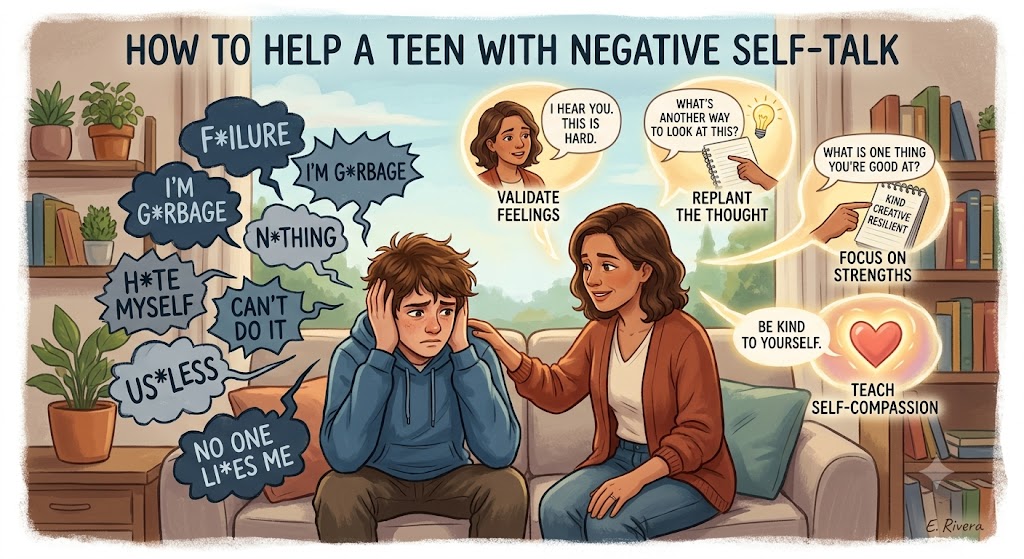
How to Help a Teen With Negative Self-Talk

Why arguing with their negative thoughts makes it worse, and what to do instead

Your teen says "I'm so stupid" after a bad test, or "Nobody actually likes me" after a hard social moment, or "I'm ugly" while looking in the mirror. The words hit you. You can see what they cannot. Your instinct is to argue them out of it. "No, you're smart\!" "That's not true\!" "You're beautiful\!" The instinct is loving and reasonable. It also rarely works, and often makes things worse. This guide explains why, and walks through what does work, with specific scripts for the most common things teens say to themselves.
Negative self-talk is not your teen lying or being dramatic. It is what their brain is actually telling them. The reflex to correct it ("No, you're not stupid\!") almost always backfires. The most useful move is to decode the pattern, not argue with the content. Naming the inner critic as a separate voice gives teens space to step back from it. Persistent negative self-talk involving worthlessness or hopelessness deserves professional attention.

The Inner Critic

What Negative Self-Talk Actually Is

Why arguing with negative self-talk backfires, and what actually helps instead

Negative self-talk is the internal voice that comments on your teen's worth, capability, appearance, and social standing. For many teens, that voice is active much of the day. It speaks before tests, after social moments, while looking in the mirror, while scrolling social media, and during ordinary moments when nothing has even happened.

Your teen is not making it up. They are not exaggerating to get attention. They are not being dramatic. They are reporting what their brain is actually telling them. The voice is automatic. It runs without their permission and often against their will. Many teens describe being unable to shut it off.

Adolescent brain development plays a major role. Teens become newly capable of self-reflection around age 11 or 12, and that capacity arrives before the perspective to use it well. The result, for many teens, is years of harsh self-judgment with limited tools to push back. Most teens experience some version of this. It is developmentally normal. It can also do real damage if left unaddressed.

Why Correcting It Backfires

"No, you're not stupid." "You have lots of friends." "You're beautiful." These responses are loving and reasonable. They are also rarely helpful, for three reasons.

First, your teen does not believe you. Their inner voice is telling them otherwise, often more loudly than your voice is. Your correction does not register as truth. It registers as something a loving parent says.

Second, the correction puts the negative thought at the center of the conversation. Now you are arguing about whether they are stupid, ugly, or unliked. The argument keeps the thought alive and gives it weight it would not otherwise have had.

Third, the correction implicitly tells your teen that their feelings are wrong. The teen feels something painful. You respond by telling them they should not feel that. The message lands as: "You are not allowed to feel what you feel." The conversation closes.

Don't Correct. Decode.

The shift that works is from arguing with the content of the negative thought to recognizing the pattern producing it. Most negative self-talk uses a small set of repeating tricks, sometimes called cognitive distortions.

"I'm so stupid" after one mistake is often all-or-nothing thinking. One bad outcome becomes a global statement.

"Nobody likes me" after one social moment is often catastrophizing or mind-reading. One bad interaction becomes evidence of universal rejection.

"I can't do anything right" is often overgeneralizing. One specific failure becomes a permanent identity.

Teaching your teen to notice the pattern is far more useful than correcting any single thought. A teen who can say "my brain just did the all-or-nothing thing again" is in a different relationship to the thought than a teen who simply concludes they are stupid.

Naming the Critic

One of the most useful moves available to parents is externalizing the negative voice as a separate entity. The technique sounds gimmicky when first described. In practice, it works. Clinical research calls it cognitive defusion: creating space between the person and the thought.

Try language like: "Your brain is being mean to you again." "Sounds like your inner critic is loud today." "That's the voice that tells you you're not enough. It's not telling you the truth, it's just telling you the same thing it always tells you."

Said with care, this kind of language gives your teen room to step back from the thought rather than be inside it. Said dismissively, it will land as eye-rolling parental cleverness, which is worse than no response. The tone matters as much as the words.

Over weeks and months, teens start to use the language themselves. "My critic is being loud right now." "I know that's not the truth, that's just my brain." When that happens, real shift has occurred.

A Script Library: What to Say When They Say…

Specific phrasings for the most common things teens say to themselves. Read these as starting points, not scripts to recite. The tone is doing as much work as the words.

When they say: "I'm so stupid." Don't say: "No, you're so smart!" Try: "That sounds like a hard thing to be telling yourself. What just happened?"

When they say: "Nobody likes me." Don't say: "That's not true, you have lots of friends!" Try: "That sounds really lonely. What's been going on?"

When they say: "I'm ugly." Don't say: "You're beautiful!" Try: "That's a heavy thing to feel about yourself. What's been making you feel that way?"

When they say: "I'm a failure." Don't say: "No you're not, you got an A last week!" Try: "That's a big word. What's underneath it?"

When they say: "I hate myself." This one deserves more care. If said in genuine distress, take it seriously. Ask directly: "Are you having thoughts of hurting yourself?" If yes, seek professional help today. If no, treat it as a significant emotional signal worth a slow conversation rather than a quick reassurance: "That's a hard thing to feel. I want to understand what's going on for you."

When This Isn't Enough

Most teens have some negative self-talk, and most situations respond to consistent parental practice over time. Some don't. The signs that more is needed:

  • Self-talk that is daily and severe.
  • Self-talk that includes language about being a burden, wanting to disappear, or not wanting to be alive.
  • Negative self-talk co-occurring with withdrawal from friends and activities, self-harm, eating changes, or sleep problems.
  • Self-talk that does not budge across months of consistent parental support.

Cognitive Behavioral Therapy, often abbreviated as CBT, is the gold-standard intervention for negative thought patterns in adolescents. A CBT-trained therapist can teach your teen the same kind of recognize-and-respond skills described in this article, but with more depth and more practice than a parent can provide. Earlier is better than later. Don't wait for the patterns to entrench.

Crisis Note: If your teen expresses thoughts of hurting themselves or not wanting to be alive, take it seriously and seek help right away. Call or text 988 (Suicide & Crisis Lifeline), available 24/7. If your teen is in immediate danger, call 911.

Sources: cognitive distortions framework drawn from cognitive behavioral therapy literature (Aaron Beck); cognitive defusion technique grounded in acceptance and commitment therapy (Steven Hayes).


Frequently asked questions

Common questions
parents may have

Answers to some of the questions families often ask when trying to understand these challenges.

Why don’t coping skills always work?

The most common reasons: the skill does not match the function (a calming technique offered to a teen seeking sensation), the skill was introduced during a crisis rather than practiced beforehand, or the emotional intensity exceeded the skill’s capacity. When skills fail, it usually means the match or the timing needs adjustment — not that the teen is failing.

Why don’t coping skills always work?

The most common reasons: the skill does not match the function (a calming technique offered to a teen seeking sensation), the skill was introduced during a crisis rather than practiced beforehand, or the emotional intensity exceeded the skill’s capacity. When skills fail, it usually means the match or the timing needs adjustment — not that the teen is failing.

Why don’t coping skills always work?

The most common reasons: the skill does not match the function (a calming technique offered to a teen seeking sensation), the skill was introduced during a crisis rather than practiced beforehand, or the emotional intensity exceeded the skill’s capacity. When skills fail, it usually means the match or the timing needs adjustment — not that the teen is failing.

Frequently asked questions

Common questions

parents may have

Answers to some of the questions families often ask when trying to understand these challenges.

What's the difference between negative self-talk and depression?
Blue plus sign icon with rounded edges on a white background.

Negative self-talk is a symptom. Depression is a condition. Most teens experience some negative self-talk; most teens do not have depression. The line: when self-talk is persistent (most days for two weeks or more), generalizes across all areas of life, and is accompanied by changes in sleep, energy, appetite, or interest, or includes thoughts of being a burden or wanting to disappear, depression is likely in the picture. Do not wait to find out which it is. The bar for talking to a professional should be lower than most parents assume. See our deep guide section on when low self-esteem is a sign of something more.

I've heard "name the thought" advice before. It feels gimmicky. Does it actually work?
Blue plus sign icon with rounded edges on a white background.

It can feel gimmicky if used mechanically. It works because it creates space between your teen and the thought, which is the necessary condition for them to start responding to the thought rather than being inside it. The technique has clinical research behind it. Cognitive defusion is a core skill in acceptance-based therapies. The gimmicky feeling usually comes from using the technique to dismiss the feeling rather than to honor it. "Sounds like your inner critic is loud today" lands when said with care and after the teen has been heard. The same phrase used dismissively or too early will land badly. Tone and timing matter.

My teen pushes back when I try the "decode" approach. They say I'm not actually listening. Now what?
Blue plus sign icon with rounded edges on a white background.

This is normal early in the shift. Your teen is used to one of two responses from you: correction or fixing. The new response feels like neither, which can read as "you're not engaging." The work is to keep going while making your engagement obvious in other ways. Ask follow-up questions. Reflect back what you hear ("so it sounds like the part that hurt most was..."). Stay with the conversation rather than ending it quickly. The shift takes time on both sides. After several conversations, your teen will start to notice the difference. If you give up early and revert to correcting, the shift never lands.

What to do the next time your teen turns on themselves, and how to shift the pattern over time:

Stop Correcting. Start Decoding.

For the next two weeks, when your teen says something negative about themselves, do not contradict it. Resist the instinct entirely. Instead, ask one curious question. "What's been making you feel that?" "What happened?" "What's underneath that?" The shift from correcting to decoding takes practice and feels strange at first. Stay with it. Your teen may not notice the change in the first week. By the second or third week, the difference is usually visible in how much more they share.

Name the Pattern, Not the Content

When you notice your teen using one of the common distortion patterns (all-or-nothing, catastrophizing, mind-reading, overgeneralizing), name the pattern gently. Not as criticism. As recognition. "Sounds like your brain is doing the all-or-nothing thing again. What if it's not actually all or nothing?" Naming the pattern often loosens the thought's grip in a way that correcting the content cannot. The teen starts to see their own thinking as patterned rather than as truth.

Model It in Your Own Self-Talk

Your teen hears how you talk about yourself. When you make a mistake, narrate the recovery out loud. "My brain is being mean to me about that meeting. I'm not going to believe everything it says." "That didn't go how I wanted, but I'll figure out what I learned." This is one of the most important things parents can do, and one of the hardest because it requires noticing your own self-talk first. Most adults have inner critics they have stopped hearing because the criticism feels normal. The work begins with you.

Help Them Talk Back to the Thought, Not Just Hear It

Once your teen can notice a harsh thought, the next step is giving it a small, honest response, not a cheerful denial. Try teaching them a phrase that questions the thought rather than fights it: "Is that the whole story?" or "Would I say that to a friend?" Practice it together in a calm moment so it is available when things get loud. The goal is not to silence the inner critic but to give your teen a steadier voice that can answer it.

Explore helpful resources

Helpful guides and articles for families seeking more information and support.

should connect to any other Parent Resources articles.

When the negative self-talk is constant or starts to sound hopeless, it can point to something that deserves real support. At Idaho Youth Ranch, our therapists help teens understand where these thoughts come from and build a kinder, more accurate way of talking to themselves.

Talk With Our Team

When Practice Isn't Enough

If you've been doing this work and the patterns are not shifting, our team can help. There is no minimum severity before reaching out makes sense.

Outline of Idaho state inside a heart behind three person icons representing community or support.

For more than 70 years, we've stood beside Idaho's youth and families.

Hope. Healing. Resilience.

Blue phone handset icon with two curved lines indicating sound or call signal.

Call Now

Speak with our Team directly.

Best for families who want to talk through next steps, ask questions, or connect with admissions for the Residential Center for Healing & Resilience.